

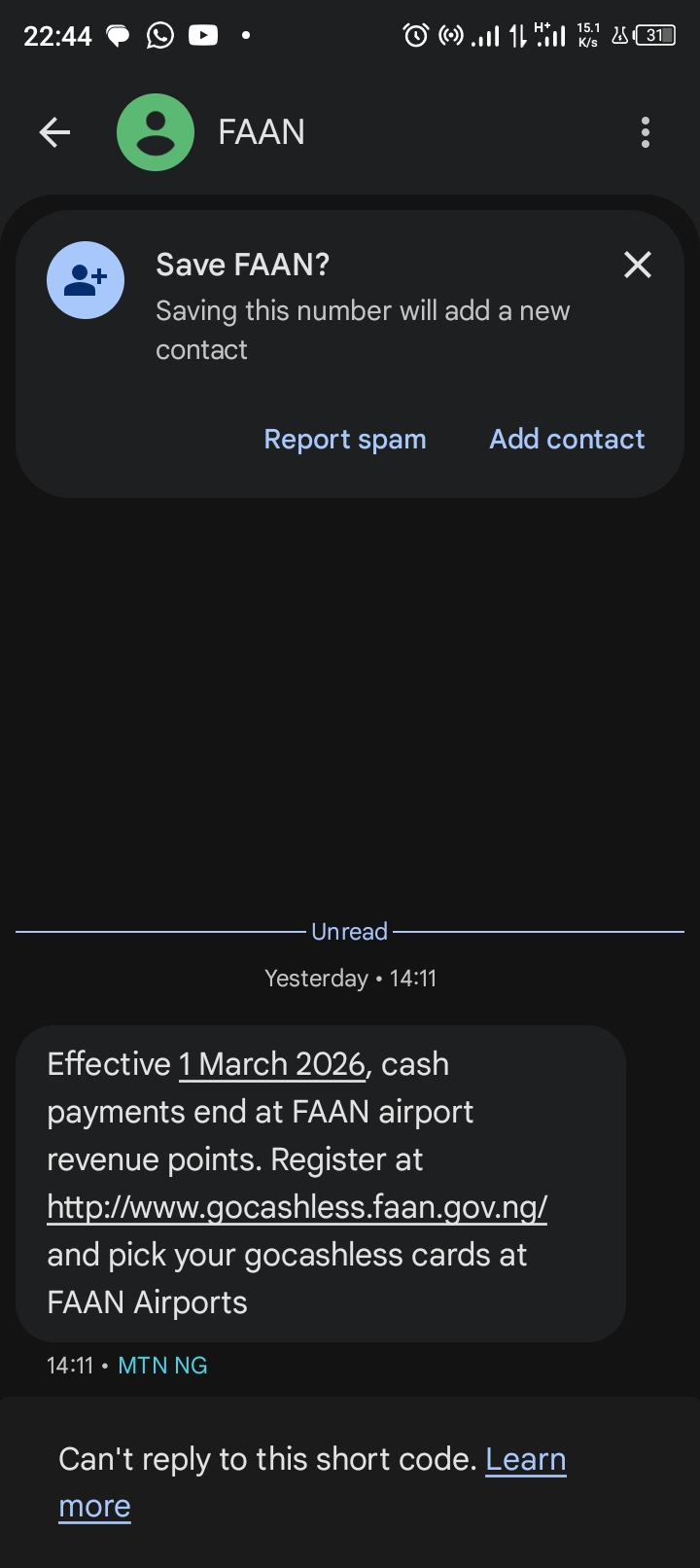

The Federal Airports Authority of Nigeria (FAAN) has formally announced that cash will no longer be accepted at all payment points across Nigerian airports, a major change slated to take effect from March 1, 2026. The move — part of FAAN’s “Operation Go Cashless” initiative — aims to modernize payment processes, enhance efficiency, and reduce risks associated with physical cash handling.
The announcement, which came in a statement from FAAN and was amplified through an SMS notification sent to airport users, has triggered both interest and confusion among travelers, businesses operating at airports and the wider public. FAAN has since clarified that the SMS message is genuine and part of a nationwide awareness campaign — dismissing claims that the notification was a scam.
What FAAN’s Cashless Policy Means
Under the new policy, physical cash will no longer be accepted at any FAAN-controlled payment point in both international and domestic airports across the country. This includes:
- Airport access gates
- Car parks
- Executive and VIP lounges
- Any ancillary service where payments are collected at airport facilities
Passengers and visitors will be expected to make all transactions digitally, primarily using the newly introduced “Go-Cashless” cards or other contactless payment methods.
The SMS Alert and Scam Concerns
In the days leading up to the implementation date, many Nigerians received a text message informing them of the policy change and reminding them to prepare for the shift to cashless transactions at airports.
Shortly after the SMS circulation, a fraudulent counter-message also began circulating on social media and messaging platforms, warning recipients not to open the link in the FAAN alert on the grounds that it would drain bank accounts. FAAN labelled this counter-message as false and misleading, stressing that the official SMS is legitimate.
In a public clarification, FAAN urged members of the public to rely only on information from official communication channels, including its verified social media pages and press releases. According to the authority, authorised SMS notifications were sent in partnership with telecommunications providers to ensure wide public awareness of the change.
Why FAAN Is Making the Change
FAAN says the shift to cashless transactions is part of a broader digital transformation strategy designed to modernise airport operations and align with national economic policy directives, including the Central Bank of Nigeria’s cashless economy drive.
Key goals of the initiative include:
- Improved transaction speed for passengers
- Reduced queue times at busy airport pay points
- Enhanced transparency and traceability of airport revenues
- Reduced instances of revenue leakage and corruption
- Heightened security by eliminating physical cash handling
‘Go-Cashless’ Cards and How They Work
To facilitate the transition, FAAN has introduced Go-Cashless cards, which users can obtain:
- Immediately at FAAN commercial offices and access gates nationwide
- From designated branches of Fidelity Bank Plc from March 16, 2026 onwards
These cards enable contactless “tap-and-go” payments at access gates, parking lots and lounge entry points, meant to speed up transactions and reduce congestion during peak travel times. Airport users are encouraged to register online and collect their cards ahead of the deadline to avoid disruptions once the policy is fully enforced.
What Passengers Should Know Now
Travellers and airport visitors are advised to:
- Prepare for the complete elimination of cash transactions at airports starting March 1, 2026.
- Obtain their Go-Cashless cards before travelling or on arrival at designated pick-up points.
- Use official FAAN channels for information and support, to guard against misinformation about the policy.
FAAN has stated that the cards will still be available even after the deadline, ensuring that no airport user is left without access to the cashless system.
Broader Implications
The cashless policy represents a significant shift in Nigeria’s aviation and payments ecosystem. If successful, it could improve operational efficiency, reduce corruption risks and set a model for other public service sectors moving toward digital payment systems. At the same time, small businesses and informal operators within airport environments may need to adapt quickly to the digital payment landscape.
As airports prepare for the full rollout of the cashless system, travellers are being urged to familiarise themselves with the new arrangements, reduce reliance on physical cash within facilities and embrace contactless payment solutions as part of everyday airport use.