


Opposition leaders from the African Democratic Congress (ADC) and the New Nigeria Peoples Party (NNPP) on Thursday renewed pressure on the National Assembly, demanding urgent amendments to the Electoral Act 2026, describing the law as fundamentally anti-democratic and skewed in favor of the ruling All Progressives Congress (APC) ahead of the 2027 general elections.
Speaking at a press conference in Abuja, leaders including former Vice President Atiku Abubakar, former presidential candidate Peter Obi, and former Minister Rotimi Amaechi, argued that the new Act undermines the transparency and integrity of the electoral process and threatens the autonomy of political parties in selecting candidates.
The leaders emphasized that unless the National Assembly acts promptly to amend the Act, the 2027 elections could be compromised, and public trust in Nigeria’s democracy would be further eroded, framing their call as a defense of the electorate’s right to free, fair, and credible elections.
Under the Electoral Act 2022, political parties enjoyed flexibility in nominating candidates for public office. They were permitted to conduct direct primaries involving all registered members of the party, indirect primaries using delegates, or arrive at consensus nominations determined internally by party leadership. Opposition leaders argued that these provisions ensured a degree of democratic choice within parties, enabling both participation and orderly candidate selection.
By contrast, the Electoral Act 2026, which was recently passed by the National Assembly and assented to by President Bola Tinubu on February 18, limits parties to only two nomination methods: direct primaries and consensus. The law also shortens campaign periods, restricts timelines for primaries, and adjusts the release of funds for the Independent National Electoral Commission (INEC), reducing the allocation window from twelve months before an election to six months, a measure the opposition contends could hinder electoral preparedness.
At the press conference, NNPP National Chairman Ajuji Ahmed argued that these changes were part of a deliberate strategy by the APC to manipulate the electoral process. Reading from a prepared statement, Ahmed said, “We therefore state unequivocally that the new Electoral Act is anti-democratic, and its implementation will undermine electoral transparency and the sanctity of the ballot, which are fundamental to free, fair, and credible elections and the bedrock of participatory democracy.”
He singled out Section 60(3) of the Act, claiming it grants “wide and undefined discretionary powers to the presiding officer” that could negate the intended benefits of electronic transmission of election results from polling units. Ahmed warned that the proviso effectively provides “a blank check to those who seek to manipulate election results by delaying the electronic transmission of results from the polling units to the IREV on the pretext of network failure,” a concern he said was inconsistent with Nigeria’s technological capacity.
Ahmed elaborated on the purported technical justification offered by the APC, arguing that the idea of network failure at polling units is unsubstantiated. “The premise of the proviso in Section 60(3) is the unavailability or possibility of network failure. We find this premise dubious and inconsistent with reality. The immediate past INEC Chairman, Prof. Mahmud Yakubu, stated on record that the BVAS equipment, which operates offline, had worked with over a 90 percent success rate across the nation, and in the event of network failure at the point of transmission, the transmitted results would be delivered successfully whenever the network is available,” he said. Ahmed further reinforced his argument by citing statements from former INEC Commissioner Festus Okoye, who confirmed that “every polling unit in Nigeria has internet access,” claiming that these authoritative accounts contradict government claims used to justify limiting electronic transmission.
Highlighting the technological readiness of the country, Ahmed also referenced Nigerian Communications Commission statistics, noting that by 2023, “Nigeria had achieved more than 95 percent 2G coverage, which is more than sufficient for the transmission of election results from polling units. By that same period, Nigeria already had more than 159 million internet subscribers and more than 220 million telephone subscribers using the 2G network. It is also noteworthy that this capacity provides 24-hour coverage of the entire country. This goes to show that denying mandatory real-time transmission of election results from polling units on the basis of lack of communication network is not supported by evidence.” He described the government’s stance as fraudulent and part of “the APC game plan to rig the election in 2027.”
On the issue of party primaries, opposition leaders strongly criticized the amendment to Section 84 of the Act, which restricts political parties to direct primaries or consensus nominations. Ahmed argued that this represents an unconstitutional encroachment on party autonomy, stating, “There is nothing undemocratic about indirect primaries, which create an electoral college for the selection of candidates in an objective, transparent, and orderly manner. Our position, therefore, is that as political parties, we do not need legislation that prescribes which mode of party primaries political parties must adopt. In other words, the mode of nominating candidates should be strictly the internal affair of political parties.”
He contended that limiting nomination methods was a deliberate strategy to allow the APC to “corrupt the electoral system” and entrench its influence ahead of 2027.
Rotimi Amaechi emphasized that the opposition’s challenges extend beyond the APC’s maneuvers to internal issues within opposition parties themselves. “Actually, Tinubu is not our problem; the opposition is the problem of the opposition. The first thing we must know is that we must separate ourselves from the government in power. I said in one of these conferences that when I was in government, (Muhammadu) Buhari wanted electoral reform.
So, a few ministers went to him and convinced him not to sign that if he signed, Russia would hack the system and impose the wrong President on us. And he refused to sign,” he said, urging a more strategic and unified approach to electoral challenges.
Amaechi added that the ruling party’s strategies are methodical, incremental, and designed to weaken opposition response: “Tinubu will one day shout electoral reforms. If he doesn’t shout electoral reforms, those who are supporting him will shout electoral reforms. Tinubu is not our problem, watch his government, watch his strategy to win elections. His strategy is simple; his pattern is simple. He tries something today, you are weak. He puts something bigger, you are weaker. So, we need to focus on our strategy.” His remarks underscored the opposition’s view that political survival requires both vigilance against ruling party tactics and internal cohesion.
Peter Obi focused on governance failures under the APC-led administration, connecting the legal and procedural challenges in the Electoral Act to broader public dissatisfaction. “We have the same view, but it is important that we repeat it as often as we can so that Nigerians know we are together. There is a need for a genuine opposition party. Those who are not here today — we are pleading that we all come together to save our dear country. The government we have today and that continues is the worst ever in our country. There is no governance in Nigeria. The legislature is at its worst. The judiciary is no longer the hope of the weak or the poor. Insecurity, killings, and abductions are worse than even in countries at war,” Obi said. He highlighted the human and socioeconomic consequences of poor governance, emphasizing the urgent need for coordinated opposition action.
Obi further cited poverty and economic deterioration as central concerns for electoral legitimacy: “Poverty has increased dramatically in the past two and a half years — from about 87 million to about 140 million today, the highest in any country on earth. In fact, we now have almost over 30 percent of the world’s poor people living in Nigeria. This government has borrowed more, according to records, than all governments since 1999, without anything to show for it. Food prices have not gone down. Actually, we have killed all our farmers because we have imported cheap goods and thrown our farmers into poverty, which will even worsen the hunger situation in Nigeria in the future. Manufacturers’ houses and warehouses are full without anything to show for it. So, we have a crisis, and everybody has to come together to save the country.”
Atiku Abubakar connected Nigeria’s domestic democratic challenges to broader regional implications: “And again, what you must bear in mind is that the collapse of democracy in Nigeria is going to lead to the collapse of democracy in Africa because we are the largest democracy in Africa. These are some of the consequences that will definitely affect other democracies in Africa. So, I will call on other opposition parties that are not here to make sure that they are part of this movement for the unity of opposition parties to ensure we restore our democracy.”
Atiku also cautioned against repeating past mistakes, referencing the 2014 opposition unity efforts: “But a word of caution: we did this exercise in 2014 also. We came together and fought in this city because we felt democracy was faulty in 2014, only for us to end up in the same position we found ourselves in. The major challenges were insecurity, the economy, and so on and so forth. Now it is really worse. So, we must bear it in mind that we must make sure we restore true democracy to our country. That was what we fought for, that was what the founders of this country fought for, and what we fought for in the military. We must make sure it is established in this country.”
The press conference also featured prominent opposition figures, including ADC National Chairman David Mark, ADC National Secretary Rauf Aregbesola, ADC National Publicity Secretary Bolaji Abdullahi, NNPP National Chairman Buba Galadima, former ADC National Chairman Ralph Nwosu, Senator Dino Melaye, and former Cross River State Governor Liyel Imoke, highlighting the unity of the opposition in calling for amendments to the Electoral Act 2026. Their presence reinforced the narrative that opposition parties were collectively pressing for reforms and seeking to galvanize public awareness ahead of the 2027 elections.
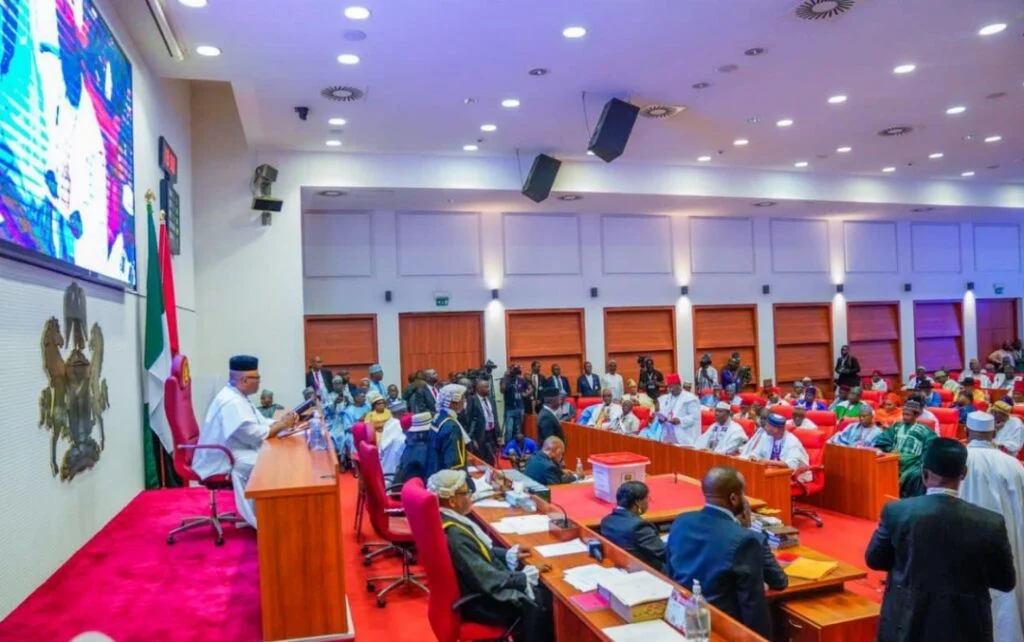
In response, the Senate dismissed the opposition’s demands for immediate legislative action. Senate spokesman Senator Yemi Adaramodu advised the opposition to submit proposals through formal legislative channels rather than heighten tensions, saying, “Electoral Act again? Do you abort a pregnancy after the naming ceremony? But no problem. If they (opposition leaders) have any grey areas, they can just make their personal proposals to their legislators and they will bring them. Once they bring it to the National Assembly, we will look at it.”
Senator Orji Uzor Kalu, Chairman of the Senate Committee on South-East Development Commission, reiterated that the power to amend the Electoral Act resides solely with the National Assembly: “Review which Electoral Act? Something that Mr President has assented to? No, it is the decision of the National Assembly to make, not an individual thing.” He warned against inflammatory rhetoric, stating, “The opposition should stop heating up the polity. The route they are taking is not the right one. They should leave this route because it can only lead to chaos. If they are not comfortable with the current administration, they should change it by contesting against Mr President in 2027 and see if they can defeat him. In the meantime, they should stop heating up the polity.”
Opposition leaders criticized the judiciary, which they said has been used as a partisan tool, undermining its impartiality in recent elections. Ahmed stated, “The final arbiter in any democracy is the judiciary. It is therefore impossible to have real democracy without an independent and impartial judiciary. Unfortunately, we have witnessed in recent years how the very institution that is meant to protect democracy has been weaponised against democracy itself. We therefore wish to remind the judiciary that partisan politics is for the executive and the legislature, not the judiciary. The judiciary must stop being complicit in undermining our democracy.”
The opposition maintained that without judicial impartiality, the people’s mandate is compromised: “A situation where elections are blatantly rigged and those who participated in such criminality are quick to say ‘if you are not happy, go to court’ has done immeasurable damage to our democratic progress and it must be stopped. Electoral outcomes must be decided by the people, and not the courts. The judiciary must therefore re-discover its capacity for impartiality and neutrality and regain the intrinsic trust of citizens in its judgments,” Ahmed argued, underscoring concerns over legal and institutional manipulation.
Peter Obi and Rotimi Amaechi jointly emphasized that the APC’s governance failures, including rising poverty, insecurity, and mismanagement, create a context where electoral laws could be exploited. Obi said, “Insecurity, killings, and abductions are worse than even in countries at war. Just in the past week, I mentioned killings in Zamfara on Friday, and today, even while we are speaking, over 20 already (killed) in Adamawa. It is all about the country; I just mentioned a few. Poverty has increased dramatically… We now have almost over 30 percent of the world’s poor people living in Nigeria.”
Amaechi added that the opposition must focus on internal coordination, saying, “Actually, Tinubu is not our problem; the opposition is the problem of the opposition… So, we need to focus on our strategy,” stressing that victory in 2027 would require both unity and strategic campaigning.
Atiku concluded by linking the opposition’s struggle to continental democratic stability, stating, “The collapse of democracy in Nigeria is going to lead to the collapse of democracy in Africa because we are the largest democracy in Africa… We must bear it in mind that we must make sure we restore true democracy to our country.”