

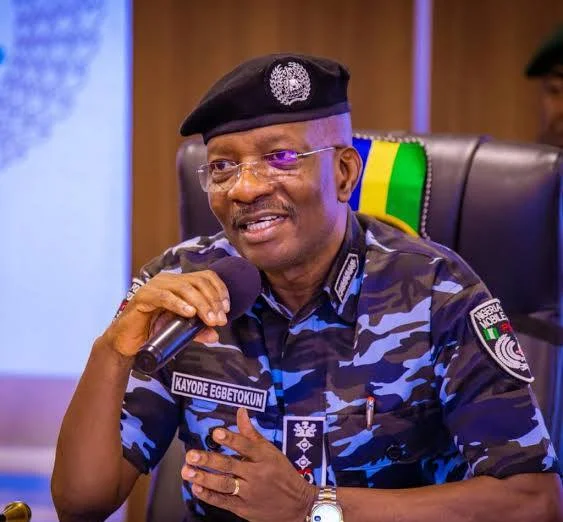

An emerging report has revealed that President Bola Tinubu compelled the resignation of Inspector General of Police Kayode Egbetokun, contrary to the official claim of family-related motives.
According to PREMIUM TIMES, an independent newsroom in Nigeria, sources within the presidency have disclosed that the decision was a direct result of Egbetokun’s clashing stance against the federal government’s policies, coupled with institutional oversights under the latter’s leadership.
Recall that on 24th February, 2026, Tinubu quickly appointed Assistant Inspector General Olatunji Disu to step in the position of the former IGP, the same day the former police boss resigned.
Egbetokun’s appointment as the 22nd IGP on June 19th, 2023, was formalized by the Nigeria Police Council in October that year. Originally set to retire at 60 or after 35 years of service according to the provision of the Police Act, an amendment of the legislation by the National Assembly granted a fixed four-year term on Egbetokun until October 2027.
As the presidency defended it under the revised law, the extension drew public scrutiny over its timing and legality.
The Real Picture — Sources from the Presidency
The primary reason for Egbetokun’s sudden resignation allegedly stemmed from his firm opposition to state policing, a policy strongly championed by President Tinubu to promote national security amid growing cases of insurgency.
On several occasions, Tinubu repeatedly endorsed his commitment to the policy, including during the April 2024 National Dialogue on State Policing, and at a recent interfaith event in Abuja.
However, Egbetokun has constantly flagged the initiative, arguing that Nigeria lacked the maturity for such a system. He warned of possible risks such as abuse by state governors for political gain, human rights violations, and undermined national security.
The former IGP’s position directly contradicted the president’s vision for localized, responsive law enforcement. While Tinubu, represented by Vice President Kashim Shettima, has described state police as an important measure to address insecurity that is plaguing the country.
Egbetokun’s resistance, often conveyed through associates like Ben Okolo, persisted even as the president vowed during a pre-resignation governors’ fast-breaking event that. During the event, the president addressed the governors, “what I promise you is not to be postponed, we will establish state police.”
Insiders from the presidency explained the dissenting stance as the reason that warranted the compelled resignation.
VIP Security Withdrawal Directive Poorly Managed
Compounding the existing rift was Egbetokun’s poor implementation of the presidential order that was sanctioned last year November, directing withdrawal of police officers from VIP. Instead, the president requested high–profile figures who seek protection to source armed personnel from the Nigeria Security and Civil Defence Corps (NSCDC). This directive was aimed to free up resources for frontline duties.
Meanwhile, sources highlighted the “very low” compliance rate under Egbetokun, viewing it as a blatant disregard that frustrated broader security overhauls.
This failure highlighted operational inefficiencies at the force’s helm, eroding trust in Egbetokun’s leadership amid escalating national threats.
Rising Press Attacks, IPI Blacklist
What further fueled the crisis, is the continuous decline in press freedom under the watch of the former IGP.
Recall that several incidents of police attack on journalists have dominated headlines throughout Egbetokun’s tenure as the police head. While this problem persisted, no case of probe was recorded, creating a culture of impunity for the offending officers.
Under his tenure, approximately 24 media professionals faced arbitrary arrests, summons, and detentions, usually Weaponising the Cybercrimes Act to hit reporters despite recent amendments.
This triggered the International Press Institute (IPI) Nigeria’s to include Egbetokun in Book of Infamy, a blacklist stemming from unchecked police harassment of journalists.
The IPI cited Egbetokun’s inaction and silence on these incidents as deeply concerning, embarrassing the administration which had urged him to curb such abuses.