

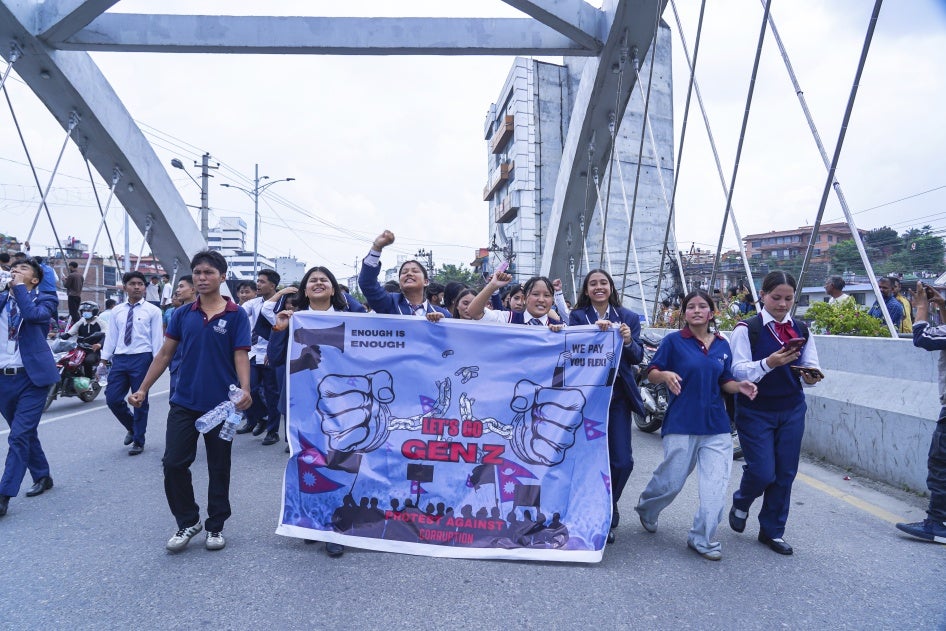

A BBC investigation has revealed that an order authorizing the use of lethal force against thousands of young, unarmed protesters in Nepal was issued by the country’s former police chief, shedding new light on one of the most violent and controversial days in the nation’s recent history.
The events took place in the capital, Kathmandu, on 8 September last year, during the so-called Gen Z demonstrations, which had erupted after weeks of growing public anger over allegations of political corruption.
The BBC investigation found that at least 19 people were killed that day, including a teenager in school uniform who was shot in the back of the head while walking away from the crowd. Dozens more were injured in what became a flashpoint for the country’s ongoing political crisis, ultimately triggering further protests that led to the resignation of Nepal’s prime minister and the collapse of the government just a day later.
Internal police documents seen by the BBC World Service reveal that someone using the call sign “Peter 1” instructed officers to “deploy necessary force” shortly after a curfew had been imposed. The directive came approximately 10 minutes after the curfew began and followed repeated requests from officers on the ground for permission to use lethal force.
According to sources familiar with the matter, “Peter 1” was the call sign used by Chandra Kuber Khapung, Nepal’s former inspector general of police. Khapung has not denied that he issued the order, though Nepal Police stated that the command was given only after receiving authorization from a government security committee and after all non-lethal options had allegedly been exhausted, in accordance with Nepali law. Khapung, who retired in November, has not responded to requests for comment from the BBC.
Video evidence examined by the BBC confirms that at least one of the victims, 17-year-old Shreeyam Chaulagain, was unarmed and attempting to leave the protest when he was fatally shot, making him the youngest of the 19 victims.
The footage, part of an extensive body of over 4,000 videos and photographs analysed by the BBC, provides a stark visual record of the events and supports accounts provided by officers and eyewitnesses.
The BBC investigation combined this visual evidence with insider testimonies from serving police officers and staff in the command center that was monitoring the demonstrations to reconstruct the sequence of events that led to the use of lethal force. The resulting report represents the most comprehensive account yet of that day, capturing both the chaotic ground-level actions and the decisions made by senior officials that escalated the violence.
The shootings have become the subject of a public inquiry, which remains ongoing and has yet to issue any findings. To date, no individuals have been held accountable for the deaths and injuries sustained during the demonstrations.
Nepal is a relatively young democracy, having transitioned to a republic in 2008 following a decade-long civil war that claimed more than 17,000 lives. The end of the monarchy promised a fresh start for the nation, and the adoption of a new constitution a decade ago was intended to solidify democratic governance and provide hope for a more equitable future.
However, for many young Nepalis, those promises remain unfulfilled. Economic challenges are widespread, with estimates suggesting that roughly one in five young people in the country is unemployed, fueling widespread frustration and disillusionment among the youth.
Much of this frustration has found expression online, particularly among Generation Z, who are currently aged between 14 and 29. Last August, young activists began coining terms on social media such as “nepo baby” to highlight and critique the perceived privilege of children from Nepal’s elite families.
The government responded to this surge of online dissent by imposing bans on major social media platforms, including Facebook, YouTube, Instagram, and X, starting on 4 September.
The restrictions, however, did not quell the unrest; activists quickly adapted by migrating their organizing efforts to alternative platforms, including Discord, a gaming chat service that became a central hub for coordination and communication.
Within these online spaces, groups such as Youth Against Corruption mobilized young people and planned demonstrations. In one particular forum, members coordinated details for a protest scheduled outside the national parliament on 8 September.
These online discussions and strategic planning sessions underscored the creativity and resourcefulness of Nepal’s young activists, who were determined to make their voices heard despite government censorship and the growing political tensions in the country.
The Gen Z-led movement reflected a broader dissatisfaction with entrenched corruption and the slow pace of reforms, illustrating the significant role of youth and digital platforms in shaping modern political activism in Nepal.
As the investigation continues, Nepal is preparing for general elections scheduled for 5 March, with the events of 8 September continuing to cast a shadow over the political landscape.