

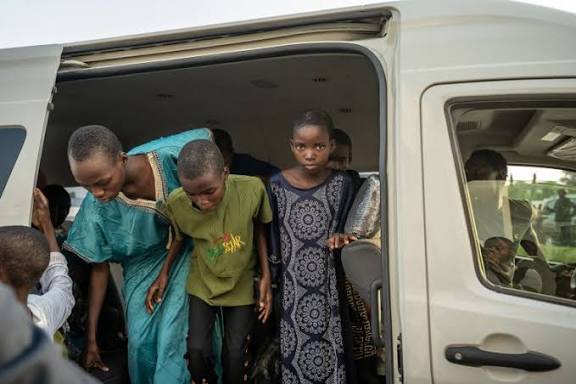

Nigeria’s government secretly paid a multi-million-dollar ransom to secure the release of up to 230 pupils and staff abducted from St Mary’s Catholic school in Niger State in November, intelligence sources told AFP, despite official denials and a law banning ransom payments.
According to four intelligence sources, the payment, estimated at between ₦2 billion and ₦40 million per victim, was flown by helicopter to Boko Haram’s stronghold in Gwoza, Borno State, and delivered to a commander known as Ali Ngulde.
Two Boko Haram commanders were also reportedly freed as part of the deal. Because of poor communication networks in the area, confirmation of the payment allegedly required crossing into Cameroon before the first group of 100 children was released.
The government has strongly denied paying any ransom. The State Security Service insisted that government agents do not pay ransoms, although officials acknowledged that families sometimes pay to secure relatives’ freedom.
The mass abduction, which saw nearly 300 students and staff seized on November 21, with at least 50 later escaping, has been linked by security and conflict analysts to Boko Haram commander Sadiku, who has previously been associated with high-profile attacks, including the 2022 Abuja to Kaduna train assault. French researcher Vincent Foucher said Sadiku’s involvement aligns with his history and operational pattern.
The incident occurred amid diplomatic tension with the United States, where President Donald Trump accused Nigeria of failing to protect Christians. Nigerian authorities and analysts reject framing the country’s security crisis as religious persecution, noting that Muslims make up the majority of kidnapping victims.
Nigeria continues to face what analysts describe as a structured kidnapping industry. Despite a 2022 law criminalising ransom payments with penalties of up to 15 years in prison, abductions remain widespread. According to ACLED, 828 kidnappings were recorded in the past year alone, more than Mexico and Colombia combined.
Security sources say ransom payments, whether publicly acknowledged or not, have become common in high-profile abductions. In 2020, authorities in Katsina State paid ₦30 million to secure the release of 340 schoolboys kidnapped in Kankara.
Families of victims often resort to crowdfunding or use security intermediaries to deliver payments.
Analysts argue that the St Mary’s kidnapping highlights both Boko Haram’s need for funding and the government’s quiet reliance on negotiations in cases involving schoolchildren or prominent victims, even as officials publicly dismiss such claims as false.