

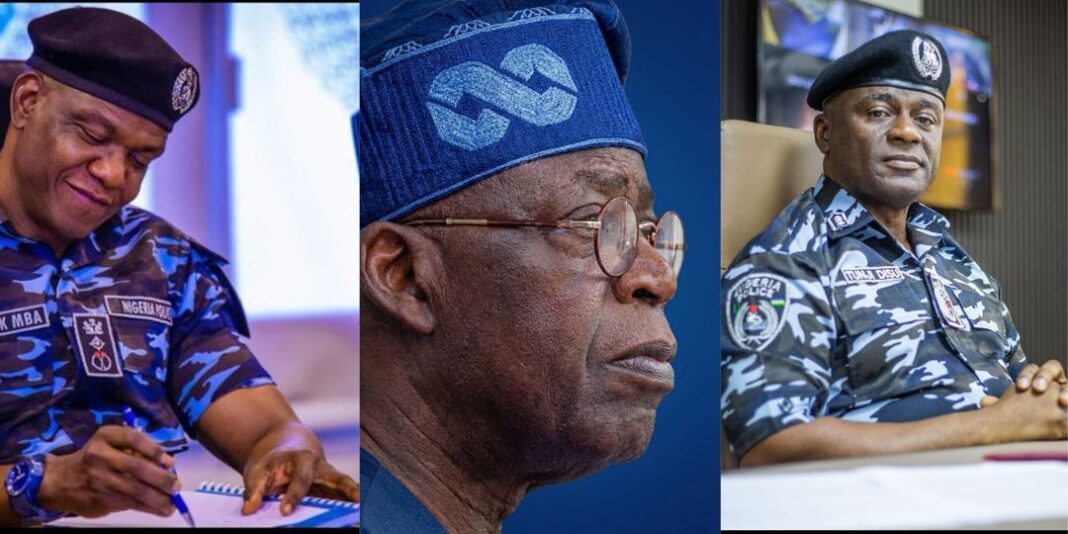

President Bola Ahmed Tinubu’s decision to appoint AIG Tunji Disu as the new Inspector General of Police has sparked outrage online following the perceived overlooking of senior officer Frank Mba.
The appointment, announced by the Presidency, followed the voluntary resignation of the former Inspector General of Police. The selection process, while constitutionally within the powers of the President, has drawn scrutiny due to debates around seniority, experience and perceived institutional expectations within the Nigeria Police Force.
Tunji Disu’s own career reflects extensive service within the Nigeria Police Force. He was born on the 13th of April, 1966, and graduated from Lagos State University with a degree in English Education. Disu joined the Force on 18th of May, 1992, and steadily ascended through the ranks. Before his appointment, he had served in a range of operational and command roles, including as Commander of the Lagos State Rapid Response Squad (RRS), Head of the Intelligence Response Team (IRT) — a unit he led following the suspension of Abba Kyari — and Commissioner of Police in both Rivers State and the Federal Capital Territory, Abuja. Most recently, Disu served as Assistant Inspector-General of Police in charge of the Force Criminal Investigation Department (FCID) Annex in Lagos, overseeing investigative operations and intelligence efforts. He holds additional postgraduate qualifications including master’s degrees in Public Administration and Criminology, Security and Legal Psychology, and has completed specialised tactical and leadership training both domestically and abroad.
However, much of the public conversation has centred on the omission of Frank Mba, a senior officer widely known for his role as Force Public Relations Officer in previous administrations. Frank Mba rose to national prominence as the spokesperson of the Nigeria Police Force where he regularly addressed the press, clarified security developments and represented the institution during periods of public tension, including during the nationwide protests against police brutality. His articulate media engagements and academic background earned him significant visibility and, in the eyes of some commentators, positioned him as a potential candidate for higher leadership within the Force.
Online reactions intensified shortly after the announcement of Dirisu’s appointment, with users debating whether considerations of seniority were set aside. Some commentators argued that Mba’s public profile and perceived reformist stance made him a suitable alternative, while others maintained that presidential discretion in security appointments often factors in broader considerations beyond public visibility or media reputation.
Under Nigeria’s constitutional framework, the President appoints the Inspector General of Police subject to confirmation and oversight mechanisms provided by law. The decision typically follows internal consultations within the security architecture and recommendations from relevant authorities. While seniority within the Force has historically influenced such appointments, it is not the sole determinant, and the President retains discretion to select from among eligible senior officers.
The Nigeria Police Force has in recent years undergone reform efforts aimed at improving accountability, training standards and community policing structures. The new Inspector General will inherit ongoing institutional reforms as well as mounting public expectations for enhanced professionalism and improved response to security threats.
As at press time, the Presidency has not indicated any reconsideration of the decision.
Samuel Aina