

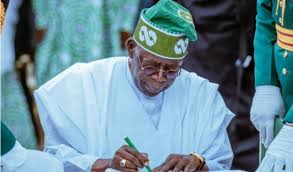

The Presidency has mounted a robust defence of President Bola Tinubu’s Executive Order 9, which halted revenue deductions by the Nigerian National Petroleum Company Limited (NNPCL) and other agencies, insisting that the directive is firmly grounded in the supremacy of the Nigerian Constitution.
According to the Presidency, the controversy surrounding the Order stems from a fundamental misunderstanding of constitutional hierarchy, particularly the relationship between the Constitution and ordinary legislation such as the Petroleum Industry Act (PIA). The government argues that where any statute conflicts with the Constitution, it is the Constitution that must prevail, and that the President is constitutionally obligated to act in defence of that supremacy.
This position was articulated by the Special Adviser to the President on Information and Strategy, Bayo Onanuga, who responded to criticism from the Petroleum and Natural Gas Senior Staff Association of Nigeria (PENGASSAN). Onanuga said the union’s opposition to the directive demonstrated a narrow focus on the PIA without adequate consideration of the Constitution.
“PENGASSAN is focusing on PIA alone. The President’s action is based on the Nigerian Constitution, which PIA violates in allowing the deductions that the President has now stopped. PIA is not superior to our constitution,” he stated in response to inquiries by The PUNCH on Monday. He further accused the union of reacting hastily, adding, “PENGASSAN should have read the constitution before making its knee-jerk reaction.”
Onanuga explained that the authority for the Executive Order flows directly from section 5 of the 1999 Constitution, which vests executive powers of the Federation in the President, including responsibility for the execution and maintenance of the Constitution and the implementation of federal laws. He added that the directive is also anchored on section 44(3) of the Constitution, which vests ownership, control and derivative rights over all minerals, mineral oils and natural gas in Nigeria in the Government of the Federation.
According to him, the intent of the Executive Order is to restore constitutionally guaranteed revenue entitlements of the Federal, State and Local Governments, which he said were “taken away in 2021 by the Petroleum Industry Act.” He argued that “the PIA created structural and legal channels through which substantial Federation revenues are lost through deductions, sundry charges, and fees.”
PENGASSAN, however, had on Friday sharply opposed the presidential fiat, accusing President Tinubu of violating the PIA through his revenue retention order. The union warned that the directive could cripple the operational capacity of NNPCL and undermine its ability to meet statutory obligations, including contributions to the Frontier Exploration Fund, which is considered critical for hydrocarbon exploration planned for 2026.
According to reports, the directive has also generated deep unease within key sector institutions, including the Nigerian Upstream Petroleum Regulatory Commission, NNPCL itself, and the board and management of the Midstream and Downstream Gas Infrastructure Fund. Despite these concerns, the Presidency has maintained that the Order is essential to plugging revenue leakages and ensuring that funds constitutionally due to all tiers of government are not diverted through statutory deductions.
Reinforcing this stance, Presidential media aide Sunday Dare defended the Executive Order in a post on X, citing section 80(1) of the Constitution, which mandates that all revenues raised or received by the Federation must be paid into the Consolidated Revenue Fund. Dare emphasised that Executive Order 9 neither creates new law nor amends the PIA, but merely operationalises existing constitutional provisions by directing the remittance of petroleum revenues including royalties, taxes, profit oil and gas, penalties and related receipts—into constitutionally recognised accounts.
“EO9 does not intrude into legislative competence,” he stated, adding that where its validity is disputed, the Judiciary remains the appropriate forum for resolution. Pending any judicial determination, he said, the Executive is duty-bound to protect Federation revenues and uphold constitutional supremacy.
The Petroleum Industry Act itself, signed into law in August 2021 by former President Muhammadu Buhari, granted NNPCL significant operational and financial autonomy, including the right to retain revenues for reinvestment before remitting proceeds to the Federation Account. Section 54 of the Act specifically exempts NNPCL from the Fiscal Responsibility Act and allows it to operate on commercial terms without certain government financial regulations. Nonetheless, protests and objections have continued to mount against Executive Order 9, with a broad cross-section of senior legal practitioners raising constitutional concerns about the legality of the President’s action.
Eight Senior Advocates of Nigeria Lekan Ojo, Adeola Adedipe, Paul Obi, Wale Balogun, Wahab Shittu, Abiodun Layonu, Isiaka Olagunju and Mofesomo Tayo-Oyetibo argued that President Tinubu lacks the authority to override or set aside an Act of the National Assembly through an executive instrument, insisting that only the judiciary can declare a law unconstitutional.
In a separate interview with The PUNCH, President of the Nigerian Bar Association, Afam Osigwe (SAN), was unequivocal, stating that while executive orders may guide administrative actions, they cannot supplant or contradict laws duly enacted by the legislature. “No, he does not. A president cannot, by executive order, modify or alter a law. A president doesn’t have the power,” Osigwe said.
Ojo echoed this position, stressing that the PIA is an Act of the National Assembly and “hence the President cannot by any form of executive order, amend, alter or abrogate or nullify any provisions of that act.” He explained that executive orders are instruments meant to give effect to executive decisions and existing laws, not to reverse them.
“Where the law has prescribed a particular thing, the President cannot, by executive order, do the opposite,” he said, adding that only the National Assembly can amend or repeal the Act. Any attempt to do so through an executive order, he warned, would amount to executive legislation, which is not permitted under the Constitution. “Neither judicial legislation nor executive legislation is permitted under the Constitution of the Federal Republic of Nigeria… It is an exercise in futility,” he said.
Other senior lawyers reinforced this argument. Adedipe noted that executive orders are limited to administrative convenience and cannot replace the constitutional law-making process. “Executive Orders help with functions and administrative convenience. Law making process is set out in the Constitution, and the same cannot be substituted by an executive fiat,” he said, warning that any order derogating from existing law is likely to be annulled by the courts.
Obi flatly rejected the idea that a president could overreach the legislature through executive directives, emphasising the separation of powers and noting that where a president is dissatisfied with an Act, the lawful route is to sponsor an amendment or propose a new law. Drawing a parallel with the United States, he cited a decision of the Supreme Court of the United States, which nullified trade tariffs imposed by Donald Trump, as evidence of judicial checks on executive overreach.
Balogun underscored the supremacy of substantive legislation over subsidiary instruments, stressing that executive orders must always be traceable to existing law. Shittu, in a detailed statement titled “Scope of Executive Power,” raised what he described as profound constitutional questions touching on separation of powers and judicial review. He emphasised that while the Constitution declares inconsistent laws void, the determination of such inconsistency lies exclusively with the judiciary.
Citing multiple Supreme Court authorities, including Attorney-General of the Federation v. Abubakar, INEC v. Musa and Military Governor of Lagos State v. Ojukwu, Shittu warned that allowing the Executive to invalidate statutes without judicial pronouncement would undermine democratic governance and erode checks and balances. Layonu and Olagunju similarly maintained that once a law has been duly enacted, only the courts can pronounce on its constitutionality, and that the proper course where inconsistency is alleged is judicial interpretation or legislative amendment.
A divergent view, however, was offered by Tayo-Oyetibo, who argued that Executive Order 9 is defensible as an assertion of constitutional supremacy rather than an attempt to repeal the PIA. He maintained that while an Executive Order cannot amend an Act of the National Assembly, the President is constitutionally bound to align executive conduct with the Constitution where a conflict is reasonably perceived.
“The supremacy clause in section 1(3) operates automatically. Courts declare inconsistency… they do not create it,” he said, adding that insisting the President must knowingly implement unconstitutional arrangements pending litigation would invert the logic of constitutional governance. According to him, the Order merely directs executive agencies on how to administer petroleum revenues in a constitutionally compliant manner, leaving room for judicial interpretation by those who disagree.
Beyond the legal debate, members of the Organised Private Sector have sought to calm fears that Executive Order 9 of 2026 could deter investment. In separate interviews with The PUNCH, business leaders argued that the directive would enhance transparency and efficiency rather than scare investors away.
Director-General of the Nigeria Employers’ Consultative Association, Adewale Oyerinde, said, “The Executive Order will, among other things, enhance transparency and operational integrity of the revenue accrued… If there’s one thing that foreign investors desire, it is transparency and predictability of any process. In our opinion, the Executive Order is in the right order.”
Similarly, President of the Lagos Chamber of Commerce and Industry, Leye Kupoluyi, stressed that honesty, transparency and policy consistency are exactly what international investors expect. “I don’t think this executive order will scare investors away… That is exactly what the international community expected,” he said, describing the development as an internal restructuring between government and its oil company and an opportunity for NNPCL to strengthen its corporate structure and grow to greater heights.