

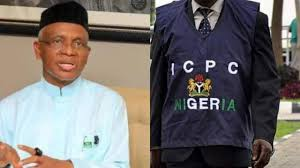

Former Kaduna State Governor Nasir El-Rufai has filed a N1 billion fundamental rights enforcement suit against the Independent Corrupt Practices and Other Related Offences Commission (ICPC), challenging what he described as an unlawful invasion and search of his Abuja residence. The suit, marked FHC/ABJ/CS/345/2026, was filed at the Federal High Court in Abuja on February 20 by his lead counsel, Oluwole Iyamu (SAN), and represents a critical legal confrontation between a former political leader and federal anti-corruption agencies over constitutional protections and procedural compliance.
In the application, El-Rufai specifically challenged the validity of a search warrant issued on February 4 by a Chief Magistrate of the FCT Magistrates’ Court, seeking a declaration that the warrant authorizing the search and seizure at his residence is “invalid, null and void.” The former governor’s legal team contends that the warrant suffered from several procedural defects, rendering the ICPC’s actions unconstitutional.
According to the suit, the warrant is “null and void for lack of particularity, material drafting errors, ambiguity in execution parameters, overbreadth, and absence of probable cause, thereby constituting an unlawful and unreasonable search in violation of Section 37 of the Constitution.” The case names the ICPC as the first respondent, while the Chief Magistrate of the FCT Magistrates’ Court, the Inspector General of Police, and the Attorney General of the Federation are listed as second, third, and fourth respondents, respectively.
El-Rufai is seeking seven reliefs, the most prominent being a declaration that the search conducted at his residence at House 12, Mambilla Street, Aso Drive, Abuja, on February 19, allegedly by ICPC and Nigeria Police Force operatives, violated his fundamental rights. The suit emphasizes breaches of Sections 34, 35, 36, and 37 of the Constitution, which cover the dignity of the human person, personal liberty, fair hearing, and privacy.
The former governor further asked the court to declare that any evidence obtained during the search is inadmissible in proceedings against him, asserting that it was procured in violation of constitutional safeguards. His legal team also requested restraining orders against the respondents to prevent reliance on or tendering of any items seized during the operation and called for the immediate return of all seized items, along with a detailed inventory.
El-Rufai is also seeking N1 billion in general, exemplary, and aggravated damages, broken down as N300 million for psychological trauma and emotional distress, N400 million as exemplary damages to deter future misconduct by law enforcement agencies, and N300 million as aggravated damages for what he described as the malicious and oppressive nature of the respondents’ actions. Additionally, N100 million was sought for legal fees and associated expenses incurred in filing the suit.
The legal grounds for the suit hinge on several alleged defects in the warrant, including lack of specificity in the items to be seized, typographical errors, ambiguous execution terms, overbroad directives, and absence of probable cause. Counsel Iyamu cited relevant legal provisions, including Sections 143–148 of the Administration of Criminal Justice Act (ACJA) 2015, Section 36 of the ICPC Act 2000, and constitutional protections against arbitrary intrusion.
Iyamu emphasized procedural violations in his argument: “Section 143 of the ACJA requires that an application for a search warrant be supported by information in writing and on oath, setting forth reasonable grounds for suspicion,” which he argued was entirely absent in this case. He added that Section 144 mandates specific descriptions of the place to be searched and the items sought, but the warrant vaguely referred to “the thing aforesaid” without further detail.
Further citing Sections 146 to 148 of the ACJA, Iyamu said, “Section 146 stipulates that the warrant must be in the prescribed form, free from defects that could mislead, but the document is riddled with errors in the address, date, and district designation. Section 147 allows direction to specified persons, but the warrant’s indiscriminate addressing to ‘all officers’ is overbroad and unaccountable. Section 148 permits execution at reasonable times, but the contradictory language creates ambiguity, undermining procedural clarity.”
In support of the application, the legal team referenced landmark cases, including C.O.P. v. Omoh (1969) NCLR 137 and Fawehinmi v. IGP (2000) 7 NWLR (Pt. 665) 481, arguing that evidence obtained through improper means is inadmissible and that the defendants’ actions violated fundamental legal safeguards.
An affidavit from Mohammed Shaba, Principal Secretary to El-Rufai, corroborated these claims, stating that ICPC and Nigeria Police operatives executed a defective warrant on February 19, seizing personal documents and electronic devices and causing “undue humiliation, psychological trauma, and distress.” Shaba further alleged that none of the items seized had been returned to the former governor, prompting the urgent filing of the suit.
The legal dispute comes against a backdrop of heightened tension since El-Rufai’s return from Cairo, Egypt, on February 12. Upon arrival at Nnamdi Azikiwe International Airport, security operatives allegedly attempted to detain him without presenting a formal warrant or invitation, which his lawyers condemned as unlawful and an executive overreach.
Subsequently, El-Rufai voluntarily reported to the Economic and Financial Crimes Commission (EFCC) on February 16, in response to an invitation. He remained in EFCC custody until February 18, when he was transferred to ICPC, prompting his legal team to describe the detention as unlawful, citing restricted access for both family and legal representatives.
Despite being granted administrative bail under conditions including a serving federal permanent secretary as surety, the former governor was reportedly rearrested by ICPC operatives, and interrogation reportedly continued on February 20. His media adviser, Muyiwa Adekeye, stated that El-Rufai had not been presented with a remand order and that the statutory 48-hour detention limit without charge had expired.
Following the search of his residence on February 19, El-Rufai filed a suit at the Federal High Court on February 23, challenging the legality of the warrant and seeking judicial intervention to prevent law enforcement from using items seized in any investigation or prosecution. The suit specifically cites defects such as lack of particularity, ambiguity, overbreadth, and absence of probable cause, framing the matter as a critical test of constitutional safeguards.
Legal experts note that the case has broad implications for law enforcement operations, anti-corruption enforcement, and the protection of individual rights in Nigeria, particularly regarding the procedural correctness of warrants and the proper execution of searches.
In addition to challenging the warrant, El-Rufai’s lawyers have highlighted the political and reputational consequences of the ICPC and police actions, framing the matter as part of a broader discourse on executive overreach and due process. They argue that the failure to comply with established procedures constitutes “malicious and oppressive” conduct by the respondents.
The former governor is also scheduled for arraignment by the Department of State Services (DSS) on February 25 on charges related to alleged unlawful interception of communications. This will occur alongside the hearing of his fundamental rights case at the Federal Capital Territory High Court, underscoring the convergence of legal, political, and security issues in his ongoing confrontations with federal authorities.
Adekeye emphasized the significance of the timeline, noting, “Today marks eight days since Malam Nasir El-Rufai was detained. He voluntarily reported at the EFCC in the morning of Monday, 16th February 2026 in response to an invitation. He has been held since, first by the EFCC which kept him in custody until the night of Wednesday, 18 February when he was moved to the ICPC. As at today, his lawyers have not received any response from the ICPC to their application for bail; and they have not been shown any remand order as the 48-hour window for holding a person without charge has expired.”
The sequence of events highlights tensions between anti-corruption enforcement agencies, law enforcement protocols, and constitutional guarantees, with El-Rufai’s legal team insisting that adherence to procedural requirements is essential to prevent abuse of power and safeguard civil liberties.
Observers note that the case may set a precedent for how ICPC, EFCC, and DSS operations intersect with fundamental rights protections, particularly regarding searches, arrests, and the treatment of high-profile political figures. Analysts also point to the potential diplomatic and political ramifications, given El-Rufai’s prominence in national and regional politics.
As the matter unfolds, the Federal Capital Territory High Court is expected to play a pivotal role in determining both the admissibility of evidence obtained during the contested search and the legality of El-Rufai’s detention. Legal observers stress that the outcome could influence future engagements between anti-corruption agencies and public officials, shaping Nigeria’s approach to balancing anti-graft enforcement and individual constitutional rights.
For now, all eyes are on the scheduled hearings on February 25, when El-Rufai is expected to face arraignment while simultaneously pursuing judicial relief for what he alleges to be a series of constitutional violations. The case remains a high-profile intersection of law, politics, and governance, with significant implications for public confidence in Nigeria’s anti-corruption and security institutions.