

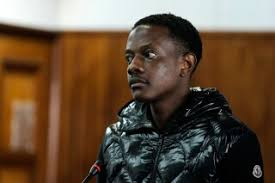

Bellarmine Mugabe, the youngest son of Zimbabwe’s late President Robert Mugabe, has been formally charged with attempted murder in South Africa following a shooting incident at a Johannesburg residence, bringing intense legal scrutiny to a high‑profile family caught up in a violent episode. Mugabe and another man were arrested last week after a 23‑year‑old man was shot and critically injured at a property in the affluent Hyde Park suburb, authorities said, and they appeared in court on Monday to face multiple charges connected to the incident in which the alleged weapon has not yet been recovered.
The court hearing took place at the Alexandra Magistrates Court in Johannesburg, where Bellarmine Chatunga Mugabe, believed to be in his late 20s, appeared alongside co‑accused Tobias Mugabe Matonhodze, 33, on charges that include attempted murder, defeating the ends of justice, and unlawful possession of a firearm. During the brief proceedings, neither man entered a plea, and the case was postponed to 3 March 2026 for a formal bail application, with both suspects remanded in custody pending further investigation.
The charges stem from a shooting on 19 February at the Hyde Park residence, where the victim—a gardener employed at the property—was shot and left in a critical condition in hospital, South African police confirmed. Police have so far recovered bullet cartridges at the scene but have not located the firearm alleged to have been used, prompting additional legal complications and contributing to the decision to delay bail.
Prosecutors allege the incident began with an altercation between Mugabe, his co‑accused and the victim inside the home, after which the injured man was shot as he attempted to flee and collapsed outside the property’s gate. The National Prosecuting Authority’s statement noted that the circumstances surrounding the confrontation remain unclear as investigations continue, and police divers and K‑9 units have been deployed in an ongoing search for the missing firearm.
The additional charges of defeating the ends of justice and unlawful firearm possession relate directly to the missing weapon and alleged efforts to hamper the inquiry, including the possibility that evidence was removed or concealed after the shooting. Authorities say they are also reviewing potential immigration and other legal issues tied to the case, with defence lawyers acknowledging that multiple agencies may need to be consulted in the broader investigation.
Mugabe’s legal counsel, Sinenhlanhla Mnguni, spoke briefly to reporters after the hearing, describing his client as “fine” but declining to comment in detail as the case progresses. Mnguni later noted that verification processes with governmental departments, including the Department of Home Affairs, are ongoing, suggesting that several procedural matters remain unresolved as the formal bail application approaches.
Bellarmine Mugabe is the youngest son of Robert Mugabe and his second wife, Grace Mugabe. Robert Mugabe led Zimbabwe for 37 years after independence in 1980, before being ousted in a military coup in 2017 and later dying in 2019 in Singapore. His family has long attracted public attention, both for its political prominence and for reports of lavish lifestyles and previous legal controversies involving members such as Mugabe’s older siblings.
The Hyde Park suburb where the incident occurred is known for its luxury residences and is one of Johannesburg’s most affluent neighbourhoods, also housing prominent figures including South Africa’s president. The fact that such a serious criminal charge has been brought against a relative of one of Africa’s most famous political figures has drawn significant media and public interest, both within South Africa and internationally.
Police in Gauteng province responded to reports of gunfire at the Mugabe home and found the wounded gardener shortly after the incident unfolded, confirming that the victim had been transported to hospital in critical condition. Gauteng provincial police spokesperson Colonel Dimakatso Nevhuhulwi said law enforcement is working to determine what led to the shooting while continuing efforts to recover the firearm.
In addition to the legal proceedings, the case has sparked widespread online discussion and speculation, with police emphasising that the investigation is ongoing and that both accused remain in custody as inquiries progress. The broader context of the case highlights the complexities of legal accountability for high‑profile individuals and the challenges faced by police in high‑stakes criminal investigations.
Mugabe’s arrest on attempted murder charges follows initial detentions and questioning last Thursday, when both he and the co‑accused were taken into custody by South African authorities. Police had earlier indicated that they received a call from private security personnel who discovered the wounded gardener and alerted law enforcement to the scene, triggering the investigation.
Search efforts at the Hyde Park residence reportedly involved extended negotiations for access, as well as forensic teams conducting thorough sweeps of the property for physical evidence related to the alleged offence. However, despite these efforts, the absence of the weapon remains a central point of contention and has contributed to the additional charges of obstructing justice.
The motive behind the shooting remains unclear, with police declining to speculate on potential reasons while investigators build their case. Authorities have described the matter as “far from over,” and the postponement of the bail hearing reflects both the seriousness of the charges and ongoing procedural requirements.
South African legal experts say that cases involving high‑profile defendants often attract intense scrutiny, and they stress that the justice system is expected to operate without bias regardless of an individual’s family background or public profile. The postponement to March 3 will give both prosecution and defence time to prepare arguments related to bail and ongoing investigative developments.
Police have reiterated that they will pursue all avenues of the investigation, including interviews with witnesses, forensic analyses of recovered cartridges, and cooperation with firearm tracing units to locate the weapon believed to have been used in the shooting.
Meanwhile, the victim’s condition remains under police and medical supervision in a hospital, with officials withholding further details pending updates from medical staff. South African law enforcement has emphasised that updates on the case will be provided as investigations reach key milestones, including any discoveries related to the missing firearm.
The involvement of foreign nationals and high‑profile families in criminal cases abroad often raises questions about diplomatic sensitivities, jurisdiction, and public perception, but legal analysts note that such matters are adjudicated under local law once formal charges are laid. As the next court appearance approaches, attention is expected to focus on legal arguments over bail, the strength of the prosecution’s evidence, and broader questions of accountability.
As South African courts prepare for the next hearing on 3 March, both supporters and critics of the case will be watching closely to see how the legal process unfolds, particularly given the international attention that comes with the Mugabe name.