

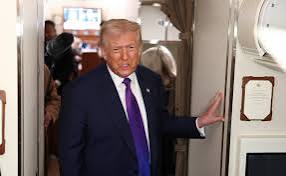

US President Donald Trump announced on Thursday that he will direct federal agencies, including the Department of Defense, to “begin the process of identifying and releasing” government files related to aliens, extraterrestrial life, unidentified flying objects (UFOs), and unidentified aerial phenomena (UAP).
The declaration came in the wake of remarks by former President Barack Obama, who stated in a recent podcast that he believes “aliens are real,” prompting Trump to accuse his predecessor of disclosing sensitive information publicly.
Speaking to reporters aboard Air Force One, Trump said of Obama’s comment, “He’s not supposed to be doing that. He made a big mistake.” When asked whether he personally believes in the existence of aliens, the former US president responded, “Well, I don’t know if they’re real or not.”
Trump further elaborated on his plan in a post on his social media platform Truth Social, noting the significant public interest in the matter.
“Based on the tremendous interest shown,” he wrote, he will seek the release of files “related to alien and extraterrestrial life, unidentified aerial phenomena (UAP), and unidentified flying objects (UFOs), and any and all other information connected to these highly complex, but extremely interesting and important, matters.”
The statement underscores Trump’s intent to mobilize federal agencies to review and potentially disclose previously classified or restricted information regarding phenomena that have long fascinated both the public and government entities.
The comments by Trump were prompted by Obama’s interview with podcast host Brian Tyler Cohen, which was released last Saturday. During a quickfire “lightning” round of questions, Obama stated, “They’re real, but I haven’t seen them, and they’re not being kept in Area 51. There’s no underground facility unless there’s this enormous conspiracy and they hid it from the president of the United States.”
Following the widespread media coverage of these remarks, Obama sought to clarify his position on Instagram, noting, “I saw no evidence during my presidency that extraterrestrials have made contact with us. Really!”
He explained that his remarks reflected a statistical assessment of life in the universe rather than any first-hand knowledge of alien encounters, emphasizing that his comments were not derived from classified government information.
The renewed public attention to UFOs and extraterrestrial life in the United States comes against a backdrop of years of government investigation and disclosure. Public interest surged in 2017 following reports of a previously undisclosed Pentagon programme designed to investigate testimony from military pilots and other personnel who reported encounters with unexplained aerial objects.
In 2022, Congress held its first hearings on UFOs in fifty years, reflecting growing legislative interest in transparency and public accountability regarding unidentified aerial phenomena.
Following these hearings, the Department of Defense established a dedicated office to collect and monitor all military reports of UAP encounters, signaling an ongoing effort to formalize tracking and analysis of such incidents within federal structures.
In 2023, a panel convened by the US House of Representatives reviewed military and government data on UAPs but produced no groundbreaking findings or confirmation of extraterrestrial life. According to a 2024 report by the Pentagon, there remains “no evidence” that the US government has encountered alien life, and most UFO sightings were ultimately explained as conventional objects, weather phenomena, or other identifiable causes.
These findings have shaped the current discourse around transparency and the release of related government files, highlighting the tension between public curiosity and classified government operations.
Trump and Obama’s recent exchange also illustrates the ongoing political rivalry between the two former presidents. Trump, a Republican, and Obama, a Democrat, have been longstanding adversaries, with public and political debates often highlighting their ideological differences.
Trump’s criticism of Obama’s public discussion of aliens reflects this broader context, as he described the podcast remarks as inappropriate for a former president.
However, media analysts note that Obama’s clarification and Trump’s subsequent announcement regarding document release appear to reflect both a continuation of this political dynamic and a response to widespread public fascination with extraterrestrial phenomena.
During his interview on Air Force One, Trump stressed his own neutrality on the question of extraterrestrial existence, stating, “While a lot of people believe in the existence of aliens, I never talk about it and I don’t have an opinion on it.”
Nevertheless, his administration’s decision to instruct federal agencies to begin reviewing and releasing relevant files suggests a recognition of public demand for transparency, particularly in light of decades of speculation, classified studies, and media coverage surrounding UFOs and UAPs. By directing agencies to take formal action, Trump has effectively acknowledged the significance of this issue to the American public.
The announcement also raises procedural and operational questions about the scope of disclosure and the classification of sensitive national security information. Federal agencies, including the Department of Defense, are expected to evaluate records on UAPs, UFOs, and extraterrestrial life while balancing security considerations and compliance with existing laws on the protection of classified material.
Experts note that the review process could involve declassifying historical reports, analysis of military encounter records, and other documentation, though it remains unclear which files will ultimately be made public or the timeline for release.
Obama’s remarks, while generating headlines, did not rely on any classified materials, according to available reports. In response to the public discussion, Obama emphasized that his comments were intended to convey the statistical likelihood of life beyond Earth rather than any confirmed encounters.
“There’s no underground facility unless there’s this enormous conspiracy and they hid it from the president of the United States,” he said, clarifying the scope of his statement. This distinction underscores that, despite the dramatic framing of the conversation, there is currently no verified evidence of contact with extraterrestrial beings held by the US government.
Trump’s move to release documents follows a growing trend in American society toward demanding openness on previously secret topics, particularly in areas that intersect with national security, science, and public curiosity.
Since the 2017 revelations regarding Pentagon programs investigating UAPs, advocacy groups, journalists, and congressional committees have pressed for access to official records and more formal government acknowledgment of unexplained aerial phenomena.
Trump’s directive may be seen as a formalization of these pressures, potentially expanding public access to information long considered restricted.
Observers note that this development is part of a broader pattern of political and media interplay, in which former and current leaders use public platforms to respond to each other’s statements while simultaneously addressing issues of public interest.
In this case, Trump leveraged both his Air Force One press interaction and posts on Truth Social to signal action, while Obama clarified his prior comments via social media, illustrating how communication channels are increasingly central to political discourse in the US. Both approaches aim to manage public perception while navigating the complexities of governance and information disclosure.
The renewed discourse over aliens, UAPs, and UFOs has prompted discussions in the scientific, policy, and defense communities. While the Pentagon maintains that there is “no evidence” of extraterrestrial contact, agencies are expected to continue monitoring unexplained aerial activity as part of ongoing safety, defense, and investigative mandates.
The establishment of a dedicated office to track reports reflects the institutionalization of data collection on aerial phenomena, with the goal of improving situational awareness for both military and civilian stakeholders.
Trump’s announcement also illustrates the continuing intersection of politics, public interest, and media coverage in shaping narratives around highly unusual or controversial topics.
His comments on Truth Social emphasized the “extremely interesting and important” nature of the subject matter, signaling both engagement with public curiosity and a willingness to prompt governmental action. While speculation persists in popular culture, the official position remains rooted in verified data and procedural review, highlighting the balance between disclosure and national security.