

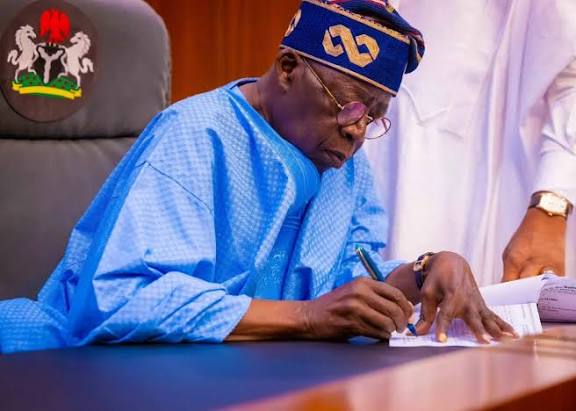

The swift assent of President Bola Tinubu to the Electoral Act 2026 (Amendment) has sparked sharply divided reactions across Nigeria, eliciting both commendation and criticism from political actors, socio-cultural groups, and civil society organisations.
While some stakeholders hailed the President’s move as a timely and necessary step to ensure that electoral processes are concluded on schedule ahead of the 2027 general elections, a coalition of civil society groups raised concerns over what they described as the opacity and haste of the legislative process, cautioning that the opportunity for comprehensive electoral reform may have been undermined.
President Tinubu signed the Electoral Act 2026 (Amendment) at the Presidential Villa, Abuja, on Wednesday, in a ceremony attended by lawmakers, government officials, and political figures.
Addressing the gathering, the President emphasised the need for public confidence in the electoral system, asserting, “It is time that we have confidence in our system. No matter how good a system is, it’s managed by the people, promoted by the people, and the result is finalised by the people.
In fact, for final results, you are not going to be talking to the computer. You are going to be talking to human beings who announce the result.”
His remarks followed heightened tension during the passage of the bill at the National Assembly, with opposition lawmakers and civil society stakeholders advocating for mandatory live electronic transmission of election results directly from polling units to the central server of the Independent National Electoral Commission (INEC).
In the weeks leading to the Presidential assent, civil society organisations, along with some opposition figures, staged protests at the National Assembly complex, demanding that provisions for real-time electronic transmission of election results be included in the Electoral Act.
Ultimately, the Senate and the House of Representatives adopted a compromise requiring results to be transmitted through the Bimodal Voter Accreditation System while allowing manual collation where network failures occur.
This approach has been described by supporters as a practical balance between technology-driven transparency and contingency for infrastructural limitations.
The Arewa Consultative Forum (ACF), along with the Lagos State chapter of the All Progressives Congress (APC) and a number of political stakeholders, welcomed President Tinubu’s swift assent to the law, describing it as a vital step towards ensuring electoral processes remain timely and orderly.
Speaking to journaliss, ACF’s National Publicity Secretary, Prof. Tukur Muhammad-Baba, noted that while the President’s approval may have appeared hurried, the time-sensitive nature of electoral legislation demanded prompt action. “The Electoral Bill, as assented to by the President, as hurried as it may seem, deals with processes of the electoral system which are time-bound,” Muhammad-Baba said.
He further emphasised, “Given that we are just about a year to the 2027 general elections, the time to put the law in place is a critical, even non-negotiable step.”
Muhammad-Baba also highlighted the importance of transparency and public access to the full contents of the Electoral Act, noting that Nigerians, including the ACF, had only seen portions of the legislation.
“The general public, including the ACF, has to date, only snippets of the bill. Outside of the contentious issue that emerged recently, that is, provisions regarding the mode of transmission of election results, we would like to see the contents of the full bill, warts and all,” he stated.
He called on lawmakers to exercise vigilance in ensuring that the final versions of bills accurately reflect legislative decisions, underscoring that incomplete public access risks undermining trust in the legislative process.
In contrast, a coalition of civil society organisations, including The Kukah Centre, Yiaga Africa, the International Press Centre, TAF Africa, Centre for Media and Society, Nigerian Women Trust Fund, and Elect Her, criticised the President’s assent, describing it as a missed opportunity for transformative electoral reform.
At a press conference in Abuja, the coalition expressed concerns that the speed and opacity of the process could erode public confidence in the law.
Speaking on behalf of the coalition, Jake Epelle, Founder and CEO of TAF Africa, said, “The civil society organisations acknowledged the passage of the Electoral Bill 2026 by the National Assembly and the presidential assent that followed, but warned that the process fell short of democratic standards. The speed and opacity raise serious concerns about legislative transparency and the commitment of lawmakers to genuine electoral reform.”
Epelle also criticised specific provisions within the Act, particularly the imposition of a N50 million administrative fee for new political party registration under Section 75(6), which he described as “a financial moat designed to exclude grassroots movements, youth-led parties, and non-elite political formations from formal competition.”
On party primaries, the coalition highlighted that restricting nomination methods to direct primaries or consensus limits flexibility and could heighten the risk of vote-buying and manipulation, thereby undermining internal party democracy.
Another key point of contention for the civil society groups is the law’s provision on electronic transmission of election results. While Section 60(3) mandates electronic transmission, the legislation permits manual collation in cases of “communication failure,” a term the coalition argued is not clearly defined.
“There is no independent verification mechanism. There are no consequences for deliberate sabotage disguised as technical failure. This loophole will be tested again in 2027, and the Act provides no protection,” the coalition stated. They also expressed concern over restrictions on who can trigger a review of election results, noting that only INEC officials have the authority to initiate such reviews, excluding political parties, candidates, and observers.
“Restricting the power of review to reports filed by INEC officials is against the spirit behind the power of review vested in INEC,” the CSOs said.
The coalition also alleged that the final version of the bill contained last-minute amendments that were not publicly disclosed prior to adoption. “The final version of the Bill voted upon reportedly contained last-minute amendments that were neither published nor made available to civil society or the broader public before adoption,” they said.
“When reforms are rushed, consolidated without scrutiny, and adopted without full disclosure, public confidence inevitably erodes.” The groups insisted that for reforms to be credible, legislative transparency and public engagement must be prioritised.
Despite the criticism, the coalition acknowledged positive aspects of the Electoral Act, including the introduction of downloadable voter cards, disability-inclusive voter registration, and tougher penalties for electoral offences.
Epelle noted, “While we have concerns about process and specific provisions, we acknowledge that some provisions are steps forward in enhancing accessibility and accountability in the electoral system.”
President Tinubu, for his part, maintained that the Electoral Act 2026 (Amendment) would serve to strengthen confidence in Nigeria’s electoral system and ensure that the 2027 general elections proceed smoothly.
His administration has argued that timely enactment of the law was necessary due to the limited timeframe before the polls and that legal certainty is critical for effective planning by INEC and other stakeholders.
The tension surrounding the passage of the Electoral Act reflects broader debates in Nigeria about electoral transparency, technology adoption, and the balance between procedural safeguards and pragmatic implementation.
Opposition figures and some civil society groups have continued to press for live, real-time electronic transmission of results from polling units to the commission’s central server, citing concerns about manipulation, delays, and public trust.
Meanwhile, the National Assembly has maintained that the adoption of electronic transmission through the Bimodal Voter Accreditation System, with provision for manual collation in case of network failures, represents a practical compromise.
The House of Representatives and Senate have encouraged public feedback and engagement with civil society to ensure that implementation measures are effective and that loopholes are addressed before the 2027 elections.
Stakeholders across the political spectrum are now calling for immediate publication of the assented Electoral Act to allow citizens, civil society organisations, and political parties to review its provisions in full. There is consensus that public access to the complete text is essential for accountability, planning, and trust-building ahead of the general elections.
Analysts suggest that the divided reactions underscore the challenge of achieving electoral reform in a context where political expediency, time constraints, and demands for technological transparency intersect. While the law’s provisions contain measures to modernise electoral processes, concerns remain that without broader public scrutiny and independent verification, confidence in the system could be compromised.
Lagos APC Throws Support Behind Tinubu’s Electoral Act Assent
The All Progressives Congress (APC) in Lagos State has publicly affirmed its support for President Bola Tinubu following his swift assent to the Electoral Act 2026 (Amendment), describing the move as a measured and constitutionally sound step in the lead-up to the 2027 general elections.
In a statement issued on Thursday by the party’s Public Relations Officer, Seye Oladejo, the Lagos APC dismissed critics of the law as “noisemakers” whose reactions were driven more by sentiment and political theatre than by substantive analysis.
Oladejo characterised the opposition’s response to the President’s action as “orchestrated hysteria,” stressing that governance must be guided by constitutional principles rather than public clamor or social media trends.
The party underscored that President Tinubu’s assent followed due constitutional process, engaged legislative debate, and involved institutional consultation. “It must be stated without equivocation that governance is a serious constitutional duty carried out in the best interest of the Nigerian people,” the statement read.
The Lagos APC warned those seeking to manipulate public sentiment for political ends, stressing that credible democracy relies on solid, transparent institutions rather than emotional reactions.
“Democracy thrives on credibility, not noise. Electoral integrity cannot be built on fragile systems designed more for headlines than for durability. Responsible governance requires anticipating risks before they mature into crises,” Oladejo added.
In its statement, the party also criticised opposition figures who have promoted what it described as a “romanticised and misleading narrative” around the adoption of so-called real-time transmission systems for election results.
The APC argued that similar models in other democracies had experienced technological failures, legal ambiguities, cybersecurity vulnerabilities, and even judicial reversals, cautioning that elevating political expediency above systemic stability could expose Nigeria to unnecessary risk.
“The people of Nigeria deserve reforms that strengthen institutions, not experiments that may compromise them,” the Lagos APC noted. “What manner of democracy suggests that the opposition alone possesses superior wisdom? Electoral reform is not the exclusive preserve of any political bloc.”
The statement emphasised that constructive reform must balance innovation with legal soundness, technological feasibility, and long-term sustainability.
According to Oladejo, President Tinubu’s assent reflects prudence rather than panic. It signals the administration’s commitment to reforms that are thoughtful, sustainable, and legally defensible, and prioritises the integrity of the electoral system over partisan advantage.
“The President’s action demonstrates foresight in ensuring that the electoral framework is robust, transparent, and capable of withstanding challenges, while still protecting the constitutional rights of Nigerians,” the statement said.
The Lagos APC also reaffirmed its position that governance is not a popularity contest, cautioning against politicising reforms through social media campaigns or digital propaganda. The party maintained that implementing effective reforms requires a careful assessment of institutional capabilities, legal frameworks, and the potential risks associated with adopting untested models.
Nigerian Entrepreneur Voices Support for Tinubu’s Electoral Reform
A prominent Nigerian businessman and political commentator, Dumebi Ifeanyichukwu, has publicly expressed strong support for President Bola Tinubu following his assent to the Electoral Act 2026 (Amendment), describing the move as a significant step toward strengthening the country’s democratic institutions ahead of future elections.
Speaking during a media interaction on Thursday in Owerri, the capital of Imo State, Ifeanyichukwu emphasised that many residents and political stakeholders in the state view the President’s approach to electoral reform as a genuine effort to improve governance and restore public trust in the nation’s electoral process.
“We want the President to know that Imo people are fully behind him. The ongoing conversation around the Electoral Act should not be reduced to politics alone. What matters is building a stronger and more credible democratic system,” he said in a statement on Thursday.
Ifeanyichukwu further underscored the importance of the President’s actions in addressing past public concerns about the transparency and reliability of election results.
“The President’s ultimate goal is to improve the electoral system in Nigeria, and he is on the right track. I recall that protests were held about a week or two ago calling for the approval of electronic transmission of results, which has now been done. It is very clear that President Tinubu is a leader who listens and has the best interests of all Nigerians at heart,” he added.
He highlighted that the swift assent by Tinubu not only addressed procedural issues but also demonstrated responsiveness to citizens’ demands for credible elections.
According to Ifeanyichukwu, the reform reflects a commitment to ensuring that future electoral contests are free, fair, and transparent, thereby bolstering confidence in democratic processes.
In addition, Ifeanyichukwu referenced the involvement of young Nigerian influencers and social commentators in public debates about governance, citing nightlife entrepreneur Pascal Okechukwu, popularly known as Cubana Chief Priest, as an example.
He noted that the participation of these figures in electoral reform discussions signals a growing civic awareness and engagement among Nigerian youth.
“The engagement of young influencers in governance-related conversations is a positive development. It shows that more Nigerians, especially the younger generation, are becoming actively involved in shaping the future of our democracy,” he stated.
Ifeanyichukwu emphasised that support for electoral reform should transcend political affiliations, focusing instead on the long-term goal of strengthening institutional credibility and democratic norms.
He described the President’s assent to the Electoral Act as a necessary and timely intervention to prepare the country for the 2027 general elections.
He also called on Nigerians to view the law as a step toward institutionalising reforms that enhance transparency, accountability, and public trust in the electoral system. “This is not about politics alone; it is about creating a more robust system that works for every citizen,” he said.
The commentator praised the President for demonstrating attentiveness to public discourse, suggesting that the successful adoption of electronic transmission of results was evidence of Tinubu’s commitment to inclusive governance.
“It is encouraging to see a leader who listens to the people, takes note of their concerns, and acts in their interest. This approach can only strengthen democracy in Nigeria,” he remarked.
According to Ifeanyichukwu, the broad acceptance of these reforms in Imo State indicates growing optimism that Nigeria’s electoral processes are moving toward higher credibility.
He encouraged civil society, political stakeholders, and citizens to continue constructive engagement to ensure that reforms are fully implemented and sustained.
He added that the collaboration between government authorities, political leaders, and civic-minded citizens, including influential voices in media and entertainment, can serve as a model for participatory democracy.
“When leaders and citizens work together, we can build an electoral system that truly reflects the will of the people,” he said.
Ifeanyichukwu also cautioned against politicising the reforms or reducing public discourse to partisan debates, urging Nigerians to prioritise the integrity of the system over individual or party interests. “The focus should be on ensuring a credible and transparent process that benefits all Nigerians, not on political point-scoring,” he said.
Highlighting the broader implications of the Electoral Act amendments, he reiterated that the law creates opportunities for a more efficient, accountable, and trustworthy electoral process, which is vital for sustaining democracy in Nigeria.
He concluded by expressing optimism that the President’s commitment to electoral reform, coupled with active civic participation, would strengthen governance structures nationwide.
“With these steps, Nigeria is on the path to more transparent, fair, and credible elections. We urge all stakeholders to support this process and work together to achieve these goals,” Ifeanyichukwu said.