

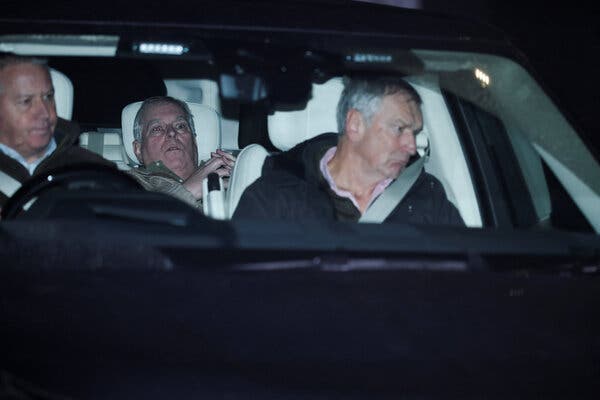

On 19 February 2026, Andrew Mountbatten‑Windsor formerly known as Prince Andrew was arrested on suspicion of misconduct in public office by Thames Valley Police as part of an investigation linked to newly released documents from the US Department of Justice’s Jeffrey Epstein files.
The arrest took place early in the morning at Wood Farm on the Sandringham Estate in Norfolk, where Mountbatten‑Windsor had been living after leaving his longtime home at Royal Lodge. Witnesses reported unmarked police vehicles and plain‑clothes officers arriving at the property shortly after 8 a.m., and officers entered the residence to detain him; he was held for around 11 to 12 hours before being released “under investigation”, meaning he has not been formally charged yet but remains the subject of active police enquiries.
The legal reason for the arrest centres on allegations that, during his decade‑long service as the UK’s special representative for international trade and investment (from 2001 to 2011), he may have shared sensitive government information and confidential reports with Epstein, a convicted sex offender, based on material unearthed in the so‑called Epstein files. Mountbatten‑Windsor has repeatedly denied any wrongdoing related to Epstein and the misconduct claims.
In a development that has intensified global media attention, police carried out searches at multiple properties connected to Mountbatten‑Windsor as part of the investigation.
Officers completed searches at his Wood Farm residence on the Sandringham Estate in Norfolk, which took place alongside his arrest, and continued searching his former home, Royal Lodge, on the Windsor estate in Berkshire, where he had lived for more than two decades before moving.
Thames Valley Police confirmed they were conducting searches at addresses in both Norfolk and Berkshire, reflecting the seriousness of the probe and the need to gather potential evidence from these sites.
The searches in Norfolk were reported to have concluded, but operations at the Royal Lodge were still ongoing as detectives combed through the property linked to Mountbatten‑Windsor’s previous residence.
These coordinated searches have formed a central part of the inquiry into whether confidential information was passed improperly, and they signal a broader effort by UK law enforcement to uncover and assess all relevant material tied to the allegations disclosed in the Epstein files.
The response to these events has been significant both in the United Kingdom and internationally. Domestically, leaders including King Charles III — who was not informed before the arrest was carried out have emphasised the principle that the law must take its course, stating publicly that they will cooperate with authorities investigating the case.
Across the political spectrum, officials have stressed that no individual, regardless of status, should be exempt from legal scrutiny. The international reaction has been intense, with media and commentators framing the incident as unprecedented: it is the first time in modern history that a senior member of the British royal family has been arrested and publicly investigated in this manner, and the details of the searches at his Sandringham and Windsor properties have underscored just how serious and complex the situation has become.
Investigators are continuing to follow leads from the Epstein files and are reviewing evidence from the searches to determine whether further action will be taken.