

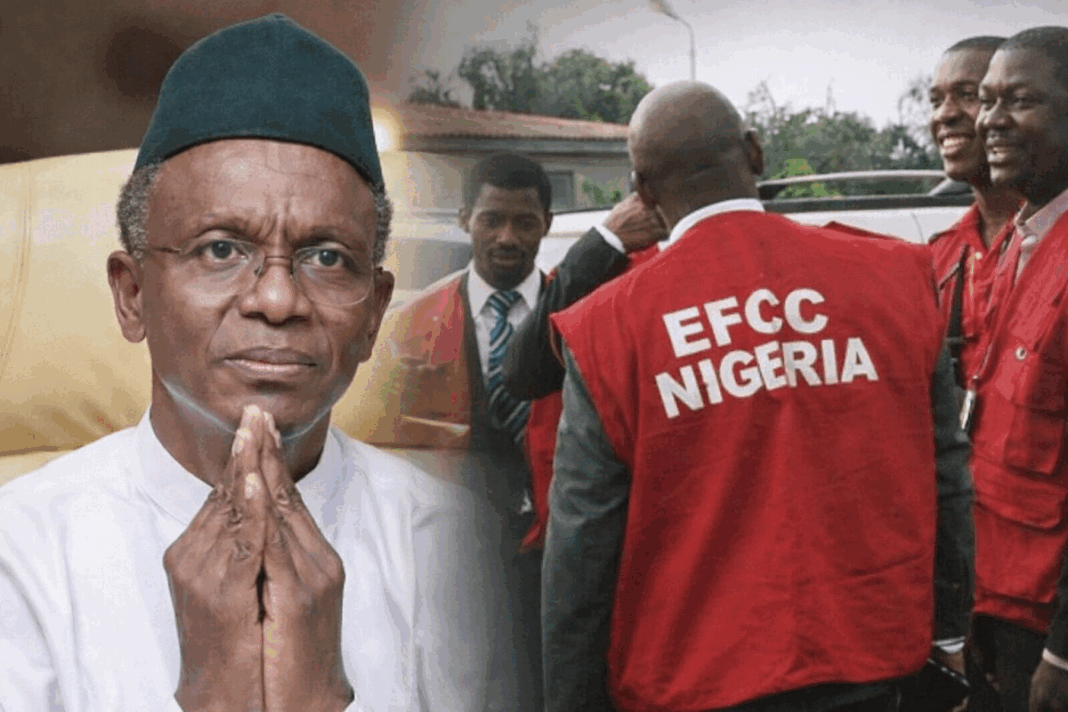

Former Kaduna State governor Nasir El-Rufai was released by the Economic and Financial Crimes Commission (EFCC) on Wednesday after being questioned for two days but was shortly taken into custody by operatives of the Independent Corrupt Practices Commission (ICPC), according to sources who spoke to The PUNCH. The development followed El-Rufai’s detention by the EFCC since Monday over allegations linked to cybercrime-related offences and national security concerns.
EFCC sources confirmed that the former governor was released after responding to questions relating to an ongoing investigation. One source, who spoke on condition of anonymity due to lack of authorisation to speak publicly, said, “El-Rufai was released by the Commission on Wednesday after he had cooperated fully with investigators. However, he was immediately taken away by another security agency.” Efforts to obtain official confirmation from the ICPC were unsuccessful, as repeated calls and messages to its spokesman, John Odey, were not answered as of the time of filing this report.
El-Rufai was said to have arrived at the EFCC headquarters in Abuja at about 10 a.m. on Monday, where he was detained and questioned until Wednesday. His lawyer, A. U. Mustapha, when contacted, declined to confirm or deny reports that his client had been transferred to ICPC custody. “I am not in a position to confirm that information at this moment,” he said. Attempts to reach El-Rufai’s media aide, Muyiwa Adeleye, were unsuccessful, as calls to his mobile phone went unanswered.
The unfolding events have also drawn in the Department of State Services (DSS), which was reported to be present ahead of El-Rufai’s planned arraignment at the Federal High Court in Abuja. Security sources disclosed that the DSS had reopened its investigation into the disappearance of Abubakar Idris, popularly known as Dadiyata, a vocal government critic who went missing in August 2019 in Kaduna State. Dadiyata was reportedly taken from his residence by unidentified persons, and his whereabouts remain unknown more than six years after the incident.
On Monday, the Federal Government filed criminal charges against El-Rufai before the Federal High Court, Abuja, under charge number FHC/ABJ/CR/99/2026. The charges were brought pursuant to provisions of the Cybercrimes (Prohibition, Prevention, etc.) (Amendment) Act 2024 and the Nigerian Communications Act 2003. The charge sheet contains three counts bordering on unlawful interception of communications and unauthorised access to sensitive information.
According to court documents, the first count alleges that El-Rufai knowingly and intentionally intercepted private telephone communications without lawful authority, contrary to relevant sections of the Cybercrimes Amendment Act 2024. The second count accuses him of unlawfully accessing protected communication data, an offence punishable under the same Act. The third count alleges that he made use of information obtained from such interception in a manner deemed prejudicial to national security, contrary to provisions of the Nigerian Communications Act 2003.
The charges are linked to comments El-Rufai allegedly made during an appearance on Prime Time on Arise TV, where he reportedly admitted to listening to intercepted telephone communications involving the National Security Adviser, Nuhu Ribadu. During the programme, El-Rufai was quoted as saying, “I listened to the recordings myself. They were played to me, and I heard the conversations clearly,” a statement now cited by investigators as central to the charges against him.
Separately, DSS actions related to the case include the seizure of El-Rufai’s international passport at Nnamdi Azikiwe International Airport to prevent him from travelling خارج the country, according to security sources. The sources said the move was intended to ensure his availability for ongoing investigations and court proceedings.
Investigations have also reportedly extended to social media posts made by El-Rufai’s sons, Bello El-Rufai and Bashir El-Rufai, particularly comments relating to the disappearance of Dadiyata. A senior security source said, “The posts are part of what we are reviewing. They may be invited to assist investigations if necessary.”
As of Wednesday night, neither the ICPC nor the DSS had issued an official public statement clarifying El-Rufai’s custody status or the scope of their investigations. The former governor has not publicly commented on the allegations since his detention, while legal proceedings are expected to continue at the Federal High Court in Abuja.