

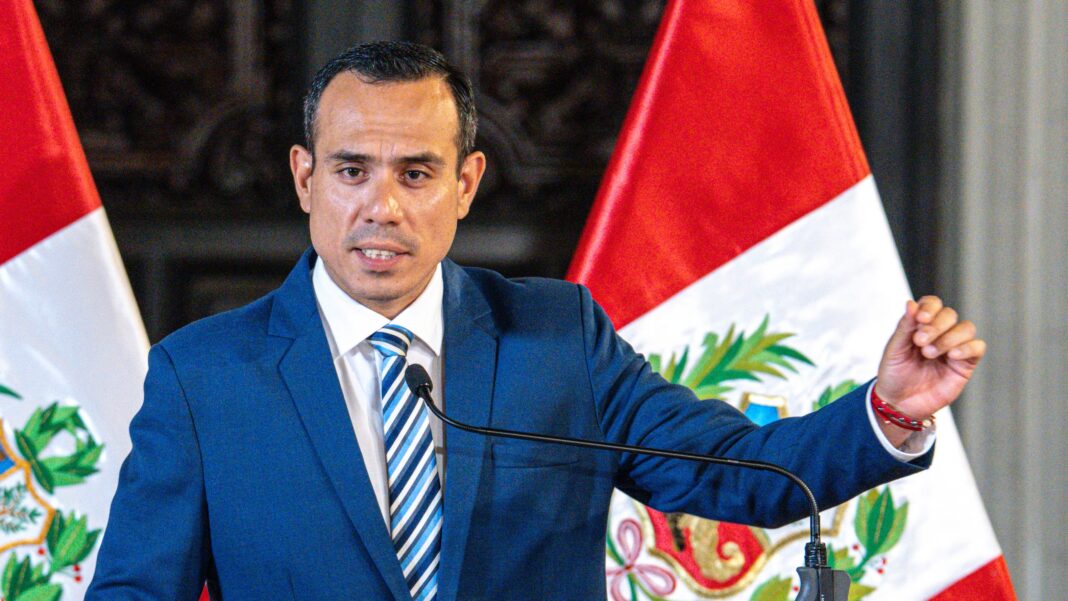

Peru’s Congress on Tuesday voted overwhelmingly to remove President José Jerí from office just four months into his tumultuous term, plunging the Andean nation deeper into a cycle of political instability that has rocked the country for much of the past decade. In a dramatic session in Lima, 75 lawmakers voted in favour of his removal, while 24 opposed and three abstained, marking yet another abrupt end to a presidency amid mounting controversy.
The move to oust Jerí came amid a scandal involving undisclosed late‑night meetings with a Chinese businessman that critics said raised serious questions about transparency and influence. The controversy, which has been widely dubbed “Chifagate” in local media, centres on a video showing Jerí arriving at a restaurant wearing a hood to meet with Zhihua Yang, a Chinese national with business interests and concessions in Peru — a meeting that was never made public.
Unlike impeachment, which under Peru’s constitution requires a supermajority of 87 votes in the 130-member legislature, Congress used a censure vote to strip Jerí of his title as head of Congress — a move that automatically removed him from the presidency given that he assumed the office through the line of succession. This procedural nuance, critics say, highlights legal ambiguities that have enabled rapid leadership turnover.
Jerí becomes the third consecutive Peruvian president to be removed from office, following the impeachments and resignations that have characterised the country’s political landscape in recent years. Lawmakers now face the task of electing a new head of Congress, who will automatically assume the presidency and lead the country into a scheduled general election on April 12.
The speed and frequency of political upheaval in Peru have underscored deep frustrations among voters, many of whom feel that political elites have consistently failed to address core concerns such as rising crime, pervasive corruption, and economic insecurity. Analysts warn that the revolving door of presidential leadership has eroded public trust and weakened institutional authority.
Ruth Luque, one of the lawmakers who backed the censure measures against Jerí, said lawmakers were determined to install leadership that prioritises the public interest and national security ahead of political self‑interest. “We ask to end this agony so we can truly create the transition citizens are hoping for,” she said. “Not a transition with hidden interests, influence‑peddling, secret meetings and hooded figures. We don’t want that sort of transition.”
Luque’s comments reflected widespread frustration with what many Peruvians see as an elite political class more focused on internal power struggles than on governance. Her call for a transition grounded in transparency resonated with citizens weary of chronic instability.
Political analyst Michael Shifter, president of the Washington‑based Inter‑American Dialogue think tank, said the ouster reflects the dominance of political calculation over statesmanship among Peru’s legislators. “It strikes me that there is no trace of high‑mindedness here, only electoral calculations,” Shifter said. “Enough lawmakers concluded their support for Jerí would hurt them in elections, so they had to act.”
Shifter’s analysis points to a broader pattern in Peruvian politics, where legislative actions often seem driven more by short‑term survival instincts than by long‑term institutional reform. The result, critics say, is a cycle in which leaders are installed and removed with dizzying frequency.
The scandal that triggered the latest removal — “Chifagate” — began last month when video footage emerged of Jerí arriving at a Chinese restaurant late at night wearing a hood. The footage showed him meeting Zhihua Yang, who owns several retail stores and holds a concession for a major energy project in Peru, raising questions about conflicts of interest and secret influence.
Jerí’s defenders initially sought to downplay the meeting, but the lack of transparency and late timing fuelled accusations of impropriety. The President had not publicly disclosed the meeting, prompting both public outrage and a loss of confidence among many lawmakers.
Jerí initially came to power in October after the country’s then‑president, Dina Boluarte, was removed by Congress amid growing political turmoil. The right‑wing parties that had backed Boluarte withdrew their support amid corruption allegations and widespread public anger, leaving her without a clear path to continue.
Because Boluarte had no vice president, Jerí — then serving as head of Congress — was next in the line of succession, temporarily assuming the presidency. However, his interim status was used as the legal basis for his removal on Tuesday, once lawmakers moved to censure him.
Jerí has said he will respect the outcome of the Congressional vote, even as many Peruvians expressed dismay over the prolonged political instability. His acceptance of the result may help avoid the kind of street protests that accompanied previous presidential removals in Peru.
Although the current head of Congress, Fernando Rospigliosi, would normally be next in line to assume the presidency, he has declined to do so, leaving lawmakers to elect a new congressional leader on Wednesday. The new leader will automatically become Peru’s president, likely serving only until the April 12 elections.
This succession process mirrors the way Francisco Sagasti became president in 2020, when he was chosen by Congress during a period of intense political crisis following the five‑day presidency of Manuel Merino and nationwide protests. Critics warn that without deeper political reforms, Peru may continue to cycle through short‑lived interim leaders.
Despite the ongoing political turmoil, Peru’s economy has shown resilience. With a mining‑heavy structure that provides a steady source of export revenue, the country recorded 3.4 per cent growth in 2025 and maintained relatively low inflation at 1.7 per cent. Economists say this suggests Peru’s financial markets and production sectors have largely remained insulated from political shocks, even as public trust in political institutions continues to erode.