

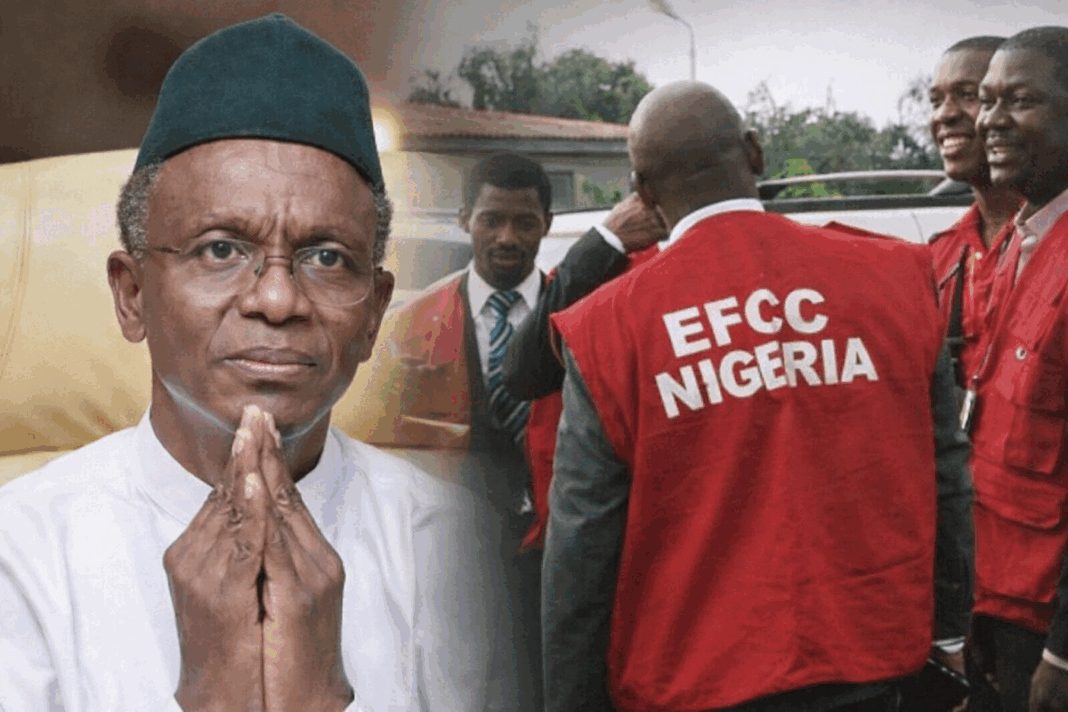

Former Kaduna State Governor Nasir El-Rufai spent a second consecutive night in the custody of the Economic and Financial Crimes Commission (EFCC) on Tuesday, as investigators continued to question him over an alleged N432 billion corruption probe linked to his eight-year tenure in office.
Mr. El-Rufai arrived at the EFCC headquarters in Abuja on Monday around 10 a.m., responding to an invitation by the anti-graft agency.
However, he was detained after initial questioning as investigators sought further clarifications on financial transactions and administrative decisions made during his administration.
An official of the EFCC, who spoke on condition of anonymity, confirmed the former governor remained in custody and suggested that the commission might seek a remand order to extend his stay beyond the 48 hours allowed by law.
“Forget the speculations being peddled on social media that he has been released. He has not. El-Rufai is still with us and will be spending another night in custody,” the source said. The official added that the extension would allow investigators to conclude their questioning fully, noting, “The investigators need some time with him to answer questions arising from his eight years as governor in Kaduna State.”
Speaking in a telephone interview with journalists on Tuesday, El-Rufai’s lawyer, A.U. Mustapha (SAN), confirmed that his client remained with the anti-graft agency while emphasizing his cooperation.
He said, “Well, as a responsible citizen, he was invited and, true to his word, he honoured the invitation. As we speak, he is still with the EFCC. He is cooperating to the best of his capacity, and we hope that the EFCC, given its integrity, will be kind enough to admit him to bail because he is presumed innocent, and I am sure if he is granted bail, he will not jump bail.”
Mustapha described his client as a law-abiding citizen, insisting that El-Rufai posed no flight risk. “He is a responsible citizen, and everybody knows him. He came to Nigeria on his own volition. He wrote a letter that he was going to honour the EFCC invitation, and he kept his word as a man of integrity. We’re hopeful that very soon he will be granted bail,” Mustapha added.
On questions about the specific allegations, the lawyer declined to provide details, stating, “You’re asking the right question from the wrong person. That question can only be answered by the EFCC and not by me. I would just be speculating, and lawyers don’t do that.”
Pressed further about whether he had witnessed parts of the interrogation, Mustapha replied, “That would be prejudicial. It’s a confidential matter and not meant for public consumption,” underscoring the sensitivity of the ongoing investigation and the confidential nature of EFCC proceedings.
The investigation against El-Rufai stems from a 2024 report by an ad hoc committee of the Kaduna State House of Assembly, which examined finances, loans, and contracts awarded between 2015 and 2023. The committee, chaired by Henry Zacharia, alleged that several loans obtained during El-Rufai’s administration were not utilized for their intended purposes.
Speaker Yusuf Dahiru Leman, presenting the report, claimed that about N423 billion had allegedly been siphoned under the former governor’s administration.
The Assembly recommended the investigation and prosecution of El-Rufai and some former cabinet members over alleged abuse of office, diversion of public funds, money laundering, irregular contract awards, and reckless borrowing.
Petitions were subsequently forwarded to both the EFCC and the Independent Corrupt Practices and Other Related Offences Commission (ICPC).
El-Rufai has consistently denied the allegations, describing the probe as politically motivated. In a statement prior to his appearance, he insisted that loans obtained during his tenure were properly appropriated for projects in infrastructure, education, healthcare, and security, stressing that all public funds were accounted for and spent according to the state’s development agenda.
The current EFCC interrogation is part of an investigation that the commission has been conducting for nearly a year. A source at the EFCC said, “The commission has been investigating him for about a year now. As a commission, we don’t just rush to invite suspects. Persons accused are always the last; that is, after we might have done our investigation to an advanced stage. We are investigating him on the allegations against him by the Kaduna State Assembly.”
In a separate development, the Department of State Services (DSS) filed criminal charges against El-Rufai before the Federal High Court, Abuja, over alleged unlawful interception of the phone communications of the National Security Adviser, Nuhu Ribadu.
The three-count charge, marked FHC/ABJ/CR/99/2026, was filed under the Cybercrimes (Prohibition, Prevention, etc.) Amendment Act, 2024, and the Nigerian Communications Act, 2003.
The first count alleges that El-Rufai “did admit during the interview that you and your cohorts unlawfully intercepted the phone communications of the National Security Adviser, Nuhu Ribadu,” an offence punishable under Section 12(1) of the Cybercrimes Amendment Act.
The second count accuses him of being aware of the alleged interception and failing to report it to security agencies, while the third count alleges the use of technical equipment that compromised public safety and national security. The prosecution noted that the alleged acts caused “reasonable apprehension of insecurity among Nigerians.”
El-Rufai is yet to be arraigned in the Federal High Court, and his lawyer has not commented on the DSS charges, focusing instead on the ongoing EFCC investigation. Legal experts note that the combination of both probes — one for alleged financial misconduct and the other for cybercrimes places the former governor under intense judicial scrutiny.
Observers say the case highlights growing public demand for accountability among former and current public officials in Nigeria, as well as the EFCC’s commitment to pursuing complex corruption allegations that span multiple administrations and sectors.
Despite the legal challenges, Mustapha insisted that El-Rufai’s cooperation and voluntary attendance at EFCC proceedings demonstrate his respect for due process. “As we speak, he is still cooperating to the best of his capacity,” he said, reiterating that his client had honored all invitations from the EFCC in good faith.
Sources within the EFCC confirmed that investigators are meticulously reviewing loans, contracts, and expenditures during El-Rufai’s tenure, focusing on documentation, approvals, and the use of public funds.
They said the agency will decide whether to seek a remand order to allow further questioning after the expiration of the statutory 48-hour limit.
As of Tuesday evening, El-Rufai remained in EFCC custody at its Abuja headquarters, with speculation on social media about his release being dismissed by the agency.
“He is very much with us and will remain so because the investigators are considering getting a remand order after the expiration of the 48 hours allowed by law,” an EFCC source reiterated. Investigations are expected to continue until the commission is satisfied that all relevant questions have been addressed.