


The decision taken on Tuesday by the National Assembly to approve the electronic transmission of election results, while simultaneously preserving manual collation as a fallback option, sparked intense controversy that quickly spilled beyond routine parliamentary disagreement.
What was initially framed as a technical adjustment to the Electoral Act Amendment Bill escalated into open confrontation, as opposition lawmakers protested the move, staged walkouts, and engaged in prolonged, heated exchanges on the floors of both chambers.
The uproar underscored how deeply sensitive electoral reforms have become as Nigeria inches closer to the 2027 general elections, with many legislators viewing the issue not merely as procedural, but as central to the credibility of the democratic process.
Rather than proceeding smoothly, the sitting of the 10th Assembly evolved into one of its most dramatic and polarising moments, laying bare entrenched partisan divisions. Lawmakers who opposed the amendments argued that the changes went beyond clarification and amounted to a fundamental weakening of hard-won electoral safeguards.
Supporters, on the other hand, insisted that the provisions were pragmatic and necessary to address technological failures that could arise on election day. The clash revealed an atmosphere of mistrust, with both sides accusing each other of ulterior political motives as debates grew increasingly charged.
In the Senate, opposition crystallised around a contentious proviso inserted into Clause 60(3) of the bill. At least 15 senators, led by Enyinnaya Abaribe of the African Democratic Congress, openly resisted the clause, which recognises the manually completed Form EC8A as the primary reference point for result collation in instances where electronic transmission fails. The senators argued that elevating manual records in this way risked reopening the door to manipulation and post-election disputes that electronic transmission was designed to eliminate.
Tensions were equally high in the House of Representatives, where members of the minority caucus staged a dramatic walkout. They accused Speaker Tajudeen Abbas of forcing through amendments without adequate consensus and deliberately frustrating efforts to enshrine mandatory real-time electronic transmission without exceptions.
According to the dissenting lawmakers, retaining manual collation as a backup effectively diluted the spirit of electoral reform and undermined public confidence in the legislative process.
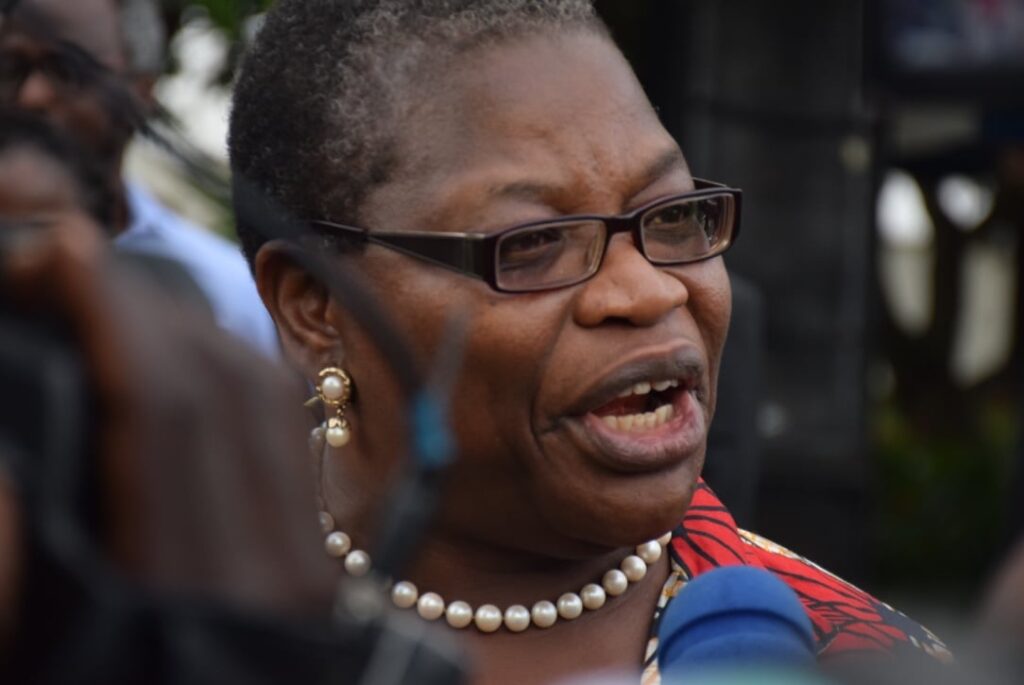
The controversy soon moved beyond the chambers of parliament, as demonstrators gathered outside the National Assembly complex to voice their opposition. Among them was former Minister of Education Oby Ezekwesili, who joined protesters in accusing lawmakers of attempting to weaken the electoral framework under the guise of flexibility.
By the end of the day, both chambers had passed versions of the bill that maintain the electronic upload of polling unit results to the electoral commission’s portal, yet stopped short of making real-time transmission compulsory in all circumstances.
At the core of the dispute lies a recurring national question: whether technology alone can be fully trusted to protect Nigeria’s democracy, or whether reliance on manual processes despite their vulnerabilities remains an unavoidable compromise.
Tempers flare as senators clash over election results clause
From the moment plenary began on Tuesday, the atmosphere in the Senate was tense and uneasy, with lawmakers clearly divided over the fate of the Electoral Act (Repeal and Re-Enactment) Bill, 2026. The chamber had earlier passed the bill but was forced to reverse itself and recommit it to the Committee of the Whole after lawmakers discovered discrepancies in several sections. Some of the affected clauses touched directly on timelines for the 2027 general elections that had already been announced by the Independent National Electoral Commission, raising fears that inconsistencies in the law could create legal confusion ahead of the polls.
As debates resumed, it became clear that Clause 60 of the bill, which deals with the transmission and collation of election results, was the most explosive issue before the chamber. The controversy centred on subsection (3), which was eventually reenacted in a form that many opposition lawmakers considered dangerous.
The clause states: “The Presiding Officer shall electronically transmit the results from each polling unit to the IREV portal, and such transmission shall be done after the prescribed Form EC8A has been signed and stamped by the Presiding Officer and/or countersigned by the candidates or polling agents where available, provided that if electronic transmission fails due to communication failure, Form EC8A shall remain the primary source of collation and declaration of the result.”
The debate took a dramatic turn when Senator Enyinnaya Abaribe demanded a division on the clause, insisting that every senator must publicly state where they stood. The Abia South lawmaker reminded his colleagues that transparency required lawmakers to be on record, especially on an issue as sensitive as election results.
This was not Abaribe’s first attempt; he had made a similar demand during an emergency plenary the previous week but later withdrew it under pressure, a decision that had attracted criticism within and outside the chamber.
His renewed insistence immediately triggered disorder, with raised voices and angry exchanges across the aisle. Senate Leader Opeyemi Bamidele stepped in to calm nerves, arguing that the request was legitimate regardless of past events. He told the chamber, “Whether he has done it or not is now in the past. But it is within his (Abaribe) rights to call for it. Let us allow him.” Bamidele’s intervention briefly restored order, but the calm did not last.
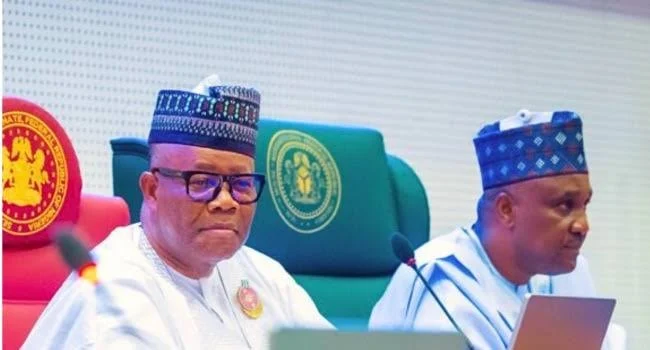
Senate President Godswill Akpabio then reminded lawmakers of Abaribe’s earlier withdrawal, a comment that many opposition senators interpreted as dismissive. “People were mocking you on social media,” Akpabio said, referring to the aborted attempt during the previous sitting. The remark immediately provoked protests from opposition lawmakers, who argued that the matter before the Senate was valid and should not be trivialised.
As the disagreement deepened, Deputy Senate President Barau Jibrin cited Order 52(6) of the Senate Standing Orders, arguing that it would be improper to revisit a provision that had already been ruled upon by the presiding officer. That position sparked fresh uproar, with lawmakers shouting across the chamber. Senator Sunday Karimi was briefly seen confronting Abaribe across the aisle as tensions boiled over and the session threatened to spiral out of control.
Bamidele again rose to argue that the procedural objections were misplaced, stressing that once a motion for rescission had been adopted, all earlier decisions were nullified. According to him, this made Abaribe’s demand for a division procedurally sound. Each time Akpabio returned to the issue of Abaribe’s earlier withdrawal—sometimes in a tone opposition senators described as mocking—he was shouted down, forcing repeated calls for order.
Eventually, the Senate President put the matter to a vote. In a dramatic moment, 55 senators from the ruling All Progressives Congress and a handful of opposition lawmakers rose in support of retaining the manual backup proviso. Among them were Deputy Minority Leader Lere Oyewunmi, Wadada Aliyu of the Social Democratic Party, and Amos Yohanna of the Peoples Democratic Party. When those opposed were asked to stand, only Abaribe and 14 others rose, sealing the outcome as the “ayes” carried the day.
For the second time in two weeks, the Senate approved a framework that allows electronic transmission of results but retains manual collation as a fallback. Under the amended proviso, the manually completed and signed Form EC8A becomes the primary basis for collation and declaration of results whenever electronic transmission is disrupted by network or communication challenges. In practical terms, results will still be uploaded to the IReV portal, but where technology fails, the signed paper result will prevail.
House leadership under pressure as lawmakers push back
Away from the Senate chamber, new details emerged about the intense negotiations that took place behind closed doors in the House of Representatives. Several lawmakers were reportedly unhappy over what they described as poor funding of capital components in the 2024 and 2025 budgets. According to a member who spoke to The PUNCH, Speaker Tajudeen Abbas personally appealed to aggrieved legislators to allow consideration of the Electoral Act amendments despite their frustrations.
“The speaker begged relentlessly for members to allow for Electoral Act consideration,” the lawmaker said. “Members later agreed with the agreement to shut down any subsequent consideration on resumption of plenary on February 24, unless the budgets are funded. Initially, members didn’t want to consider anything today (Tuesday).” While the compromise prevented an outright boycott, it did not stop the rebellion that later played out during plenary, as minority lawmakers staged a walkout in protest.
With a conference committee already constituted to reconcile differences between the versions passed by both chambers, the bill has now moved into the harmonisation stage before transmission to the President. However, the backlash following its passage has continued to reverberate. House spokesman Akin Rotimi defended the process, insisting that consultations had taken place and that the outcome reflected legislative consensus. He said, “The House leadership consulted extensively, which formed the basis of a lot of the provisions that you saw earlier today (Tuesday). When you have a conference committee, it only considers the provisions in either the Senate or the House.”
Rotimi also argued that flexibility was necessary to accommodate the realities faced by INEC, noting, “INEC acted within the provisions of the extant law. But you need to be able to walk around those provisions to allow for more flexibility for INEC to be able to fix the timetable while keeping with the provisions of the law.” He dismissed the chaotic scenes as part of the democratic process, adding that “the majority carries the day.” Yet, the images of senators standing in defiance, opposition lawmakers chanting before walking out, and protesters gathering outside the National Assembly gates suggested a deeper crisis of trust over how Nigeria safeguards its elections.
Senate revisits election law ahead of 2027 polls
Before the dramatic division that later split the chamber, the Senate had first taken steps to reverse its earlier approval of the Electoral Act (Repeal and Re-Enactment) Bill, 2026. Rising under Order 52(6), Senate Leader Opeyemi Bamidele moved a motion asking that the bill be rescinded and recommitted for fresh consideration. He explained that the decision by the Independent National Electoral Commission to fix the 2027 general elections for February 2027 had raised new concerns among lawmakers and stakeholders.
According to senators, the proposed election date appeared to conflict with Clause 28 of the bill, which required elections to be scheduled at least 360 days before the expiration of tenure. In addition, lawmakers expressed worries that holding elections in February 2027 could coincide with the Ramadan fast, potentially affecting voter turnout and election logistics in parts of the country. After debating the issue, the Senate amended Clause 28, reducing the mandatory notice period from 360 days to 300 days.
With the amendment, INEC is now required to publish notice of elections not later than 300 days before polling day. Senators said the 60-day reduction would give the electoral body more flexibility to schedule presidential and National Assembly elections between late December 2026 and January 2027, while also taking religious sensitivities and operational realities into account. The motion further corrected inconsistencies in the bill’s Long Title and several clauses, including Clauses 6, 9, 10, 22, 23, 28, 29, 32, 42, 47, 51, 60, 62, 64, 65, 73, 77, 86, 87, 89, 93 and 143.
Akpabio praises dissent as democracy at work
After the heated vote on Clause 60, Senate President Godswill Akpabio struck a calmer and conciliatory tone, praising both the majority and minority blocs for their roles in the process. He said the senators who opposed the clause showed courage by standing their ground despite being outnumbered, describing their actions as proof that democracy was functioning within the chamber.
He told his colleagues, “Let me thank distinguished senators for their act of patriotism and display of democracy, particularly by those who had the courage even in the face of an overwhelming majority to stand up and to answer your father’s name by showing so much courage to vote against a proviso in 60 (3).” Akpabio added, “Your minority status notwithstanding, you showed overwhelming courage. You were able to prove that democracy works.”
At the same time, the Senate President commended lawmakers who supported retaining the manual backup provision, arguing that their votes would help prevent endless reruns of elections. “I also want to thank those who voted for the proviso to remain, as you have saved democracy by making sure that we don’t go on continuous reruns and repeats of elections by ensuring that the primary mode of election results is the form EC8A,” he said.
Akpabio also highlighted the significance of introducing electronic transmission of polling unit results to the IReV portal, describing it as a historic step since Nigeria’s independence in 1960. According to him, “I want to also thank the Senate for introducing electronic transmission of polling unit results through the portal to the IReV, which will now make it possible for election monitors, including foreigners, who monitor our results, who are not able to visit the 176,000 plus polling units in Nigeria, to see the polling unit results dropping into the IReV.”
He stressed that elections are decided at polling units rather than collation centres, explaining why the Senate insisted on properly completed and signed polling unit results as the foundation of the process. “This is a major innovation since 1960, which is still a stance to be applauded,” he said. “Elections are not done at the collation centres. That is why you insisted that the polling unit results filled by presiding officers and co-signed by the polling clerk as well as agents of candidates and political parties, where available, remain the primary mode of collation of all results in Nigeria.” However, Akpabio did not clarify whether the earlier announced February 20, 2027 presidential election date would be formally shifted.
House erupts as minority stages walkout
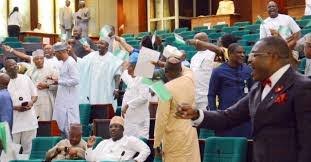
If the Senate session was intense, proceedings in the House of Representatives were equally dramatic. Chaos broke out when Francis Waive moved a motion to rescind the Electoral Act (Amendment) Bill, 2025. Explaining the motion, Waive said a technical committee made up of leaders of both chambers, members of the conference committee, clerks of the National Assembly and legal experts had met to address anomalies in the bill.
He told lawmakers, “The House is aware that a Technical Committee comprising the leadership of both chambers, members of the Conference Committee, the Clerks of the Senate and the House of Representatives and legal drafting experts from the Directorate of Legal Services of the National Assembly, met to harmonise and address the identified anomalies.” He added, “Desirous of correcting the identified inconsistencies and unintended consequences through appropriate legislative action in order to safeguard the integrity of the Electoral framework; the House resolved to rescind the decision on the Electoral Act (Amendment) Bill, 2025, and recommit the same to the Committee of the Whole for consideration.”
When Speaker Tajudeen Abbas called for a voice vote, loud “nay” responses filled the chamber, but he ruled in favour of the “ayes,” triggering anger from opposition lawmakers. As shouting intensified, the House went into an executive session. When plenary resumed, Deputy Speaker Benjamin Kalu attempted to proceed clause by clause, but opposition members protested loudly, chanting slogans and demanding that the Speaker personally take over proceedings.
Moments later, Minority Leader Kingsley Chinda led opposition lawmakers out of the chamber. Speaking to journalists afterward, Chinda said, “As a caucus, we want to clearly register our position and protect it, with particular reference to Section 60 (3), which has to do with electronic transmission.” He added, “Our position is that elections shall and should be transmitted electronically. We are against any clause that will give room for any legislation, rigging or leeway for any untoward act.”
Chinda said the minority had proposed that electronic transmission should remain mandatory and unconditional. “We have asked that the clause should remain solely for electronic transmission without any condition,” he said. “We have also proposed where there is a conflict between the form EC8A, which is capable of being manipulated, and the electronically transmitted result, the electronically transmitted result should prevail.” He accused ruling party lawmakers of rejecting the amendments for partisan reasons, saying, “These positions were turned down… not on grounds of patriotism, but on grounds of political party affiliation.
Dispute over party primaries and street protests
Another contentious issue was Section 84 of the bill, which recognises only direct primaries and consensus, effectively removing indirect primaries. Chinda objected strongly, arguing that political parties should be free to choose their internal nomination processes. “Our position remains that methods of selection of candidates should be the internal affairs of political parties,” he said. “Political party should be allowed to determine what method they want to adopt… whether it is direct, indirect primaries or consensus.”
Outside the National Assembly complex, protests continued as civil society activists joined demonstrators. Former education minister Oby Ezekwesili was among those who addressed the crowd. She said, “I have been particularly loud in stating that if the Senate gets away with a provision that is ambiguous, that gives power of discretion to determine the ifs and the buts, instead of making the clause mandatory; that every vote must count in this country.”
Ezekwesili warned that anything short of mandatory, real-time electronic transmission would undermine transparency. “The only reason they don’t want transparency through the mandatory provision for there to be instant, real-time, electronic transmission of the results is because they want to continue to capture our democracy,” she said.
She added, “The society is labouring under the weight of poor governance that we have seen so far in our democracy. And so we as citizens are saying, stop any coup against this democracy. Stop it.”