

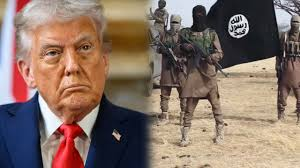

The United States has frozen the assets and properties of eight Nigerians accused of having links to Boko Haram and the Islamic State of Iraq and the Levant (ISIL), in a move underscoring Washington’s continuing focus on counterterrorism and cyber threats. The announcement was contained in a 3,000-page document released by the US Treasury’s Office of Foreign Assets Control (OFAC) on February 10, 2026, and sighted on Monday, February 16, 2026. The document also identified individuals sanctioned for cybercrime-related offenses and other security threats.
According to the OFAC report, the Nigerians listed include Salih Yusuf Adamu, Babestan Oluwole Ademulero, Abu Abdullah ibn Umar Al-Barnawi, Abu Musab Al-Barnawi, Khaled (or Khalid) Al-Barnawi, Abu Bakr ibn Muhammad ibn Ali Al-Mainuki, Nnamdi Orson Benson, and Ibrahim Ali Alhassan.
Several of the individuals have multiple aliases and varying birth dates recorded in official records. Salih Yusuf Adamu, also known as Salihu Yusuf and born on August 23, 1990, in Nigeria, was among six Nigerians convicted in 2022 in the United Arab Emirates for setting up a Boko Haram cell to raise funds for insurgents in Nigeria. The men were convicted for attempting to send $782,000 from Dubai to Nigeria to support Boko Haram operations.
Other sanctioned individuals include Abu Abdullah ibn Umar Al-Barnawi, known as Ba Idrisa, reportedly born between 1989 and 1994 in Maiduguri, Borno State, and flagged under terrorism-related sanctions. Abu Musab Al-Barnawi, also called Habib Yusuf, was listed with birth years ranging between 1990 and 1995 and identified as a Boko Haram leader. Khaled or Khalid Al-Barnawi, born in 1976 in Maiduguri, Nigeria, appeared twice in the OFAC publication under aliases including Abu Hafsat and Mohammed Usman, also linked to Boko Haram.
Abu Bakr ibn Muhammad ibn Ali Al-Mainuki, known as Abu-Bilal Al-Minuki, born in 1982 in Mainok, Borno State, was identified as having ties to ISIL. Ibrahim Ali Alhassan, born January 31, 1981, reportedly resides in Abu Dhabi, UAE, while Nnamdi Orson Benson, born March 21, 1987, was sanctioned under cybercrime-related provisions (CYBER2).
The sanctions follow recommendations by the US Congress for visa bans and asset freezes on persons and groups accused of violating religious freedom and persecuting Christians in Nigeria. Among those cited by lawmakers for potential US sanctions were former Kano State Governor Dr Rabiu Kwankwaso, the Miyetti Allah Cattle Breeders Association of Nigeria, and the Miyetti Allah Kautal Hore. These recommendations reflect longstanding US concerns about religious freedoms and human rights in the country.
The OFAC document, titled “Specifically Designated Nationals and Blocked Persons List,” serves as a formal reference tool providing notice of blocked property and interests. The agency noted in its statement,
“This publication of Treasury’s Office of Foreign Assets Control is designed as a reference tool providing actual notice of actions by OFAC with respect to Specially Designated Nationals and other persons (which term includes both individuals and entities) whose property is blocked, to assist the public in complying with the various sanctions programmes administered by OFAC.”
Under the sanctions, all property and interests of the listed individuals within US jurisdiction are blocked, and US persons are generally prohibited from engaging in transactions with them. The measures are enforced under Executive Order 13224, a counterterrorism instrument that targets individuals and entities associated with terrorist organizations, including those involved in funding, supporting, or facilitating attacks. Officials noted that the move underscores Washington’s commitment to countering terrorism financing, cyber threats, and transnational security risks.
Boko Haram, the militant group at the center of the sanctions, was officially designated a foreign terrorist organization by the US in 2013. The group has been responsible for numerous attacks in Nigeria’s northern and northeastern regions, as well as in the Lake Chad Basin, including Cameroon, Chad, and Niger, killing thousands since 2009. According to the US State Department, countries that repeatedly provide support for acts of international terrorism are designated under Section 1754(c) of the National Defense Authorization Act (2019), Section 40 of the Arms Export Control Act, and Section 620A of the Foreign Assistance Act of 1961.
In October 2025, US President Donald Trump announced that Nigeria would be added to the Department of State’s list of “Countries of Particular Concern”, citing alleged persecution of Christians and violations of religious freedom. Trump stated on X that the designation reflected the administration’s concerns that “Christians were facing persecution and being killed by Muslims” in parts of northern Nigeria. Nigeria had previously been placed on the same watchlist in 2020, but former President Joe Biden removed the country from the list shortly after taking office.
Analysts say the sanctions carry significant implications for both the individuals involved and Nigeria’s international relations. Freezing assets abroad, blocking property, and prohibiting transactions with US entities could hinder the financial operations of those linked to Boko Haram and ISIL, while also reinforcing US counterterrorism and human rights policies. Experts also suggest that the sanctions send a diplomatic signal about Washington’s expectations regarding religious tolerance, rule of law, and counterterrorism cooperation.
OFAC officials highlighted that the publication of the SDN list is not punitive in isolation but is designed to provide legal clarity and ensure that both US and international financial institutions can comply with sanctions rules. A senior OFAC official explained,
“These measures provide actual notice to the public and financial institutions to ensure that transactions and interactions with designated individuals are prohibited. It is part of a broader strategy to limit the operational capacity of terrorists and those engaged in cyber threats.”
The inclusion of Nigerians with known ties to Boko Haram and ISIL also aligns with US efforts to curtail the transnational reach of extremist groups. Several of the listed individuals, including Yusuf Adamu and the Al-Barnawi family members, have histories of attempting to raise funds, recruit operatives, or conduct attacks across borders, illustrating the international dimension of Nigeria’s security challenges.
The US move further underscores Washington’s ongoing focus on cybersecurity threats, with figures such as Nnamdi Orson Benson sanctioned under the CYBER2 provisions, highlighting the intersection of terrorism and digital crimes. OFAC noted that the sanctions cover not only property and assets but also prevent US persons from engaging in financial, contractual, or technological transactions with the designated individuals.
Legal scholars observe that the sanctions, coupled with Nigeria’s designation under the US religious freedom framework, may have financial, political, and diplomatic ripple effects, potentially affecting bilateral aid, cooperation in security operations, and global perceptions of Nigeria’s internal governance and security posture.
While the sanctions are targeted, they are also part of a broader narrative of US commitment to human rights and counterterrorism, signaling to domestic and international audiences that financial accountability and security compliance are non-negotiable. In doing so, the United States continues to employ economic tools alongside diplomatic engagement to influence policy outcomes in conflict-prone regions.
Officials emphasized that the OFAC list is dynamic, subject to updates, and intended to provide transparency for compliance purposes. The Treasury Department reinforced that,
“All US persons are expected to comply fully with the sanctions and exercise due diligence to ensure they do not engage in prohibited dealings with any Specially Designated Nationals or blocked entities. These actions are part of a comprehensive approach to promote international security and counter threats that endanger US citizens and global peace.”
As Nigeria continues to grapple with Boko Haram insurgency, ISIL-affiliated activities, and domestic religious tensions, the OFAC sanctions add an international layer of accountability. Analysts note that financial restrictions combined with law enforcement cooperation could limit the operational capacity of militant networks, while also signaling to policymakers in Nigeria the importance of addressing systemic security challenges.