


By 2026, Nigeria is already campaigning, even though the presidential election is still a year away.
Unlike previous election cycles that typically heat up only months before voting, the 2027 race has effectively started early. But this time, it is not politicians driving the momentum.
It is citizens.
Across X (Twitter), TikTok, WhatsApp groups, and street demonstrations, Nigerians have begun treating the 2027 election less like a political event and more like a national survival referendum. At the center of this movement lies one issue: electoral reform, particularly the battle over real-time electronic transmission of election results.
What began as a legislative debate inside the National Assembly has evolved into protests, accusations of intimidation, and a widening conflict involving the African Democratic Congress (ADC), opposition figures, civil society, and the federal government.
The Law That Sparked the Fire
The immediate trigger was the proposed amendment to Nigeria’s Electoral Act.
For years, Nigerians have complained that elections are not necessarily lost at the polling unit — they are lost during collation. After votes are counted locally, results are transported manually to collation centers, where allegations of manipulation frequently emerge.
Civil society groups therefore pushed for a simple reform: upload results electronically in real time from polling units.
When the Senate initially resisted mandatory electronic transmission, outrage followed.
Pro-democracy activists, lawyers, and labor unions warned that manual collation encourages manipulation and erodes public trust.
The backlash was immediate.
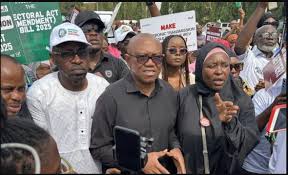
Youth activists mobilized protests outside the National Assembly, demanding restoration of electronic transmission provisions.
Even political figures joined.
Former Anambra governor Peter Obi appeared with protesters during the demonstrations urging lawmakers to reverse their position.
The protests — tagged #OccupyNASS — quickly spread across social media.
Why Social Media Became the Real Opposition
What makes 2027 different from past elections is that political agitation is no longer party-driven.
It is network-driven.
Nigerian political movements once required rallies and party structures. Today, a hashtag can mobilize thousands overnight. Online discussions turned the Electoral Act debate into a national cause, with many users framing it as a struggle between citizens and the political elite.
On Nigerian online forums, users described the rejection of electronic transmission as “undermining electoral transparency” and called for protests rather than petitions.
The conversation echoes the earlier #EndSARS protests of 2020. The same digital infrastructure — influencers, online fundraising, and decentralized organization — is now being repurposed for electoral accountability.
This explains why politicians are increasingly worried about social media: it has become an independent political force.
Enter the ADC — And the Allegations
The African Democratic Congress (ADC) unexpectedly became central to the crisis.
Opposition leaders began aligning around the party as a potential coalition platform ahead of 2027.
Soon after, the party alleged political pressure.
ADC leaders claimed their members were being targeted and that actions by authorities were intended to weaken the opposition coalition.
The party also accused the National Assembly of delaying electoral reforms in ways that could disadvantage opposition parties and undermine election credibility.
Even earlier, the party complained of attacks against its members and gatherings.
This is where social media intensified the situation: online discussions quickly interpreted the developments as a “hunt” or suppression of opposition figures — whether fully accurate or not, the perception itself became politically powerful.
In modern politics, perception can be more consequential than official statements.
Why the Reform Matters So Much
Nigeria’s elections historically suffer from three recurring problems:
- Vote-buying
- Violence
- Result manipulation during collation
Reform advocates argue electronic transmission addresses the third — the most decisive stage.
Analysts note courts increasingly determine election outcomes because disputes over results are so common.
That is why labor unions even warned of nationwide action or possible election boycotts if reforms were blocked.
In simple terms:
Many Nigerians no longer believe the problem is voting —
they believe the problem is counting.
A Generational Political Shift
Nigeria is witnessing a structural political change.
Historically:
- 1999–2015 → Party-driven politics
- 2015–2023 → Personality-driven politics
- 2027 → Citizen-driven politics (emerging)
Young voters now see electoral reform as more important than party loyalty. The election debate has shifted from who should win to whether the system itself is trustworthy.
This is why protests about a law — not a candidate — have become the biggest political movement in the country.
The Danger Ahead
The situation carries risks.
If citizens believe the process is unfair, two outcomes are possible:
Apathy: people stop voting
Agitation: people stop trusting the state
Neither is healthy for democracy.
The Senate eventually moved to support real-time transmission after public pressure, showing the protests already influenced policymaking.
But the tension remains.
Because the real battle is not just about uploading results.
It is about legitimacy.
What 2027 Is Really About
The 2027 election is shaping up to be more than a contest for the presidency.
It is becoming a referendum on Nigeria’s democratic credibility.
The protests, social media activism, and the controversies involving ADC officials all point to one underlying issue:
Nigerians are no longer simply asking who should govern them.
They are asking:
Can they trust the process that chooses their government?
And unless that question is convincingly answered, 2027 may be remembered not just as an election year — but as the year Nigeria renegotiated the meaning of democracy itself.