

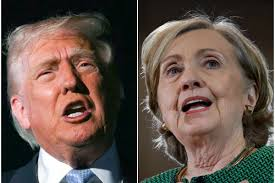

Former US Secretary of State Hillary Clinton has accused the administration of President Donald Trump of engaging in a “cover-up” over its handling of files linked to the late sex offender Jeffrey Epstein, alleging that authorities are deliberately delaying full disclosure of the records.
Speaking in an interview with BBC in Berlin, where she attended the annual World Forum, Clinton said the American public deserved complete transparency, insisting that the remaining files should be released without further delay. “Get the files out. They are slow-walking it,” she said, framing the issue as one of public trust, accountability, and justice for victims. Her comments immediately reignited political tensions surrounding the long-running Epstein controversy, which continues to implicate powerful figures across the political and social spectrum.
The White House swiftly rejected Clinton’s accusation, defending the administration’s handling of the Epstein documents and insisting that it had acted more decisively than previous Democratic administrations. In a statement, officials said that by releasing thousands of pages of material, cooperating with congressional subpoenas, and backing further investigations, the Trump administration had “done more for the victims than Democrats ever have.”
The response underscored how the Epstein files have become a deeply politicised issue, with both parties accusing each other of obstruction or exploitation, even as survivors and advocacy groups continue to press for clarity over who enabled Epstein’s crimes and how institutions failed to stop him.
Earlier this month, the US Department of Justice announced the release of millions of pages of records related to Epstein, following the passage of a law by Congress compelling disclosure of investigative material. However, the release was incomplete. The deputy attorney general disclosed that roughly three million pages were withheld, citing the presence of sensitive personal medical information, graphic depictions of child sexual abuse, and material that could compromise ongoing or future investigations. That explanation has done little to quell criticism on Capitol Hill, where lawmakers from both parties argue that the scale of redactions and omissions undermines the spirit of transparency promised by the new law.
Among the most vocal critics is Kentucky Republican Representative Thomas Massie, a co-sponsor of the legislation that mandated the release. Massie has argued that the Justice Department should go further by publishing internal memoranda that explain past prosecutorial decisions, including why Epstein and some of his associates were not charged earlier or more aggressively. According to Massie, without those internal deliberations, the public cannot fully understand whether justice was delayed, denied, or influenced by political considerations.
The controversy has also expanded into a dispute over testimony before a congressional oversight committee examining the Epstein files. Clinton told the BBC that “everybody should testify who is asked to testify,” a remark that has been interpreted as support for broader accountability, regardless of status or nationality.
The files reference several high-profile figures, including Britain’s Andrew Mountbatten-Windsor, though officials and legal experts have repeatedly stressed that appearing in the documents does not in itself indicate wrongdoing. Andrew has consistently denied any misconduct and previously reached an out-of-court settlement with his accuser without admitting liability. While the committee lacks the authority to compel him to testify, US lawmakers and victims’ advocates have continued to call for his cooperation.
Closer to home, the oversight committee has focused significant attention on the Clintons themselves. Bill and Hillary Clinton agreed last month to testify after initial resistance prompted threats of a contempt of Congress vote, which was later shelved. Bill Clinton is scheduled to appear on February 27, with Hillary Clinton testifying a day earlier. The hearings will mark the first time a former US president has testified before a congressional panel since Gerald Ford did so in 1983, lending historic weight to the proceedings and further intensifying media and public scrutiny.
Hillary Clinton has insisted that the hearings should be conducted in public rather than behind closed doors, arguing that openness is essential to restoring confidence. “We will show up but we think it would be better to have it in public,” she said, adding, “I just want it to be fair. I want everybody treated the same way.” She maintained that she and her husband had “nothing to hide” and reiterated their long-standing call for the complete release of the Epstein files, saying, “We think sunlight is the best disinfectant.”
Republican committee chair James Comer has accused the Clintons of attempting to delay proceedings and only agreeing to testify when a contempt vote became imminent. Clinton rejected that characterisation, countering that the focus on her family amounted to a political diversion. “Look at this shiny object. We’re going to have the Clintons, even Hillary Clinton, who never met the guy,” she said, suggesting that the controversy was being used to shift attention away from questions surrounding Trump and other figures named in the files.
Epstein died in a New York prison cell on August 10, 2019, while awaiting trial on federal sex trafficking charges, a death officially ruled a suicide that nonetheless sparked widespread suspicion and conspiracy theories. More than a decade earlier, he had been convicted of soliciting prostitution from a minor and registered as a sex offender, yet he continued to move in elite circles.
The renewed scrutiny following the document releases has placed pressure on a range of prominent individuals, including former President Trump, who is mentioned in the files but has consistently denied any wrongdoing, saying he severed ties with Epstein years before his arrest.
Responding to Clinton’s remarks, Trump told the BBC that he had “nothing to hide,” insisting that investigations had cleared him. “I’ve been exonerated. I had nothing to do with Jeffrey Epstein,” he said, arguing that efforts to link him to the disgraced financier had failed. The Justice Department has previously echoed that position, stating that some allegations against Trump contained in submissions to the FBI were “untrue and sensationalist,” and that any credible claims would already have been acted upon.