

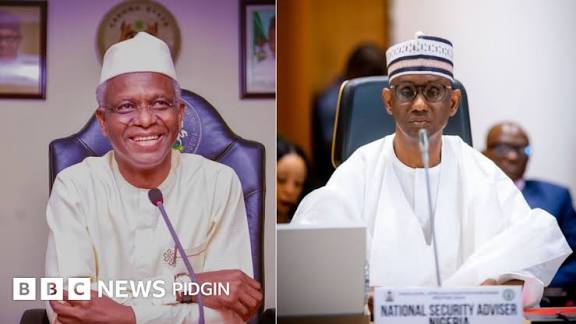

A former governor of Kaduna State, Nasir El-Rufai, has written a formal letter to the Office of the National Security Adviser (ONSA), requesting clarification over what he described as information available to opposition figures regarding an alleged plan to procure thallium sulphate, a highly toxic chemical substance, reportedly from Poland.
The letter, dated January 30, 2026, was addressed to the National Security Adviser, Nuhu Ribadu, and has since triggered a wave of political, security, and public-health debates, following El-Rufai’s decision to make the correspondence public.
In the letter, which El-Rufai shared on his official X handle on Sunday, the former governor said he was seeking “clarification and reassurance” over reports circulating among opposition leaders that ONSA planned to obtain approximately 10 kilograms of thallium sulphate from a foreign supplier.
He framed the request as one motivated by concern for public safety, democratic accountability, and the need to sustain public trust in national institutions, particularly in matters involving substances widely known to pose serious health and environmental risks.
El-Rufai stressed that thallium salts are among the most dangerous chemical compounds in existence, noting that they are highly toxic and tightly regulated globally due to their potential for misuse and the severe harm they can cause to humans and the environment.
He argued that any government involvement in the procurement or importation of such a substance must be transparent, strictly regulated, and clearly justified, given Nigeria’s existing security challenges and public-health vulnerabilities.
In his words, “I am writing as a concerned citizen to seek clarification and reassurance regarding information available to the political opposition leadership about a procurement of approximately 10 kilograms of Thallium Sulphate by the Office of the National Security Adviser (ONSA), reportedly from a supplier in Poland. Given that thallium salts are highly toxic and tightly controlled substances, I believe it is important, for public safety, democratic accountability and for maintaining public trust, to confirm the following details.”
The former governor went on to outline six specific areas where he sought clarification from the NSA’s office. These included “the intended purpose and end-use of the imported thallium sulphate, the identity of the supplier and whether the importation followed due authorisation, the quantity and concentration involved, storage arrangements, and the regulatory oversight and coordination in place with NAFDAC, NCDC, and relevant public-health and environmental agencies.”
He also asked “whether any public-health risk assessments or hazard-mitigation plans have been developed, given the compound’s extreme toxicity.”
While emphasising that his inquiry was made in good faith, El-Rufai maintained that openness would strengthen confidence in government institutions rather than weaken them.
“I want to stress that this inquiry is made in good faith, solely to ensure that due processes, safety standards, and transparency are observed. Public confidence in the integrity of national institutions is strengthened when potential risks are openly addressed and managed,” he wrote, adding that he would appreciate a response or a designated point of contact for further engagement.
For completeness, El-Rufai disclosed that he copied other relevant regulatory and public-health agencies in the correspondence, including the National Agency for Food and Drug Administration and Control (NAFDAC) and the Nigeria Centre for Disease Control (NCDC), which he described as playing “essential roles in chemical safety and public-health preparedness.”
He said this was done to ensure institutional awareness and coordination, given the sensitivity of the subject matter.
The letter, however, drew a sharp and forceful response from the Presidency, which accused El-Rufai of deliberately spreading misinformation and attempting to create unnecessary political tension. In a statement posted on X, the Senior Special Assistant to the President on Media and Publicity, Temitope Ajayi, dismissed the allegation of any planned procurement or importation of thallium sulphate by ONSA as false and misleading.
Ajayi stated, “Mallam Nasir El-Rufai is playing games and, in his typical fashion, also playing to the gallery. He knew there was no government procurement or importation of Thallium sulphate into Nigeria from Poland through the office of the National Security Adviser.”
He further claimed that El-Rufai had already received a response from the NSA’s office but chose not to make it public.
“El-Rufai certainly got a reply to his letter from the NSA’s office, and he should be honourable enough to release it just as he mischievously released his own letter,” Ajayi wrote.
According to the Presidency, the former governor’s actions were driven by ulterior motives rather than genuine concern for public safety.
Ajayi alleged that El-Rufai had “two clear intentions behind his recent actions and tantrums,” the first being “to create political tension in the country, create an atmosphere of fear and unrest, and then damage the government through deliberate misinformation,” and the second being “to divert attention from his domestic problems in Kaduna State, where he is facing massive corruption allegations.”
Ajayi went further to argue that El-Rufai was attempting to portray himself as a victim of persecution in order to “nationalise his personal problems with his home state government,” despite, in his words, knowing that “Nigerians will not be on his side over corruption charges.”
He insisted that neither President Bola Tinubu nor the National Security Adviser was responsible for the former governor’s current predicament.
In a detailed political critique, the Presidency questioned El-Rufai’s standing in Kaduna State following his eight years in office. “The question should be asked: how did El-Rufai lose almost everyone in the state he governed for eight years?”
Ajayi asked, noting that the former governor had lost the support of key stakeholders, including the incumbent governor, whom he described as a former political ally.
He also pointed out that all 28 members of the Kaduna State House of Assembly had unanimously endorsed petitions to anti-corruption agencies to probe El-Rufai over alleged financial impropriety.
Specifically, Ajayi said the House of Assembly had petitioned both the Economic and Financial Crimes Commission (EFCC) and the Independent Corrupt Practices and Other Related Offences Commission (ICPC) to investigate allegations involving N432 billion, adding that both agencies had since invited the former governor.
“Instead of behaving like a drowning man holding on to a straw to stay afloat, Mallam El-Rufai should brace up to face his corruption allegations and make peace with himself and his own people,” the statement added.
The controversy has unfolded alongside developments surrounding El-Rufai’s recent return to Nigeria from Cairo, Egypt.
The former governor claimed that security operatives attempted to arrest him at the Nnamdi Azikiwe International Airport shortly after his arrival on Thursday, an incident that further heightened public interest and speculation around his ongoing disputes with federal authorities.
Reacting to reports of the attempted arrest, El-Rufai’s legal counsel, Ubong Esop Akpan, said the former governor would honour invitations from anti-corruption agencies.
Akpan confirmed that El-Rufai was expected to appear at the EFCC office by 10:00 a.m. on Monday and also disclosed that his client had received a separate invitation from the ICPC, which he intended to honour on Wednesday, February 18.
El-Rufai himself addressed the situation on his X account, stating that he had received the ICPC’s invitation letter and had instructed his lawyer to formally communicate his readiness to comply.
He added that his return to Nigeria and subsequent interactions with security agencies had dominated headlines, alongside his allegations involving ONSA and the National Security Adviser.
The former governor further escalated the controversy during an interview on The Morning Show on Friday, where he alleged that he became aware of a plan to arrest him through a leaked phone conversation from the NSA’s line.
“Ribadu made the call because we listened to their calls. The government thinks that they’re the only ones who listen to calls. But we also have our ways. He made the call. He gave the order that they should arrest me,” El-Rufai claimed, without providing independent evidence to substantiate the allegation.
The claims drew reactions from opposition figures, including Atiku Abubakar’s media adviser, Paul Ibe, who weighed in on the dangers associated with thallium sulphate. In a post on X, Ibe described the substance as “a highly toxic, odourless inorganic salt” historically used as a rodenticide and insecticide, noting that it had been banned in many regions due to its severe health effects.
Ibe wrote, “Thallium Sulphate, which has been dubbed the ‘perfect poison’, has symptoms manifesting in hair loss (alopecia), severe stomach pain, and neurological damage (numbness, pain in extremities).
It was formerly used as a pesticide, and in some medical treatments (e.g., ringworm), its use is now severely restricted or banned for consumer products.”
He added that the compound is regulated by agencies such as the Occupational Safety and Health Administration and the United States Environmental Protection Agency, before asking, “I am constrained to jump the gun and ask what is the need for Thallium Sulphate to our national security?”
Countering these views, a coalition of concerned Nigerians faulted El-Rufai’s claims, describing them as reckless and capable of triggering public panic.
Addressing journalists in Kaduna, the group said the allegation involving ONSA lacked credible evidence and risked eroding trust in security institutions at a time when the country was grappling with terrorism, banditry, and organised crime.
The coalition’s spokesperson, Victor Bobai, described El-Rufai’s assertion as “misleading, inflammatory and dangerous to national cohesion,” adding, “At a time when our security agencies are battling terrorism, banditry and organised crime, it is irresponsible for any public figure to circulate unverified claims capable of creating fear among citizens.”
He insisted that allegations of such magnitude must be backed by verifiable intelligence and subjected to proper institutional scrutiny.
Other members of the coalition echoed similar concerns. Hamisu Malumfashi said Ribadu had continued to coordinate inter-agency responses to security threats “with professionalism and discipline,” warning that “those making sensational claims should understand the weight of their words.”
Another member, Adeosun Olayinka, urged Nigerians to critically assess the records of political leaders before accepting claims at face value, saying, “Accountability must be holistic. No one should weaponise fear to gain political relevance or to undermine institutions working to keep the country safe.”
The coalition also announced plans to mobilise civic volunteers to counter what it described as misinformation through fact-checking and public enlightenment campaigns, while calling on El-Rufai to provide concrete evidence to support his allegations and urging security agencies to remain focused on their mandates without being drawn into political distractions.
The unfolding controversy comes against the backdrop of heightened political tension in Nigeria, marked by ongoing corruption probes, debates over national security management, and growing demands for transparency as election cycles approach.
While opposition figures continue to press for greater openness in sensitive government procurements, civil society groups and the Presidency have warned against politicising security issues in ways that could undermine public confidence.