

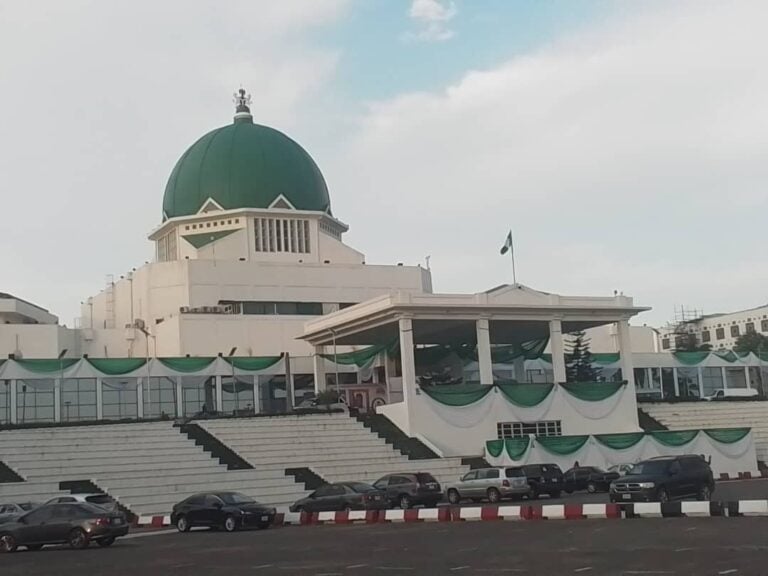

The National Assembly on Sunday announced that it would reconvene its plenary session on Tuesday, February 17, 2026, abruptly cutting short its annual recess in a development that has triggered intense political scrutiny and renewed debate over the conduct and timing of the 2027 general elections.
The announcement, which immediately drew national attention, came amid mounting indications that federal lawmakers may be preparing to review and possibly alter the date earlier fixed for the 2027 presidential election, a move that would have far-reaching legal, political, and religious implications.
The decision was formally communicated through a notice signed by the Clerk to the National Assembly, Kamoru Ogunlana, and circulated to all senators and members of the House of Representatives.
In the notice, lawmakers were directed to resume sitting at exactly 11:00 a.m. on Tuesday, February 17, 2026, and to rearrange their personal and official engagements to accommodate what was described as an urgent legislative session.
“I am directed to inform all Distinguished Senators and Honourable Members of the National Assembly that the Senate and House of Representatives shall reconvene plenary session at 11:00 am on Tuesday, 17th February 2026, respectively,” the notice read in part.
It continued, “Consequently, all Distinguished Senators and Honourable Members are kindly requested to take note and reschedule their engagements accordingly to enable them attend the session, as very crucial decisions shall be taken by each Chamber during the session.”
The phrase “very crucial decisions,” contained in the official communication, immediately fuelled speculation within political circles and among civil society observers, with many linking the emergency sitting to unresolved controversies surrounding the Electoral Act (Repeal and Re-enactment) Amendment Bill, 2026, as well as the timetable released by the Independent National Electoral Commission (INEC) for the 2027 general elections.
Findings by correspondents revealed that a central issue likely to dominate the extraordinary plenary session is a proposed adjustment to the date of the 2027 presidential election.
Multiple sources within the National Assembly disclosed that lawmakers are considering shifting the presidential poll from Saturday, February 20, 2027, to Saturday, February 13, 2027, largely in response to religious and public concerns over the coincidence of the original date with the Muslim holy month of Ramadan.
A senator, who spoke on condition of anonymity due to the sensitivity of internal legislative discussions, confirmed that the recess was cut short specifically to accommodate this agenda.
“It is more of an extraordinary plenary session to review the 2027 presidential election date as stipulated in the Electoral Act amendment. That is why our recess has been cut short through the announcement made by the Clerk of the National Assembly,” the lawmaker confided.
The source further explained that the move was not arbitrary but intended to provide legislative backing for concerns raised by INEC itself regarding the feasibility and inclusiveness of conducting nationwide elections during Ramadan.
“The ultimate aim is to give legislative backing to INEC’s request to address the concerns raised regarding the 2027 election slated to hold during Ramadan,” the senator added, suggesting that the legislature was responding to institutional rather than purely political pressure.
Another Senate insider provided additional clarity on the possible outcome of the session, stating, “If all goes according to plan, the presidential poll date may be brought forward to February 13 from the previously announced February 20 by INEC.”
According to the source, internal consultations have already been held across party lines, with lawmakers weighing the legal implications of such a shift against the broader need to ensure maximum voter participation.
A separate lawmaker described the stakes involved in stark terms, saying, “This session is crucial. It is about more than dates it is about ensuring that every Nigerian, regardless of faith, has a fair opportunity to participate in the electoral process. The decisions we take here could define the credibility of the 2027 elections.”
The source noted that failure to address the concerns could deepen mistrust in the electoral system and fuel post-election disputes.
The emergency reconvening comes barely a week after the Senate, bowing to intense public pressure, approved the electronic transmission of election results to INEC’s Result Viewing Portal (IReV), while retaining manual collation as a backup mechanism in areas where technology may fail.
That decision followed days of nationwide protests and sustained criticism from opposition parties, civil society organisations, and youth movements.
At the heart of the controversy was a disputed clause in the Electoral Act (Repeal and Re-enactment) Amendment Bill, 2026, which critics argued weakened transparency and undermined the credibility of future elections.
Protesters accused lawmakers of deliberately creating loopholes that could be exploited to manipulate election results ahead of the 2027 polls.
Although the Senate ultimately approved electronic transmission, it stopped short of making the process compulsory and rejected calls for real-time uploading of results to the IReV portal, a key demand of protesters who insisted that only real-time transmission could curb manipulation during result collation.
Under the revised provision, presiding officers at polling units are required to electronically transmit results to the IReV portal after voting concludes and all documentation is completed.
However, where electronic transmission is not possible due to poor network coverage or technical challenges, the manual result sheet, Form EC8A, will serve as the primary basis for collation and declaration.
While putting the motion to a voice vote, Senate President Godswill Akpabio urged senators who opposed the amendment to formally challenge it through legislative procedures. He encouraged dissenting lawmakers to engage constructively by raising objections on the floor rather than resorting to external agitation.
With plenary set to resume, attention is also focused on the Joint National Assembly Conference Committee, constituted to harmonise differences between the versions of the Electoral Amendment Bill passed separately by the Senate and the House of Representatives.
The joint committee, made up of members from both chambers, has been given a strict one-week deadline to resolve all contentious provisions.
Once harmonisation is completed, the revised bill will be transmitted to President Bola Tinubu for assent, potentially setting the final legal framework governing the timing of elections and the use of electronic transmission in the 2027 polls.
Meanwhile, INEC has acknowledged the widespread concerns over the election timetable, particularly its overlap with Ramadan. The National Commissioner and Chairman of the Information and Voter Education Committee, Mohammed Haruna, disclosed this in a statement last Friday.
Haruna explained that the timetable was drawn up in strict compliance with the Constitution, the Electoral Act 2022, and INEC’s Guidelines and Regulations for the Conduct of Elections, 2022.
According to him, INEC initially fixed Saturday, February 20, 2027, for the presidential and National Assembly elections, and Saturday, March 6, 2027, for governorship and state Houses of Assembly elections.
However, he acknowledged the objections raised by stakeholders. “Notwithstanding the foregoing, the commission has taken due notice of concerns expressed by stakeholders regarding the coincidence of the scheduled dates with certain nationally recognised holidays and observances,” Haruna said.
He added, “The commission wishes to assure the public that it remains sensitive to all legitimate concerns that may impact electoral participation and the overall conduct of elections. In view of these representations, the commission is currently undertaking consultations and may, where necessary, seek appropriate legislative intervention to address the concerns raised, while ensuring that any adjustment remains consistent with constitutional and statutory requirements.”
Muslim Rights Concern and other Islamic stakeholders were among the first to reject the proposed timetable, arguing that conducting elections during Ramadan would disadvantage Muslim voters, election officials, and observers. Former presidential candidate Atiku Abubakar also joined the call for reconsideration.
On his X handle, Atiku said the February 20 date falls “squarely within the Ramadan period (February 7 – March 8, 2027), a sacred season of fasting, reflection, and spiritual devotion for millions of Nigerian Muslims.”
Former presidential aide Bashir Ahmad echoed similar concerns.
He wrote, “If the intention is to encourage full and inclusive participation in the electoral process, scheduling such a critical national exercise during Ramadan may present challenges for a large segment of the population. Many Muslims tend to reduce engagement in worldly activities during this period in order to focus on religious obligations.”
He further stated, “Given the significant Muslim population in this country, it may be worthwhile to reconsider the timing to ensure broader participation and convenience for all citizens. I do hope this observation will be taken in the spirit of inclusiveness and national cohesion.”
The debate over election timing is not new. In October last year, the National Assembly proposed holding elections in November 2026, about six months earlier than usual, to ensure that all election petitions are concluded before the May 29, 2027 handover date. The draft amendment proposed that elections be held “not later than 185 days before the expiration of the term of office of the last holder of the office.”
Chairman of the House Committee on Electoral Matters, Adebayo Balogun, explained that the proposal was designed to “ensure that all manner of election litigations are dispensed with before the swearing in of winners.”
Lawmakers also proposed amendments to Sections 285 and 139 of the 1999 Constitution to drastically shorten timelines for election petitions and appeals.
Other proposals included early voting for security personnel, INEC staff, accredited journalists, and election observers at least 14 days before election day. Stakeholders, including INEC representatives such as Abdullahi Zuru, supported the reforms, describing them as critical to reducing litigation and enhancing electoral credibility.
Explaining why the Senate removed the “real-time” transmission clause, Senate Leader Opeyemi Bamidele cited infrastructure challenges, referencing Nigerian Communications Commission data showing broadband coverage at 70 per cent in 2025, internet penetration at 44.53 per cent, and Nigeria ranking 129th out of 150 countries in fixed broadband speed at 33.32 Mbps.
On power supply, Bamidele said 85 million Nigerians about 43 per cent of the population still lack access to grid electricity, despite generation capacity hovering between 12,000 and 13,500 megawatts.
“By global standards, the real-time electronic transmission of election results may not be practicable at this stage of our development,” he said.
He concluded, “The term ‘real time’ was removed to ensure Nigeria’s electoral framework remains workable given current infrastructural and technological limitations, while still addressing citizens’ concerns across the country.”
As the National Assembly prepares to reconvene, analysts say the extraordinary session comes at a politically charged moment, with pressures of religious inclusivity, technological readiness, legal reform, and public trust converging ahead of the 2027 elections.
Many observers believe that decisions taken on Tuesday could prove pivotal in shaping not only the election timetable but also public confidence in Nigeria’s democratic process.