

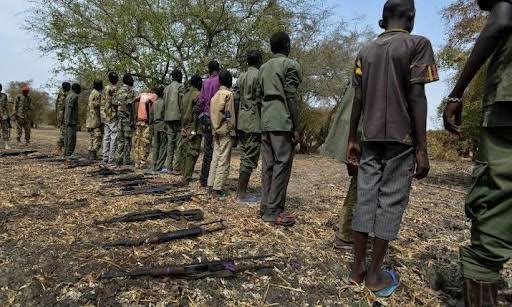

According to the United Nations report ahead of the International Day Against the Use of Child Soldiers on February 12, Nigeria has been ranked among the top countries for child soldier recruitment by armed groups.
The UN’s Special Representative for Children and Armed Conflict, Vanessa Frazier, highlighted this crisis in an interview. She noted that over 7,400 verified cases of child recruitment were recorded in 2024 alone, enlisting Nigeria alongside the Democratic Republic of Congo, Somalia, Syria, and Myanmar, where these menace thrives.
The UN monitored 26 global conflict hotspots, where child recruitment remained one of the most prevalent violations against children. Over the past 30 years, more than 220,000 children have been separated from armed groups through UN efforts.
These figures likely underestimated the true scale, as each verified case represents a child whose life has been profoundly disrupted by violence.
Nigeria’s Insurgency Legacy
For over a decade, Nigeria regions have endured multidimensional security crises, including IPOB militants, Boko Haram and splinter group insurgencies, which exploit children amid military setbacks.
Frazier shared poignant accounts from her visitations to Nigeria, such as a 13-year-old Boko Haram abduction survivor holding her baby, illustrating how conflict irreparably devastated childhoods. Children out of school in these areas are especially vulnerable to forced or coerced recruitments.
Prominent in Northeast Nigeria, groups like Boko Haram have succeeded in recruiting children as fighters, informants, and other roles. Despite military gains, children in affected areas remain highly vulnerable to exploitation by splinter factions.
More than 8,000 children were trapped in insurgents’ recruitment, using them as child soldiers while playing different roles for the armed groups since 2009, a 2022 report published by UNICEF revealed.
On Monday, 2nd June, HumAngle, a media organization focused on covering conflict and insecurity in Nigeria, published a months-long investigation, diving into how terrorists in North-Central Nigeria are weaponizing hunger as a strategy to recruit vulnerable children into their violent war against humanity.
The report uncovered how children can be easily lured into criminality when they are well fed and promised of enough food.
Speaking on the implications of children’s vulnerability to food, Dapit Joseph, a child psychologist at the Federal University Kashere, Gombe State, explained to HumAngle “You know, food is a physiological need; it’s the foundation of human motivation and the first in the hierarchy of needs.
“People need food to survive, and in the quest to get it, they can do anything to survive. When people are hungry, especially children, that hunger can be weaponised to lure them into terrorism.”
Bridging the Gap
In an effort to bridge the gap of the post–effect implications of these children fighters, UNICEF and partners provide psychosocial support, education, and reintegration services to help children reclaim their lives.
However, female victims often experience stigma and rejection by communities as damaged goods, especially if those who return with children. Keeping children in school during conflicts is vital for prevention, as out-of-school youths are prime targets for recruitment.
Prosecuting warlords in national courts and the International Criminal Court deters recruitment by imposing real consequences, the UN pleaded. Frazier emphasized that children must never be war’s collateral, advocating education, justice, and protection to foster lasting peace.
“Children are the epitome of innocence. They have not taken sides in any war, yet their innocence and childhood have both been interrupted. Children should never be treated as collateral of war,” Ms Frazier stated.
“When warlords or armed group leaders are prosecuted and sentenced for recruiting children, including in national courts and at least three cases before the International Criminal Court, it sends a powerful message.”