

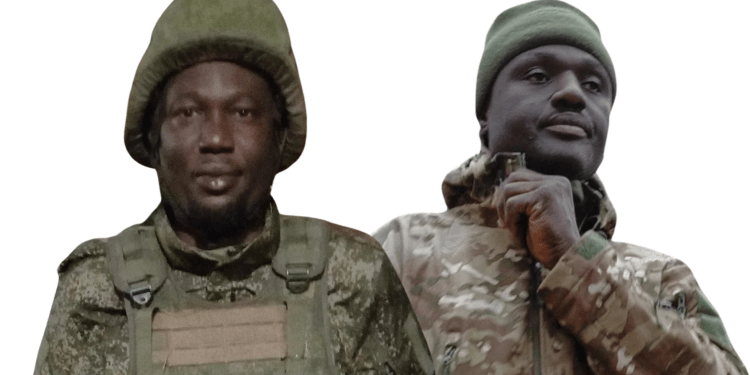

The Ukrainian Defence Intelligence has identified two Nigerian nationals killed while fighting for Russia in the Luhansk region, highlighting ongoing foreign recruitment in the conflict.
Ukraine’s intelligence agency discovered the bodies of Hamzat Kazeen Kolawole, aged 42 (born April 3, 1983), and Mbah Stephen Udoka, aged 37 (born January 7, 1988). Both served in Russia’s 423rd Guards Motor Rifle Regiment and signed contracts in late 2025—Kolawole on August 29 and Udoka on September 28—without receiving military training.
They died in late November 2025 during a failed assault on Ukrainian positions, eliminated by a drone strike before any firefight occurred. Kolawole left behind a wife and three children in Nigeria, while no family details were specified for Udoka.
Ukrainian authorities released photos of the men in military gear and one family image to confirm their identities. Recall that Russia faces accusations of luring foreigners, including Africans, with job promises to bolster its forces in the war launched in February 2022.
Ukraine warns against such offers in Russia, amid the conflict’s strain on global markets and displacement of millions. This incident underscores risks for recruits from Nigeria in the Donbas region’s meat-grinder battles.
Contexts
A New York Times report published in January stated that nearly four years of war have resulted in approximately two million Russian and Ukrainian troop deaths.
Various investigations have also uncovered instances where African nationals including Nigerians were enticed with job offers, better pay, or education prospects, only to be sent to fight in combat zones.
A CNN probe revealed that young people from Nigeria, Ghana, Kenya, and Uganda were tricked with bogus job ads into traveling to Russia, before being forced onto the war front lines. Last month, Punch investigation detailed similar cases in Nigeria, where arrivals faced pressure to sign untranslated military contracts without legal advice before being conscripted.
Other probes have exposed African girls being drawn to Russia and subjected to exploitation. In a collaborative effort last year, ZAM and PREMIUM TIMES investigated how young Africans, especially women aged 18-22, were targeted via schemes promising training, scholarships, education, and steady jobs in Russia.
The focus was on Alabuga Start, a state-supported Russian program advertised as providing fully funded two-year scholarships. Official branding and marketing materials lent it an air of legitimacy.
In Nigeria, the program hired unlicensed agencies to recruit, including influencers with large social media audiences who amplified outreach through constant posts. It mainly preyed on young women from low-income backgrounds.