

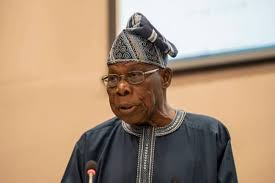

Former President Olusegun Obasanjo on Thursday traced Nigeria’s persistent dependence on imported rice to a pivotal policy reversal in 1979, asserting that the civilian administration that succeeded the outgoing military government undone efforts aimed at self-sufficiency and, in his view, “set the country back by decades.”
Speaking in Abuja at the International Memorial Lecture and Leadership Conference marking the 50th anniversary of the assassination of former Head of State, General Murtala Muhammed, Obasanjo said that the decision to lift the rice import ban imposed by his administration undermined years of planning and progress in Nigeria’s agricultural sector. He linked this historical misstep to broader challenges facing Nigeria and Africa in achieving sustainable economic independence, framing his remarks within the theme of the lecture, which celebrated General Muhammed’s defining “Africa Has Come of Age” address delivered at the Organisation of African Unity Summit in Addis Ababa.
Obasanjo recounted that at the conclusion of military rule in 1979, his administration was on the verge of achieving rice self-sufficiency, with preliminary reports indicating that the goal would be met within the year. “By the time we left in July 1979, we wanted to be self-sufficient in rice production. We asked that a report be prepared on what was in the fields. The report showed that we would be self-sufficient that year,” he said, underscoring the systematic planning undertaken by his government. In an effort to consolidate gains, Obasanjo explained, his administration banned rice importation before handing over power in October 1979.
“When the civilian administration came in, one of the first things they did was to lift the ban on rice importation so they could allocate import licences to their supporters and political associates,” he said, illustrating how policy reversals can be driven by political patronage rather than national interest.
To highlight the depth of systemic abuse that followed the lifting of the ban, Obasanjo provided a detailed anecdote involving a politically connected importer.
“Let me give you an example. One of the barons who obtained a rice import licence from America ordered rice and then asked the suppliers to add $5 million to the cost. They added the $5 million and supplied the rice. He then went back to New York and demanded $2.5 million out of the $5 million. They refused and gave him only $1 million. He reported the matter to the Nigerian embassy and to the Nigerian representative at the UN, who contacted the suppliers.
The suppliers said they did not understand what the issue was. Eventually, the suppliers explained that the man had asked them to add $5 million to the cost and, without doing so, they would have lost the contract. They took the risk and secured the deal. He wanted $2.5 million but had taken no risk, so they gave him $1 million. The ambassador said he felt like digging a hole and sinking into it. That was your country,” Obasanjo recalled, offering a vivid portrayal of the corruption and opportunism that ensued. Reflecting on the long-term consequences, he added, “Since the lifting of the rice import ban in 1979, we have not recovered from it. That is why we are still importing rice today…These are the kinds of things that go wrong, and then we ask whether Africa has come of age. I wonder.”
Turning to broader economic observations, Obasanjo lamented that Nigeria’s potential had been curtailed by policy inconsistencies and mismanagement over the years, even though the country had previously shown the capacity to excel. “There was a time when Nigeria ranked 37th among the economies of the world. If we had continued at that rate for 20 years, we would by now have been among the top 10. Today, I do not even know where we stand,” he said, underscoring the gap between past promise and current realities.
In prescribing a pathway to development for Africa, he urged leaders to prioritize structural reform and productive capacity. “What we need to do is reform and produce. Reform and produce…For Africa to come of age, it must record annual GDP growth of nine to ten per cent. We have done something like that before, and we can do it again. When we do, Africa will truly come of age,” Obasanjo asserted, emphasizing the interconnection between governance, policy consistency, and economic growth.
Obasanjo also highlighted agriculture as a tangible example of policy success and regression. He reflected on cocoa production during his elected presidency, noting the significant gains achieved and the subsequent decline: “When I became elected president, cocoa production in Nigeria was 150,000 metric tonnes. We introduced a new system to boost production, and within four to five years, we were producing 450,000 metric tonnes. We tripled output. President Kufuor once joked that Nigeria, as an oil-producing country, should leave cocoa to them. I told him we would produce cocoa while also producing oil. Today, I understand we are producing no more than 300,000 metric tonnes. We have gone backwards. That is not how Africa will come of age.”
Through this illustration, Obasanjo drew attention to the critical importance of sustaining policy initiatives and ensuring long-term continuity in economic planning.
Beyond the economy, Obasanjo reflected on leadership, governance, and the enduring legacy of General Murtala Muhammed. He lauded Muhammed’s patriotism, discipline, and commitment to national service, emphasizing the former leader’s foresight in preparing Nigeria for presidential democracy.
“The greatest achievement of Murtala, in my view, was that he created a successor who could continue after him. The failure of all leaders after Murtala, including myself, is that we have not been able to create successors who could go on after us,” he said, highlighting the essential link between leadership continuity and national development. Obasanjo’s remarks underscored a recurring challenge in African governance the difficulty of establishing institutionalized succession planning to ensure stability and policy persistence.
The lecture, which focused on the 50th anniversary of General Muhammed’s assassination, provided a platform for reflection on the late Head of State’s vision for Africa. Obasanjo repeatedly linked Nigeria’s domestic policy missteps, such as the rice importation issue, to broader continental development, asserting that sustainable progress required African nations to maintain consistent, forward-looking economic policies. His commentary placed Nigeria’s historical economic decisions within the context of Africa’s journey toward self-sufficiency, industrialization, and competitive participation in global markets.
Obasanjo’s address also emphasized the practical implications of historical policy decisions for contemporary governance. By tracing the consequences of the 1979 rice importation reversal and the resulting dependence on imports decades later, he illustrated the enduring impact of short-term, politically motivated decision-making. His detailed anecdote about the politically connected rice importer served not only as a critique of past mismanagement but also as a cautionary tale for present and future policymakers. “These are the kinds of things that go wrong,” he said, urging leaders to consider the long-term national interest over immediate political gain.
Throughout the lecture, Obasanjo interwove lessons on agriculture, economic management, and leadership, presenting a comprehensive view of what he believes Africa must achieve to “come of age.” By using historical examples, such as rice and cocoa production, he reinforced the argument that Africa’s potential is immense but contingent on disciplined governance, sound policies, and sustained reform. His repeated call to “reform and produce” emphasized that growth and self-reliance are achievable if African nations commit to systematic planning, policy consistency, and productive investment.
Concluding his remarks, Obasanjo framed the reflection on General Murtala Muhammed’s leadership as both a tribute and a blueprint for Africa’s future. He connected Muhammed’s visionary approach, including his emphasis on disciplined governance and preparing successors, to the broader imperatives of economic self-sufficiency, continental integration, and leadership accountability.
Through his detailed analysis, Obasanjo conveyed that Africa’s progress and Nigeria’s development are inexorably linked to the ability of leaders to enact sound policies, sustain them beyond individual tenures, and prioritize national and continental interests above personal or political gains.