

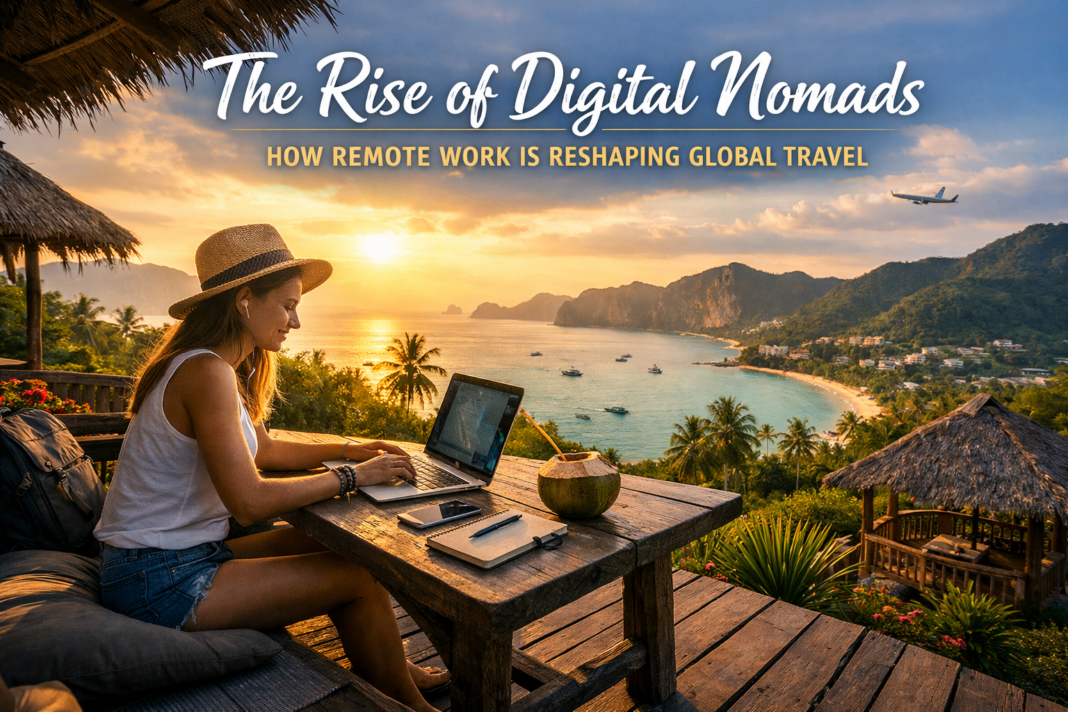

At sunrise on a quiet beach in Zanzibar, Tanzania, a young software designer balances her laptop on a wooden café table as fishing boats drift back to shore and the scent of salt fills the air. Her office for the day is a seaside hut with strong Wi-Fi, fresh coconut water, and a view worthy of any postcard. By noon, she will have joined two virtual meetings with colleagues across three continents, submitted a design draft to a client in London, and booked a weekend ferry trip to Stone Town. She is not on holiday. She is at work. This is the everyday reality of a growing class of professionals known as digital nomads people who use technology to earn a living while living far from a fixed home base, often moving from country to country with little more than a backpack and a stable internet connection.
Digital nomads are not tourists in the traditional sense, nor are they expatriates who settle long-term in one foreign country. They exist somewhere in between, blending work and travel into a lifestyle made possible by laptops, cloud computing, collaboration tools, and the global expansion of high-speed internet. While remote work existed before 2020, the COVID-19 pandemic forced companies worldwide to adopt flexible work arrangements at an unprecedented scale. Offices closed, video calls replaced boardrooms, and many employers realized that productivity was not tied to a physical location. As borders reopened, a new realization dawned on thousands of workers: if their jobs could be done from home, they could just as easily be done from anywhere in the world.
This shift has quietly begun to reshape global travel patterns. Instead of short, intensive vacations, digital nomads often stay for weeks or months in one destination, spending more like residents than tourists. They rent apartments instead of hotel rooms, shop in local markets, use public transport, and frequent neighborhood cafés. Cities once known primarily as holiday spots Bali, Lisbon, Medellín, Chiang Mai have become hubs for remote workers seeking affordable living costs, vibrant culture, and reliable internet. These longer stays blur the line between tourism and migration, creating a new category of traveler who contributes steadily to local economies without fully settling.
Governments have taken notice. In recent years, several countries have introduced special “digital nomad visas” designed to attract remote workers. Estonia was among the first to formalize such a program, followed by countries like Portugal, Barbados, Croatia, Costa Rica, and the United Arab Emirates. These visas typically allow foreigners to reside legally for extended periods while working for employers or clients outside the host country. For nations recovering from tourism losses during the pandemic, digital nomads represent a new, stable source of income: visitors who stay longer, spend consistently, and require fewer public services than permanent migrants.

The impact on local economies can be significant. Co-working spaces have sprung up in cities and small towns alike, offering desks, fast internet, and community for itinerant professionals. Cafés now advertise Wi-Fi speeds as prominently as their menus. Property owners convert apartments into short-term rentals tailored for remote workers, complete with ergonomic chairs and work desks. In some places, entire neighborhoods have been revitalized by the influx of digital nomads who bring spending power and international networks. Local businesses from language schools to fitness studios adapt their services to cater to this new clientele.
Yet, the rise of digital nomads is not without tension. In popular destinations, an influx of relatively well-paid foreigners can drive up rent prices and contribute to housing shortages for local residents. Critics in cities like Lisbon and Mexico City have argued that short-term stays by remote workers are accelerating gentrification and changing the cultural character of neighborhoods. While digital nomads may see themselves as harmless travelers, their collective economic footprint can have complex social consequences. Balancing the benefits of foreign spending with the protection of local affordability has become a policy challenge for many governments.
For the nomads themselves, the lifestyle carries both freedom and uncertainty. The appeal is obvious: the chance to explore new cultures, avoid long commutes, and design a life less tied to routine. But constant movement can also be isolating. Time zone differences complicate work schedules, visa rules can be confusing, and the absence of long-term community may take an emotional toll. Reliable healthcare, taxation rules, and legal residency status are practical issues that many digital nomads must navigate on their own. The lifestyle, often glamorized on social media, demands careful planning and resilience.
Tourism models are also evolving in response to this trend. Traditional tourism focuses on attractions and short stays, but destinations now market themselves as “live-work” environments. Some cities promote their internet infrastructure, safety, and affordability as much as their beaches or historic sites. Tourism boards collaborate with co-working spaces and accommodation providers to create packages for remote workers. This signals a shift from seeing visitors as temporary guests to viewing them as semi-residents who integrate into daily life.
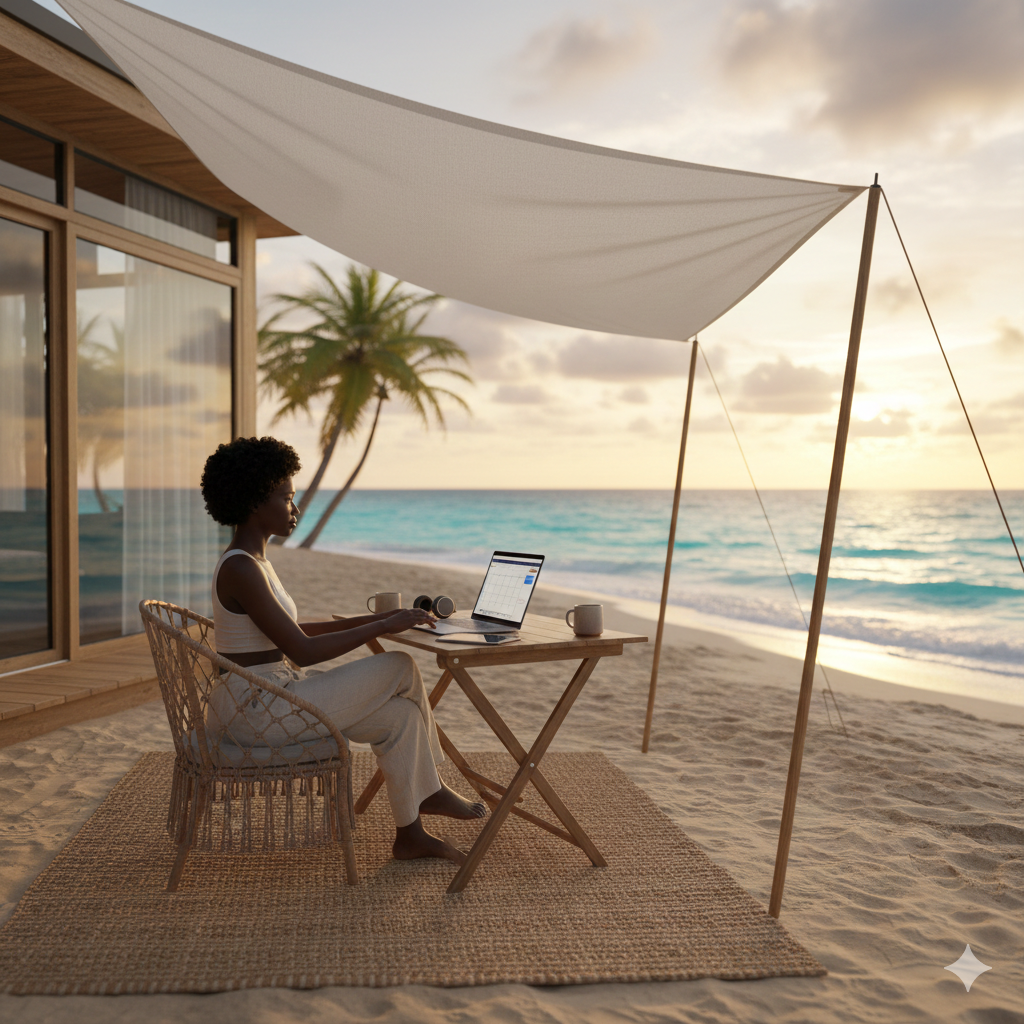
Ultimately, the rise of digital nomads points to a broader transformation in how the world understands work and mobility. Work is becoming less about where you are and more about what you can do from wherever you choose to be. Travel is no longer just an escape from work but, for many, the backdrop to it. As more companies embrace flexible work arrangements and more countries compete to attract mobile professionals, the boundaries between home, office, and destination will continue to blur. In this emerging landscape, global mobility is not defined by migration or tourism alone, but by a new way of living that merges productivity with exploration, turning the world itself into a workplace.