

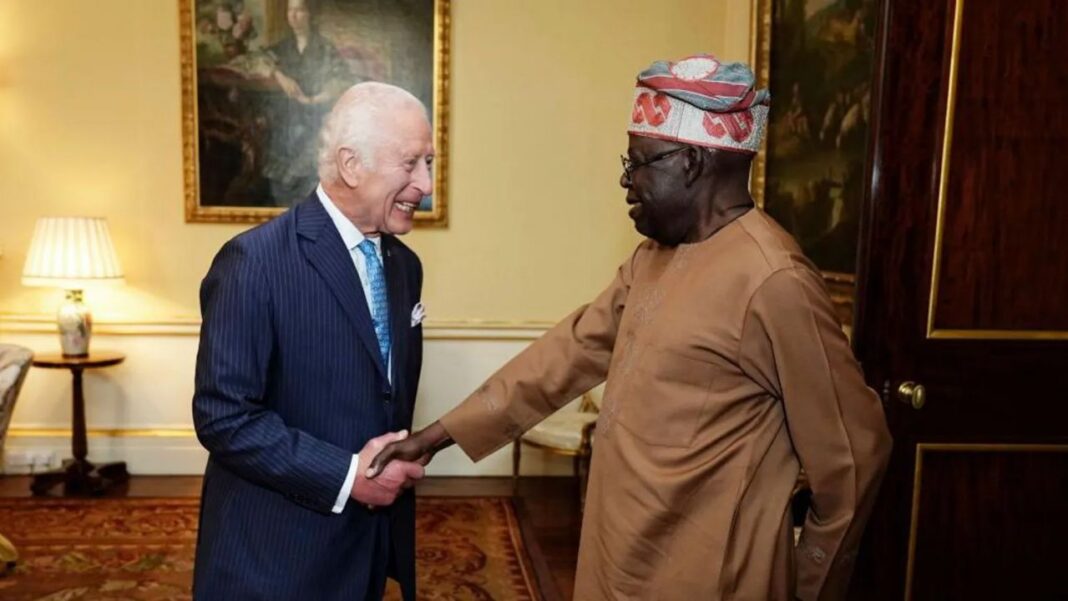

King Charles III and Queen Camilla are scheduled to host Nigeria’s President Bola Ahmed Tinubu and First Lady Oluremi Tinubu on a state visit to the United Kingdom from the 18th to the 19th of March, marking Nigeria’s first formal state visit to the UK in thirty seven years, Buckingham Palace has announced. The visit will take place at Windsor Castle and represents one of the highest levels of diplomatic engagement between the two countries in recent decades.
State visits are traditionally regarded as the most prestigious form of diplomatic engagement, combining ceremonial royal hospitality with political meetings and symbolic gestures designed to reinforce strategic partnerships. Such visits typically involve formal welcoming ceremonies, carriage processions, state banquets, and private and public meetings between visiting leaders and senior political figures in the host country. While the detailed programme for President Tinubu’s visit has not yet been disclosed, Buckingham Palace has confirmed that further information will be released in due course.
The last time a Nigerian leader was accorded a state visit to the United Kingdom was in 1989, when then military ruler General Ibrahim Babangida travelled to meet Queen Elizabeth II during a four day visit. Earlier Nigerian state visits to the UK occurred in 1973 under General Yakubu Gowon and in 1981 under President Shehu Shagari, reflecting a historical pattern of high level diplomatic engagement during Nigeria’s post independence period. Since Babangida’s visit, no Nigerian head of state or president has been hosted in the UK on a full state visit basis, making the upcoming visit by President Tinubu a significant diplomatic milestone.
Although this will be President Tinubu’s first formal state visit to the UK since assuming office in 2023, he has already had multiple interactions with King Charles III. Both leaders assumed office in May 2023, and have since engaged on several occasions. Tinubu and his wife were received by the King at Buckingham Palace in September 2024, and they also held bilateral discussions on the sidelines of the COP28 climate summit in Dubai, where issues of global and regional concern, including climate change, were discussed. These engagements laid the groundwork for the deeper diplomatic ties now being symbolised by the state visit.
The visit is also taking place amid expanding diplomatic and economic relations between the United Kingdom and Nigeria. Trade between the two countries was valued at more than eight billion pounds in the year to October according to British government figures, positioning Nigeria as one of the UK’s most significant partners in Africa. In 2024, both countries signed a new trade and investment partnership aimed at expanding opportunities for businesses and strengthening economic cooperation. The UK has long been one of Nigeria’s key trading partners and investors, with deep historical links dating back to the colonial era and continuing through Nigeria’s post independence development.
Beyond trade, the United Kingdom and Nigeria share long standing political, educational, and cultural ties through the Commonwealth, migration, and institutional partnerships. Thousands of Nigerians live, study, and work in the UK, contributing significantly to British society, while British companies maintain substantial investments in Nigeria’s energy, finance, telecommunications, and manufacturing sectors. The state visit is therefore expected to symbolically reaffirm these multi layered relationships and open new channels for cooperation across governance, security, climate policy, and youth development.
King Charles III has maintained a personal and institutional interest in Nigeria over several decades. Before ascending the throne, he visited the country four times as the Prince of Wales, in 1990, 1999, 2006, and 2018, with Camilla accompanying him on the latter trip. He has publicly expressed an appreciation for Nigerian culture, including Pidgin English and Afrobeats music, and in 2023 his charitable organisation, the King’s Trust International, launched operations in Nigeria with initiatives focused on addressing youth unemployment and supporting entrepreneurship. These engagements have contributed to sustained people to people and institutional ties between both countries.
The announcement of President Tinubu’s state visit comes after the United Kingdom hosted three state visits in 2025 from France, the United States, and Germany, marking the first time since 1988 that the country held such a number of high level visits in a single year. The inclusion of Nigeria in this cycle of high level engagements underscores the UK’s recognition of Nigeria’s strategic importance in Africa and in global affairs.
Historically, UK Nigeria relations have evolved through periods of cooperation, tension, and transformation. Following Nigeria’s independence in 1960, the UK remained a key partner in governance, defence training, trade, and education. During periods of military rule in Nigeria, diplomatic engagement continued, though often with varying degrees of political and human rights concerns. The return to democratic rule in 1999 marked a renewed phase of engagement, with successive Nigerian administrations seeking deeper economic and political partnerships with the UK.
Samuel Aina