

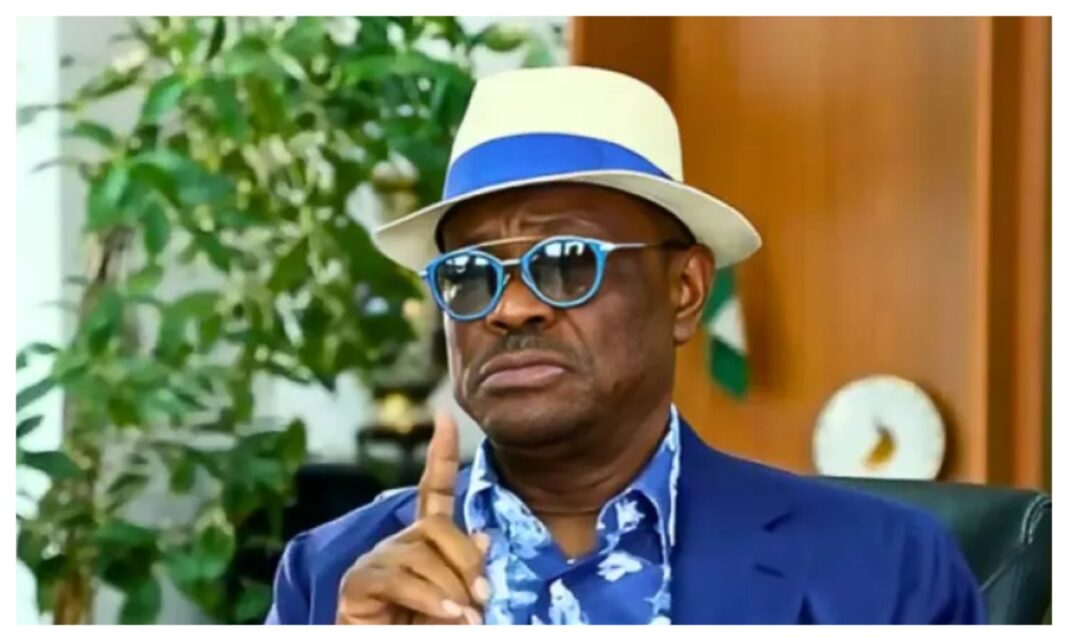

The Minister of the Federal Capital Territory, Nyesom Wike, has asserted that his political camp does not require the backing of a sitting governor to mobilise support for President Bola Tinubu in Rivers State ahead of the 2027 general elections, signalling a deepening rift within the state’s political leadership.
Wike made the statement in Port Harcourt during the inauguration of the headquarters of the Renewed Hope Ambassadors, a political support structure aligned with President Tinubu’s reelection bid. Addressing party supporters and political stakeholders, the former Rivers State governor declared that his political network possesses the organisational strength, grassroots structures, and political influence necessary to secure electoral support for the president without relying on the incumbent governor of the state.
He emphasised that his political machinery includes senators, members of the national and state assemblies, council chairmen, party officials from both the All Progressives Congress and the Peoples Democratic Party, and other local political actors who have pledged commitment to Tinubu’s political future.
Wike praised the coordinator of the Renewed Hope Ambassadors in Rivers State, Desmond Akawor, for mobilising across the state’s local government areas to promote Tinubu’s political agenda. He described Rivers as a state that would work massively for Tinubu’s reelection, reiterating his earlier claims that the state is politically aligned with the president’s camp. He also challenged critics to observe the level of mobilisation already underway, arguing that political commitment must be demonstrated through tangible organisational structures and grassroots engagement rather than verbal assurances or media statements.
The former governor stated that political loyalty requires independent commitment rather than reliance on the resources or influence of a single political officeholder, insisting that his camp has demonstrated the capacity to mobilise without external inducements. His remarks were widely interpreted as a pointed reference to Governor Siminalayi Fubara, with whom he has been embroiled in an escalating political conflict over control of Rivers State’s political structure.
The political feud between Wike and Fubara dates back to the 2023 governorship election. Wike, then the outgoing governor and a dominant political figure in the state, played a decisive role in Fubara’s emergence as governor under the Peoples Democratic Party. Fubara was widely seen as Wike’s political protégé, having served as the state’s accountant general and later as a close ally within Wike’s political structure. However, soon after assuming office, tensions emerged between the two camps over political appointments, control of party structures, legislative influence, and governance priorities. The disagreement escalated into open political confrontation, with factions forming within the state legislature and party hierarchy.
The conflict later spilled into the national political arena. Wike, a prominent PDP figure, controversially supported Bola Tinubu of the APC during the presidential election, citing issues with the PDP’s internal processes and the zoning of its presidential ticket. His appointment as Minister of the Federal Capital Territory by Tinubu further solidified his alignment with the ruling party and deepened suspicions of political defection, although he has maintained that he remains a member of the PDP.
The political battle between Wike and Fubara has had significant implications for governance in Rivers State. The state legislature experienced factional divisions, with parallel leadership claims and disputes over legislative proceedings. There have been reports of defections, suspensions of lawmakers, and legal battles over the legitimacy of legislative actions. The federal government and national political actors have closely monitored the situation due to Rivers State’s strategic economic importance, particularly its role in Nigeria’s oil and gas sector and its influence within the South-South geopolitical zone.
Wike’s comments also included criticism of unnamed governors whom he accused of betraying political allies, warning that such leaders could face similar betrayals from their successors.
Samuel Aina