

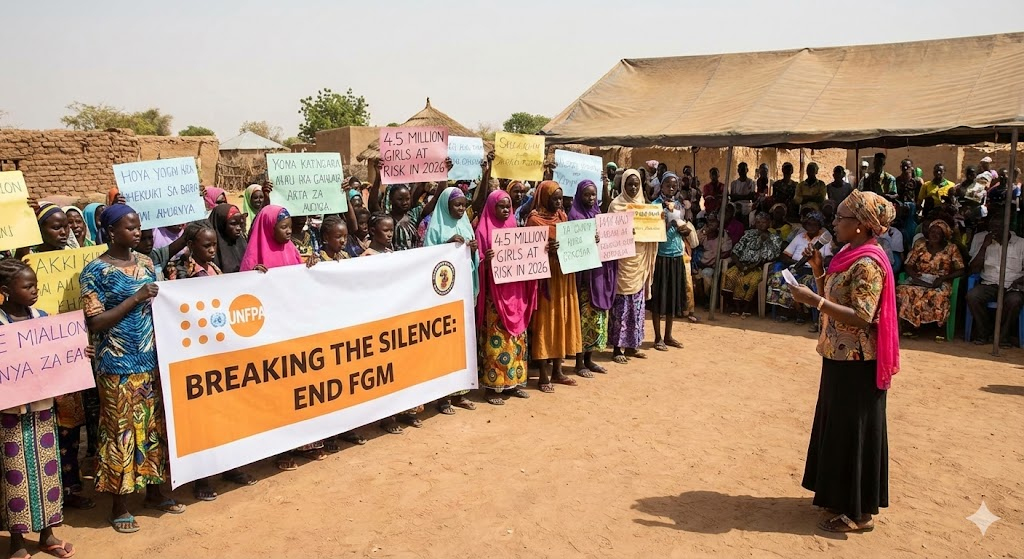

The world on February 6 marks the International Day of Zero Tolerance for Female Genital Mutilation (FGM) amid renewed urgency from the United Nations Population Fund (UNFPA), which warns that at least 4.5 million girls are at risk of being subjected to the practice in 2026 alone, even as an estimated 230 million girls and women globally are already living with its consequences. The figures underscore both the scale of the challenge and the critical need for intensified global action. Despite decades of advocacy, legislation, and community engagement, FGM remains a persistent threat to millions of girls, particularly in parts of Africa, the Middle East, and Asia, where entrenched social norms continue to sustain the practice.
Female genital mutilation refers to procedures that involve altering or injuring the female genital organs for non-medical reasons. It is internationally recognized as a violation of the human rights of girls and women, infringing on their rights to health, security, bodily integrity, and freedom from torture and discrimination. UNFPA emphasizes that there is no medical justification for FGM under any circumstance. Even when carried out by trained healthcare providers in clinical settings — a trend known as “medicalised FGM” — the agency maintains that the procedure remains unsafe, unnecessary, and harmful. The presence of sterilized equipment and professional personnel does not remove the risks or the ethical violations inherent in the act.
FGM is not confined to one region or culture. According to UNFPA, the practice is reported in 94 countries across all continents, making it a truly global issue. Survivors often endure lifelong physical complications such as chronic pain, infections, complications in childbirth, and increased risk of newborn deaths, alongside profound psychological trauma that can affect their well-being for decades. These deep, lasting, and sometimes life-threatening consequences persist even as governments and international organizations step up efforts to eliminate the practice.
One of the enduring barriers to eradication, UNFPA notes, is the misconception in some communities that opposition to FGM is driven by foreign influence seeking to erode cultural identity. Ahead of this year’s observance, the agency moved to dispel this narrative, declaring that the movement to end FGM is increasingly being led from within communities themselves. Local leaders, survivors, religious figures, and grassroots organizations are challenging long-held beliefs and advocating for the protection of girls’ rights, demonstrating that change is rooted in local agency rather than external pressure.
There are, however, measurable signs of progress. Data from about a third of the countries where FGM is practiced show a decline in prevalence over the past three decades, with rates among girls dropping from one in two to one in three in some settings. Surveys also reveal a significant shift in public opinion, with two-thirds of men and women worldwide expressing support for ending FGM. These changing attitudes are seen as critical to dismantling the social norms that have sustained the practice for generations.
UNFPA is calling for intensified collaboration to meet the global target of ending FGM by 2030, in line with the Sustainable Development Goals. The agency stresses that governments, donors, private sector actors, communities, grassroots organizations, and individuals — including girls, women, boys, and men — all have a role to play as agents of change. Cost-effective interventions, investment in education and health services, and sustained community dialogue are considered essential to accelerating progress.
Education, particularly comprehensive sexuality education in schools, is emerging as a powerful tool in prevention. Thousands of children are now learning about bodily autonomy, health, and the dangers of FGM at an early age, helping to shift perceptions among younger generations. By equipping children with accurate information, educators are fostering a culture that questions harmful traditions and promotes respect for human rights.
Africa continues to bear the largest burden of FGM cases worldwide. In countries such as Ethiopia, surveys indicate that three-quarters of women and girls aged 15 to 49 have undergone some form of the practice, reflecting how deeply entrenched it remains in certain communities. However, legislative reforms and stronger enforcement mechanisms in many African nations are beginning to yield results, signaling gradual but important change.
Religious leadership is also playing a transformative role. In Djibouti, Eritrea, and Somalia, Islamic scholars issued a national fatwa in 2025 declaring that there are no religious grounds to justify FGM. This landmark declaration is helping to dismantle one of the most commonly cited justifications for the practice and empowering communities to reconsider long-held assumptions about faith and tradition.
As the world observes the International Day of Zero Tolerance for FGM, the message from UNFPA and its partners is clear: progress is possible, but acceleration is vital. Millions of girls remain at risk, and every delay prolongs the suffering of future generations. Ending FGM requires sustained commitment, local leadership, and a collective global resolve to ensure that every girl grows up free from harm, fear, and discrimination.