

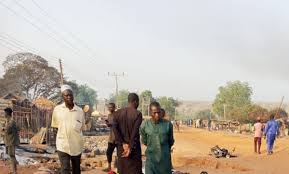

Dozens of residents in the villages of Nuku and Woro in Kaiama Local Government Area of Kwara State, Nigeria, were killed in a ferocious attack on Tuesday, as armed assailants opened fire indiscriminately, set fire to homes, shops, and the residence of the traditional ruler, and forced surviving villagers to flee into surrounding bushes and forests, local lawmaker Saidu Baba Ahmed told BBC Hausa. Conflicting reports have emerged regarding the exact number of fatalities, with Ahmed initially stating that at least 35 people had been killed, while Kwara State Governor AbdulRahman AbdulRazaq confirmed a death toll of 75, describing the victims as “local Muslims massacred for refusing to surrender to extremists preaching a strange doctrine.”
Human rights groups and humanitarian agencies, including the Red Cross and Amnesty International, have since reported far higher figures, with the Red Cross citing 162 deaths and Amnesty International noting that over 170 people had died, many shot at close range and others reportedly burned alive. Several residents were abducted during the attack, highlighting the “stunning absence of any form of security for the protection of lives,” according to Amnesty International, which has called for a thorough investigation into the incident. Eyewitness accounts reveal harrowing scenes of mass killings, arson, and abduction, with villagers describing how the attackers moved methodically through the communities, targeting those who resisted their ideological preaching while leaving the infrastructure in ruins and instilling fear among survivors.
Governor AbdulRazaq, while addressing residents at the palace of the Emir of Kaiama on Wednesday night, emphasized that the attack was a deliberate act of terror and that the state government was coordinating with federal authorities to prosecute counter-offensives under the code-named Operation Savannah Shield. “These people have massacred our citizens in cold blood. President Bola Ahmed Tinubu has approved the immediate deployment of an Army battalion to the affected areas, and security agencies are being reinforced to prevent further attacks,” he said, noting that the attackers were believed to be members of Lakurawa, an armed group linked to the Islamic State Sahel Province. The governor’s statement underlined the sense of vulnerability among border and forest communities in Kwara, highlighting the ongoing threat posed by extremist groups expanding operations into previously relatively secure rural areas. Mohammed Omar Bio, the lawmaker representing the area in the House of Representatives, confirmed the assault to The PUNCH, acknowledging the challenges in accurately reporting the fatality figures due to conflicting information from local communities. Bio noted that some reports suggest around 100 people were killed, while others put the figure at 160, stressing the need for immediate federal intervention to protect lives and restore security in the area. Sources from the affected communities disclosed that approximately 70 victims had been buried in a mass grave in Woro, reflecting the devastating human toll and the urgent need for humanitarian support and forensic investigation to document the extent of the carnage.
Residents recounted that the attackers had previously moved through villages in neighboring Niger State, preaching that locals should abandon Nigeria’s constitution in favor of Islamic law, and that some community members who challenged this messaging in Nuku and Woro were immediately targeted. Alhaji Umar Tanko, the head of Woro village, described losing his daughter and two sons to the attack, while his junior wife and two others were abducted, stating, “I was in my shop when they arrived. They shot my children and took my second wife away.” Another resident, Razaq Abdulazeez, said he narrowly escaped with his family and witnessed people climbing trees or fleeing to the outskirts of the town to evade the gunmen. Reports suggest that the assailants operated from surrounding forested areas along the Borgu axis, a route often linked by security analysts to extremist sleeper operations infiltrating border communities, illustrating the increasing sophistication and reach of such attacks into the north-central region. The violence is part of a broader wave of attacks across Nigeria, including kidnappings in Kaduna, mass killings in Niger, Katsina, Benue, and other states, with human rights organizations estimating that over 271 people have been killed and 253 abducted in the past four weeks alone.
The federal government has acknowledged a small contingent of U.S. troops in Nigeria to provide intelligence and training support, marking the first official confirmation of American military presence in the country since November when former President Donald Trump authorized preparations to tackle Islamist militant groups. Defence Minister Chrisopher Musa did not provide specific details regarding the size, location, or duration of the deployment, while Gen Dagvin Anderson of US Africa Command noted that the presence was in response to a Nigerian request and focused on intelligence support, emphasizing the partnership between the two countries in combating terrorism. The involvement of international partners highlights the gravity of Nigeria’s security challenges, which encompass Islamist insurgency, criminal banditry, farmer-herder clashes, and separatist unrest, compounded by porous borders with Niger and Benin and extensive forested terrain that facilitate the movement and concealment of armed groups.
Political reactions to the Kwara attacks were immediate and strong. Former Senate President Bukola Saraki described the killings as a national disaster, urging decisive federal intervention, writing, “What we are witnessing in parts of Kwara State—particularly in the northern and southern senatorial districts—has gone beyond the capacity of the state government and now requires decisive, direct federal intervention. Kwara State is too strategic to this country, serving as a bridge between the North and the Southwest. We should not allow insurgency to gain ground here.” Saraki emphasized the need for collaboration among all security agencies and called for the establishment of military bases in affected districts. The Speaker of the Kwara State House of Assembly, Yakubu Danladi-Salihu, and Senator Saliu Mustapha also called for intensified military action and additional troop deployments along vulnerable border areas, highlighting the need for community cooperation in intelligence gathering and preventive security measures.
Opposition parties in Kwara, including the Peoples Democratic Party (PDP) and the New Nigeria People’s Party (NNPP), condemned the attacks and criticized the state government’s response as insufficient. Ladipo Johnson, National Publicity Secretary of the NNPP, expressed sympathy for victims and their families, urging national unity and a review of Nigeria’s security architecture, noting that more advanced technologies, including drones, may be necessary to counter rapid and mobile banditry operations. The PDP’s State Publicity Secretary, Olusegun Adewara, described the governor’s statements as “cosmetic and lacking hope or concrete reassurance for wounded victims,” emphasizing that Kwara requires decisive, practical, and people-oriented leadership, immediate humanitarian relief, and medical assistance for affected communities. Both parties stressed that superficial public statements were inadequate given the scale and brutality of the attacks.
The Nigerian military and forest guards have taken control of Nuku and Woro to prevent further incursions and protect surviving residents. Troops from ongoing counterterrorism operations, including Operation Fansan Yamma and Operation Whirl Stroke, have been redeployed to forested and rural areas, with mandates to arrest suspects, rescue abductees, recover weapons, and dismantle criminal networks before they can establish new operational bases. Despite these deployments, the continuing frequency of attacks has reinforced concerns about the vulnerability of rural communities and the capacity of security forces to prevent massacres before they occur.
The Kwara attacks occurred against the backdrop of a spate of violence elsewhere in the country. In Benue State, bandits attacked Abande community in Kwande Local Government Area on Tuesday, killing a police officer and several residents, with casualty figures ranging from five to 17 according to different local sources. Governor Hyacinth Alia condemned the assault and called for enhanced security presence, stressing the government’s commitment to protecting lives and restoring order. Similarly, the Senate raised alarm over escalating bandit attacks in Katsina State’s Funtua Zone, where at least 35 people were reportedly killed within 24 hours across multiple local government areas, prompting calls for the establishment of a military barracks, deployment of armoured police vehicles, and comprehensive federal intervention.
In Ebonyi State, the Nigerian Army dismissed reports of fatalities among soldiers during an attack in Oso Edda community, clarifying that the operation was ongoing in coordination with police, DSS, and the NSCDC. Lt. Col. Emmanuel Chielo, Cantonment Commander of Nkwagu Military Barracks, described allegations of two soldiers killed and a vehicle destroyed as false, while committing to recovering victims beheaded during attacks on Okporojo village. He warned of the risks posed by the illicit movement of small arms across states and emphasized that security should not be left to government alone, noting that local vigilance is crucial in preventing further violence.
The cumulative effect of these incidents emphasizes a national security crisis characterized by the convergence of extremist insurgencies, banditry, and communal conflicts, amplified by challenging terrain, porous borders, and insufficient intelligence in vulnerable areas. The attack on Nuku and Woro in Kwara is emblematic of the growing sophistication of armed groups who exploit gaps in security coverage, targeting civilians, traditional authorities, and infrastructure while instilling fear and displacing thousands. Humanitarian agencies have stressed the urgency of relief, psychological support, and food assistance for survivors, many of whom have lost homes, livelihoods, and family members. Analysts note that Kwara’s strategic location as a bridge between northern and southwestern Nigeria makes it a critical area for federal security operations, and the attack has intensified public scrutiny of government responses at both state and federal levels, highlighting the need for comprehensive strategies combining military, humanitarian, and community-based interventions to prevent the recurrence of such massacres.