

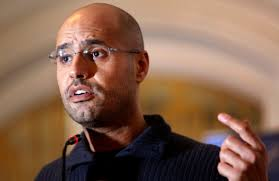

Libyan prosecutors have opened an investigation into the reported killing of Saif al-Islam Gaddafi, son of former Libyan leader Col Muammar Gaddafi, after he allegedly died from gunshot wounds during what authorities described as a “direct confrontation” with armed men in the city of Zintan. In a statement on Wednesday, the public prosecutor’s office said four unidentified gunmen were said to have broken into his residence, leading to an exchange that left the 53-year-old dead. Officials confirmed that forensic experts had been dispatched to Zintan to examine the scene and gather evidence, while security agencies work to identify those responsible for the attack.
The prosecutor’s statement said Saif al-Islam “died from wounds by gunfire” and emphasized that investigations were ongoing to establish the circumstances surrounding the incident. The authorities noted that the situation remained fluid, with initial reports still being verified. The swift deployment of forensic teams underlined the sensitivity of the case, given Saif al-Islam’s controversial political history and symbolic weight in Libya’s post-revolution narrative.
However, conflicting accounts quickly emerged. Saif al-Islam’s sister told Libyan television that he did not die in Zintan but near Libya’s border with Algeria, raising questions about the exact location and sequence of events leading to his death. These divergent narratives have added uncertainty to an already complex situation and reflect the broader challenge of verifying information in a country where authority is fragmented and communication lines are often opaque.
Adding to the confusion, Saif al-Islam’s lawyer told the AFP news agency that the incident appeared to be a targeted assassination carried out by what he described as a “four-man commando unit.” The lawyer said it was unclear who may have ordered the attack or what motives lay behind it, but he insisted that the circumstances pointed to a premeditated operation rather than a spontaneous confrontation. This claim has intensified speculation about whether the killing was politically motivated.
BBC World Affairs editor John Simpson, who had met Saif al-Islam on several occasions, described him as “a strange, mercurial figure, but much less eccentric than his father.” Simpson recalled interviewing him during the 2011 uprising, recounting how Saif al-Islam initially berated him in front of officials before later apologizing privately, saying, “They expect it of me.” Simpson also attended Saif al-Islam’s trial in Zintan and observed what he described as his remarkable ability to negotiate with and win over his captors.
Libyan journalist and writer Abdulkader Assad suggested that Saif al-Islam’s death could have been the result of local political rivalries, given his lingering popularity among some segments of the population. Assad also noted the possibility of foreign actors being involved due to Saif al-Islam’s controversial past and his potential re-emergence in Libya’s political scene. These theories, while unconfirmed, reflect the many layers of political tension that still characterize Libya’s fractured environment.
Born in 1972, Saif al-Islam Gaddafi rose to prominence during his father’s long rule and was widely regarded as the most influential of Muammar Gaddafi’s children. Though he held no formal government office, he played a key role in shaping policy and representing Libya abroad, particularly during the early 2000s when the country sought to rebuild relations with Western nations after years of sanctions and isolation.
Saif al-Islam was central to negotiations that led Libya to abandon its nuclear weapons programme in 2003, a move that resulted in the lifting of international sanctions and a tentative rapprochement with Western governments. During this period, he cultivated an image as a reformist figure, engaging with diplomats, academics, and media outlets to present a more moderate face of the Libyan regime. Despite this, he repeatedly denied ambitions to inherit power, famously saying that leadership was “not a farm to inherit.”
The collapse of the Gaddafi regime during the 2011 uprising marked a dramatic turning point. Saif al-Islam was accused of playing a leading role in the violent suppression of protests against his father’s rule. After months on the run, he was captured by a militia in Zintan, where he remained imprisoned for nearly six years under the control of local fighters rather than the central government.
The International Criminal Court (ICC) issued a warrant for his arrest on charges of crimes against humanity, alleging his involvement in orchestrating violence against civilians during the uprising. In 2015, a court in Tripoli sentenced him to death in absentia, a ruling issued while the capital was under the control of the UN-backed government. However, this sentence was never carried out due to the fragmented authority across the country.
In 2017, Saif al-Islam was released by a militia in Tobruk under an amnesty law passed by eastern authorities. His release reignited debate about his possible return to politics, especially after he announced in 2021 that he intended to run in Libya’s postponed presidential elections. For many Libyans, his name remained tied to memories of repression, while for others he symbolized stability amid chaos.
Since the overthrow of Muammar Gaddafi, Libya has been divided between rival governments in the east and west, alongside numerous militias that control territory and wield significant power. This fractured political landscape has made the country vulnerable to lawlessness and has left high-profile figures exposed to threats from various factions with competing interests.
The reported killing of Saif al-Islam highlights the enduring instability in Libya and the lingering impact of unresolved grievances from the revolution. His life embodied both the attempt to modernize Libya’s image and the darker legacy of authoritarian rule, making him a deeply polarizing figure whose fate continues to resonate politically and symbolically.