

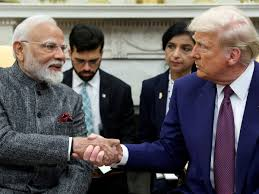

In a significant development in global trade relations, United States President Donald Trump announced that Washington will reduce tariffs on Indian goods to 18 percent from the previous 50 percent, following a diplomatic phone call with Indian Prime Minister Narendra Modi. The tariff cut comes with reciprocal commitments by India to ease barriers to American goods and to significantly expand its purchases of U.S. energy, technology, agricultural, and other products. Trump said India would buy more than $500 billion worth of U.S. exports, a figure that reflects the scale of economic engagement both sides are seeking in the years ahead.
“Out of friendship and respect for Prime Minister Modi and, as per his request, effective immediately, we agreed to a Trade Deal between the United States and India, whereby the United States will charge a reduced Reciprocal Tariff, lowering it from 25% to 18%,” Trump said in a social media post following the call with Modi. His statement underscored the personal rapport between the two leaders and the strategic importance the Trump administration places on strengthening commercial ties with New Delhi.
Modi responded warmly to the announcement, taking to the social platform X (formerly Twitter) to say, “Wonderful to speak with my dear friend President Trump today. Delighted that Made in India products will now have a reduced tariff of 18%. Big thanks to President Trump on behalf of the 1.4 billion people of India for this wonderful announcement.” Modi’s message highlighted both the diplomatic warmth and the domestic political messaging inherent in a major trade shift.
A senior White House official, speaking to Reuters on condition of anonymity, clarified that the U.S. was rescinding a punitive 25 percent duty on all imports from India that had been levied over New Delhi’s purchases of discounted Russian crude. That duty had been stacked atop an already existing 25 percent “reciprocal” tariff rate, effectively placing a 50 percent net tariff on many Indian goods entering the United States.
The tariff reduction represents not just an economic adjustment but the culmination of months of tense negotiations and escalating bilateral trade tensions. Last August, in an effort to pressure India to curb purchases of Russian oil amid widespread sanctions by Western nations following Russia’s invasion of Ukraine — Trump doubled duties on imports from India to 50 percent. Washington signaled that the rate could rise even further if New Delhi continued to purchase substantial volumes of Russian crude.
India, for its part, has relied heavily on imported oil to meet its energy needs, with around 90 percent of its consumption satisfied through foreign crude purchases. Buying cheaper Russian oil after sanctions helped reduce India’s import bill, but it drew sharp criticism from the United States. Alongside Russia, India has also been a historic buyer of Venezuelan oil — despite sanctions and production challenges — leading some analysts to speculate that expanding purchases from Venezuela could help New Delhi replace some Russian volumes while complying more with Western preferences.
Trade experts say this newly announced tariff adjustment is important, but they caution that it may be too soon to call the outcome a full comprehensive trade deal. “The deal has definitely been some time in coming,” said Rachel Ziemba, adjunct senior fellow at the Center for a New American Society. “Eighteen percent puts it near the level for Southeast Asian goods into the U.S., which is significant. But we need to watch how quick India implements changes on its side,” she said, emphasizing that reciprocal actions would determine the deal’s depth.
Others agreed that the announcement was essentially a de‑escalation of tariffs rather than a sweeping trade pact. “Prime Minister Modi welcomed the news, but didn’t reassert President Trump’s claim that India was lowering tariffs on U.S. goods,” noted Vina Nadjibulla, vice president of research and strategy at the Asia Pacific Foundation of Canada. “It looks like — for now — a deal around tariffs and de‑escalation of tariffs… It’s still an important breakthrough, but not the end of negotiations.”
The tariff dispute had tangible economic effects. With high U.S. duties in place, Indian markets underperformed relative to peers among emerging economies, at times becoming the worst‑performing market globally in 2025. Foreign investors pulled capital in response to increased trade uncertainty, dampening investment sentiment. Analysts said the tariff adjustments could help stabilize markets and wick away some of the trade‑related uncertainty that had shadowed Indian equities and bonds.
India’s strategic economic calculus is also influenced by trade developments beyond its relationship with the United States. Just days before the tariff announcement, India and the European Union reached a long‑awaited free trade agreement after nearly two decades of negotiations. Known informally as the India‑EU deal, it would enable free trade on almost all goods between the EU’s 27 members and India, covering sectors from textiles to pharmaceuticals and reducing high import taxes on wine, autos, and other products.
That pact with the European Union has been interpreted as part of New Delhi’s broader strategy to diversify trade partners and reduce over‑reliance on any single market, including the U.S. and China. By securing favorable access to the European bloc, India aims to strengthen its export base and attract investment across a wide range of sectors, making it less vulnerable to geopolitical shifts in bilateral relations.
Energy supplies remain a central theme in the economic and diplomatic interplay. With Russia under sanctions and the Middle East volatile, securing stable, diversified energy sources has become a priority for India. U.S. oil and liquefied natural gas (LNG), as well as Venezuelan crude where feasible, now receive added attention in Indian import planning, although pricing and long‑term contracts will be key determinants of actual trade flows.
U.S. officials said the expanded purchase commitments, especially in energy, represent a mutually beneficial relationship. Washington views India as a partner in global energy markets, while New Delhi sees U.S. technology and agricultural products as essential components of its modernization and growth agenda. These commercial linkages are increasingly framed as part of a strategic partnership extending beyond trade into security cooperation in the Indo‑Pacific region.
Nevertheless, critics of the tariff reduction within both the U.S. and India question whether economic benefits will materialize as projected. American industrial groups, while welcoming improved access for U.S. exports, have urged clearer commitments on intellectual property protections and investment safeguards. Indian business representatives, meanwhile, caution that rapidly lowering tariffs without adequate transition periods could expose domestic manufacturers to sharp competition.
Diplomatic analysts argue that this tariff move may also be interpreted through a wider geopolitical lens. As the U.S. and India navigate shared concerns about China’s economic and military rise, strengthening commercial ties may serve strategic interests on both sides. Trade negotiations, in this view, are not purely economic exercises but part of broader geopolitical positioning, alliance building, and influence.
Despite the progress signaled by the announcement, much work remains ahead. Negotiations over tariff schedules, non‑tariff barriers, and market access will continue. Observers say both countries need to formalize commitments, establish monitoring mechanisms, and clarify timelines before the deal can be fully operationalized and confidence restored among investors and manufacturers.
As Washington and New Delhi move forward with their trade engagement, the global economic landscape will be attentive. How this agreement shapes trade flows, impacts energy markets, and influences broader diplomatic relations will provide key insights into 21st‑century global trade dynamics, where economic policy is increasingly tethered to strategic alliances and geopolitical objectives.