

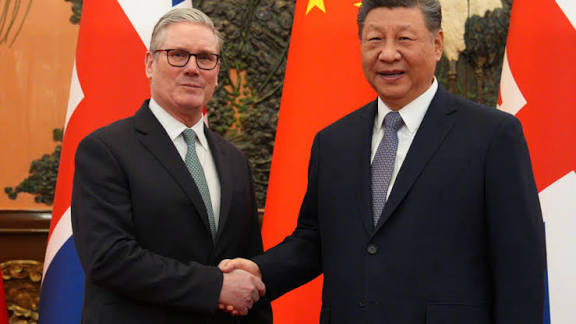

United Kingdom Prime Minister Keir Starmer on Wednesday arrived in Beijing to begin a four-day visit to China, stating that Britain does not have to choose between maintaining relations with the United States and engaging with China. Speaking to reporters aboard his plane before landing, Starmer emphasized that his trip was aimed at balancing engagement with China alongside national security concerns. “I’m a pragmatist, a British pragmatist applying common sense,” he said, stressing his approach to navigating the complexities of international relations.
Starmer’s visit marks the first trip by a sitting U.K. prime minister to Beijing since Theresa May in 2018. The bilateral relationship has cooled significantly since that time, affected by concerns over Chinese espionage, Beijing’s support for Russia in the Ukraine war, and the erosion of civil liberties in Hong Kong, the former British colony. These issues have created tension, yet both countries have indicated a willingness to seek areas of common ground while managing differences. Zheng Zeguang, China’s Ambassador to the U.K., wrote in a commentary for The Times of London that the two nations should “seek common ground while managing differences,” highlighting a shared interest in stabilizing relations.
The economic aspect of Starmer’s visit is central to the agenda. He is accompanied by a delegation of over 50 British business leaders, including executives from British Airways, HSBC, and Jaguar Land Rover. The itinerary includes Shanghai, China’s financial hub and major port, as well as Beijing, where Starmer is scheduled to meet with President Xi Jinping and other Chinese leaders. The goal is to expand opportunities for British companies in China, particularly in the services sector.
British strengths in finance, consulting, and other service industries align with growing demand in China for services such as healthcare and elderly care. Starmer told members of the business delegation that they were “making history” and that engaging with China is in the U.K.’s national interest. “Of course, we will have to manage our differences,” he added, acknowledging the political and security sensitivities that exist alongside economic opportunities.
Trade between China and the U.K. shows a substantial imbalance in goods, with China exporting $85.1 billion worth of products to the U.K. in 2025 while importing only $18.6 billion. However, the U.K. maintains a trade surplus in services, offering potential for expansion. The China-Britain Business Council highlighted that recent Chinese policies aimed at boosting domestic consumption and opening the services sector to international businesses could create “significant opportunities for growth for U.K. businesses,” demonstrating the strategic importance of Starmer’s delegation.
The visit occurs against the backdrop of global trade disruptions. Tariffs imposed under the Trump administration prompted countries to diversify supply chains and explore new markets. Britain and China, both affected by these disruptions, are seeking to expand trade and investment relationships in ways that strengthen economic resilience. Canadian Prime Minister Mark Carney also visited China earlier this month with similar objectives, demonstrating the international imperative to secure trade partnerships amid uncertainty.
While the potential economic benefits are significant, the visit comes with clear risks. Britain has barred Chinese investment in sensitive telecom infrastructure and excluded China from nuclear power projects, reflecting longstanding concerns about espionage and national security. Starmer’s government has stated that it will protect national security while maintaining diplomatic dialogue and economic cooperation with China.
The construction of a new Chinese Embassy in London is a notable development in bilateral relations. The embassy addresses prior diplomatic tensions, but critics argue that its scale could facilitate espionage and pressure on dissidents. The U.K. government has approved the plans, signaling its commitment to engagement with China while emphasizing that security measures remain in place to mitigate potential risks.
Human rights issues, particularly related to Hong Kong, remain sensitive in the U.K.-China relationship. The conviction of Jimmy Lai, a former newspaper publisher and British citizen, under Hong Kong’s national security law has heightened scrutiny. Starmer is expected to raise concerns about political freedoms and the treatment of dissidents while navigating the broader economic and diplomatic agenda of his visit.
Chris Patten, the last British governor of Hong Kong, urged Starmer to adopt a firm stance on Lai’s imprisonment and other human rights matters, citing the U.K.’s historical responsibility toward Hong Kong. Patten emphasized that engagement with China should not preclude raising issues related to press freedoms and democratic protections in the territory.
Starmer’s approach seeks to maintain strong engagement with China while safeguarding national security interests. The government has signaled that measures such as restricting Chinese investment in sensitive infrastructure will continue alongside diplomatic efforts and commercial engagement.
British companies in the delegation are expected to explore opportunities in sectors where the U.K. has a comparative advantage, including financial services, consulting, technology, and healthcare. China’s ongoing policy shifts to increase domestic consumption and liberalize the services sector provide a framework for potential growth, particularly for high-value service exports.
China’s trade surplus in goods with the U.K. contrasts with the British surplus in services, reinforcing the focus on expanding the services market. U.K. officials emphasize that a strong presence in China’s service sector could yield sustainable economic returns while maintaining strategic engagement.
The visit also reflects the broader strategic balance that the U.K. seeks between major powers. Starmer has consistently underscored that Britain can pursue economic and diplomatic engagement with China without undermining its longstanding alliance with the United States, highlighting an independent approach to foreign policy.
Security concerns are intertwined with economic priorities. Excluding Chinese companies from sensitive sectors, such as telecommunications and nuclear energy, aims to protect critical infrastructure while allowing other areas of collaboration. The U.K. government communicates that this approach ensures economic opportunity does not compromise national security.
Meetings with Chinese leaders, including President Xi Jinping, are set to address multiple dimensions of the bilateral relationship, including trade, investment, technology, and security. Both sides have emphasized the need to manage differences while identifying areas for cooperation, reflecting a pragmatic approach to complex relations.
The services sector is a major focus of the visit. British strengths in financial and professional services, healthcare, and technology consulting match China’s growing domestic demand in urban centers such as Shanghai and Beijing. Government officials have highlighted that leveraging these opportunities could significantly enhance the U.K.’s trade performance.
Concerns over espionage and surveillance continue to affect decision-making. The U.K. has implemented policies to prevent Chinese investment in sensitive areas, reflecting broader apprehensions about security. These measures coexist with ongoing efforts to expand trade, illustrating the dual-track approach of engagement alongside protection.
Human rights remain an integral dimension of Starmer’s diplomatic engagement. The Hong Kong national security law and the conviction of Jimmy Lai have increased attention on political freedoms. While economic engagement is a priority, the U.K. is navigating the diplomatic landscape to address these issues without derailing commercial and strategic objectives.
The trip also coincides with global pressures on trade and investment. Disruptions from previous U.S. tariff policies and ongoing geopolitical competition highlight the need for careful strategic planning. Britain’s delegation, political leadership, and business representatives are all focused on maximizing opportunities while managing challenges in this evolving environment.