

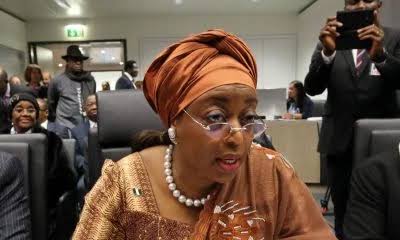

Former Nigerian petroleum minister Diezani Alison-Madueke appeared at Southwark Crown Court in London on Tuesday to formally deny multiple bribery charges as her trial began, facing allegations that she used her position to secure illicit payments and live a “life of luxury” while in office. Alison-Madueke, 65, was charged with accepting bribes between 2011 and 2015 while serving as Nigeria’s minister of petroleum resources under former President Goodluck Jonathan, according to prosecutors who detailed the alleged wrongdoing at the opening of the trial. The court heard that the charges stem from claims that individuals seeking lucrative contracts with Nigeria’s state-owned oil company provided her with financial and other advantages in exchange for influence over contract awards.
The prosecution told the court that Alison-Madueke received substantial financial benefits and gifts from individuals linked to Atlantic Energy and SPOG Petrochemical, two companies that secured contracts with the Nigerian National Petroleum Corporation (NNPC) and its subsidiaries. “She should not have accepted benefits from those doing extremely lucrative business with government-owned entities,” the prosecutor said, highlighting the central allegation of corruption. Among the alleged benefits were £100,000 in cash, chauffeur-driven vehicles, private jet flights, refurbishment work on London properties, staff costs, and school fees for her son, as well as luxury items from stores including Harrods and Louis Vuitton.
Alison-Madueke has consistently denied all charges, and she maintained her plea of not guilty as the trial opened. She has been on bail since her arrest in London in October 2015 and was formally charged in 2023. Her legal team emphasized that she denies any wrongdoing and is prepared to contest the allegations in court. Two co-defendants, her brother Doye Agama and Olatimbo Ayinde, are also standing trial on related bribery charges, and the court heard that the proceedings will examine their involvement alongside that of the former minister.
The court was told that Alison-Madueke’s tenure as minister coincided with Nigeria’s ongoing struggle to manage its oil wealth transparently and effectively, with allegations of systemic corruption in the sector drawing international scrutiny. The UK National Crime Agency previously said it suspected she “abused her power in Nigeria and accepted financial rewards for awarding multi-million-pound contracts,” a statement that has informed international investigations into her activities. Prosecutors noted that her high-profile role, including serving as president of the Organisation of Petroleum Exporting Countries (OPEC) from 2014 to 2015, placed her in a position of considerable influence over global oil policy as well as domestic contracts.
Alison-Madueke’s legal troubles are not confined to the United Kingdom. In the United States, she has been linked to several investigations concerning alleged financial misconduct, and Nigerian authorities have previously seized her properties valued at several million dollars in 2017. The Economic and Financial Crimes Commission (EFCC) in Nigeria continues to pursue additional cases against her, reflecting the long-standing domestic concern over allegations of corruption and misuse of office. Analysts note that her case is emblematic of the broader challenges in Nigerian governance, where oversight of the petroleum sector has historically been limited.
The opening statements in court detailed how the alleged bribes were allegedly funneled through a variety of means, including cash, personal expenses, and luxury items, illustrating the lavish lifestyle prosecutors claim Alison-Madueke enjoyed while in office. Items such as high-end fashion, jewelry, and private travel were cited as examples of benefits she allegedly received from companies seeking preferential treatment from Nigeria’s oil institutions. Prosecutors emphasized that these payments were connected to her ability to award contracts through her official position as petroleum minister, framing the charges as a breach of trust at the highest levels of government.
Judge Justine Thornton, overseeing the trial, addressed the court at the opening, noting the complex nature of the case and the international dimensions involved. She said she hoped the trial would conclude by April 24, signaling the court’s intent to manage a detailed and evidence-intensive proceeding efficiently. The judge also emphasized the importance of ensuring a fair trial given the high-profile nature of the defendant and the serious financial and legal implications of the case.
Corruption in Nigeria’s oil sector has long been a source of public concern, with billions of dollars reportedly lost to mismanagement, fraud, and illicit dealings over decades. Alison-Madueke’s trial has drawn attention because it involves allegations at the top levels of government, where policy decisions intersect with personal enrichment, highlighting the difficulties in enforcing accountability in sectors critical to national revenue. Analysts note that outcomes in high-profile cases such as this could influence future governance reforms and anti-corruption measures in Nigeria.
The prosecution argued that Alison-Madueke’s acceptance of inducements allowed her to maintain a lifestyle that would have been difficult to sustain on her official salary alone, citing expenditures on London properties, private education, and international travel. Prosecutors suggested that these benefits were directly tied to the awarding of contracts and that they represented a misuse of her ministerial authority for personal gain. This framing positions the trial not only as a criminal matter but also as an examination of systemic vulnerabilities in international contract enforcement and oversight.
Alison-Madueke’s defense team has questioned the reliability of witnesses and the admissibility of evidence obtained during various stages of investigation, noting that many of the transactions and contracts occurred years ago and were entangled in complex corporate structures. Legal experts observing the case have noted that her lawyers are likely to challenge the interpretation of financial flows and the connection between alleged benefits and official acts, a strategy that could complicate the prosecution’s narrative. The defense has reiterated that Alison-Madueke is cooperating with the court and intends to clear her name.
The broader international context of Alison-Madueke’s case is notable, as it coincides with increasing scrutiny of corruption linked to global oil markets. The OPEC presidency she held placed her in a position with both national and international visibility, intensifying the consequences of any proven wrongdoing. Analysts argue that successful prosecution could set a precedent for holding high-ranking officials accountable across borders, especially in cases involving transnational financial flows and cross-jurisdictional investigations.
In Nigeria, public perception of Alison-Madueke has been shaped by earlier investigations and media reporting, including the seizure of her assets and the high-profile nature of her tenure. The EFCC’s ongoing cases reflect a persistent domestic effort to recover allegedly misappropriated funds and enforce accountability, while also navigating the challenges posed by international law and cross-border enforcement. Observers suggest that the trial in London will be closely watched both within Nigeria and internationally for indications of how major corruption cases may be handled in courts outside the defendant’s home country.
The case also illustrates the role of global law enforcement agencies in tackling alleged corruption involving politically exposed persons. The involvement of the UK National Crime Agency and the coordination with Nigerian authorities highlights the complexity of transnational financial crime investigations. Legal commentators note that cases like Alison-Madueke’s test the capacity of courts to adjudicate intricate financial and political allegations while balancing the rights of defendants and the interests of justice.
As the trial progresses, court officials have indicated that it will involve detailed examination of financial records, witness testimonies, and contractual documents connecting Alison-Madueke to the alleged bribes. Prosecutors are expected to present a comprehensive case demonstrating the flow of inducements and the corresponding decisions made in her official capacity. Observers anticipate that the proceedings will attract significant media coverage, given both the high-profile nature of the defendant and the enduring public interest in governance and corruption issues in Nigeria’s oil sector.