

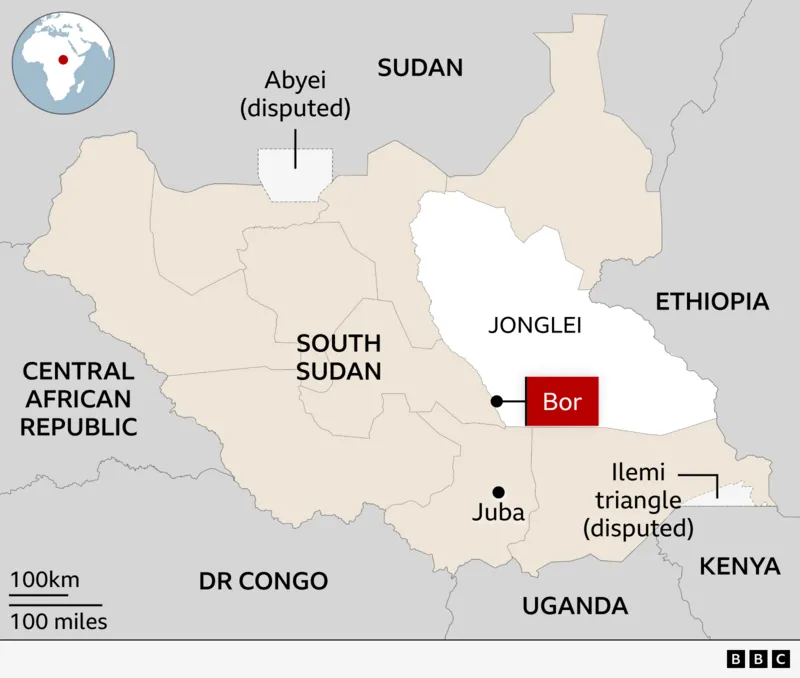

South Sudan is facing a new wave of tension and fear as the country grapples with escalating violence in Jonglei state, following inflammatory remarks by Deputy Army Chief Gen. Johnson Oluny, who reportedly urged his troops to “spare no one,” explicitly including children, the elderly, and civilians, during preparations to deploy forces to opposition-held areas. The remarks, captured in a video posted on Facebook, have drawn immediate condemnation from the United Nations, with the head of the UN Mission in South Sudan (UNMISS) describing the rhetoric as “utterly abhorrent” and warning that it must stop immediately. The UN Commission on Human Rights in South Sudan (UNCHRSS) echoed these concerns, expressing “grave alarm” at the situation, noting that such public incitement to commit serious crimes against civilians, including the most vulnerable, is not only shocking but profoundly dangerous. According to UNCHRSS head Yasmin Sooka, language calling for the killing of those no longer participating in hostilities and civilians, including the elderly, represents a direct threat to international human rights norms, raising fears of large-scale atrocities if the military operation proceeds without restraint.
The remarks by Gen. Oluny come amid heightened military activity in Jonglei, where forces aligned with South Sudan’s suspended Vice President Riek Machar and his Sudan People’s Liberation Movement-in-Opposition (SPLM-IO) have captured several counties in recent weeks. The South Sudanese military has ordered all civilians and personnel from UNMISS and other aid agencies to evacuate Nyirol, Uror, and Akobo counties within 48 hours, citing an imminent operation to “crush the rebellion.” An Unmiss spokesperson confirmed that peacekeepers in Akobo remain in place to de-escalate tensions and protect civilians, though the status of personnel in the other counties remains unclear. Meanwhile, SPLM-IO officials have publicly stated their forces expect to reach the capital, Juba, by the end of February, signaling the potential for the conflict to expand beyond Jonglei. The army, however, has downplayed the threat, with spokesperson Gen. Lul Ruai Koang asserting that opposition forces lack the capacity to seize the capital and expressing confidence in the military’s preparedness for any eventualities. These statements underline the tense standoff between government and opposition forces, with both sides framing the situation as critical to their strategic objectives.
The humanitarian consequences of the conflict are already severe, with the UN estimating that more than 180,000 people have been forced to flee their homes due to the escalating fighting. Witnesses in Jonglei have described civilians seeking refuge in swamps to escape military operations, highlighting the immediate risks posed to non-combatants. The UNCHRSS issued a statement underscoring that “no senior political or military leader in Juba can claim to be unaware of the blatant public incitements to commit serious crimes” in the region, emphasizing the urgent need for restraint to prevent widespread human suffering. In addition to displacement, the threat to critical humanitarian operations is substantial, with evacuations of aid workers potentially hampering the delivery of essential food, medical care, and other support services to vulnerable populations. The rhetoric employed by Gen. Oluny, combined with the military’s operational plans, has prompted international concern that the situation could rapidly deteriorate into targeted violence against civilians, a scenario the UN and human rights bodies are actively seeking to prevent through diplomatic engagement and on-the-ground monitoring.
The unfolding crisis must also be understood in the broader historical and political context of South Sudan, the world’s youngest nation, which gained independence in 2011. Conflict erupted in 2013, just two years after independence, when President Salva Kiir accused his former deputy, Riek Machar, of plotting a coup. The civil war that followed, fueled by both political rivalry and deep-seated ethnic divisions between Kiir’s Dinka community and Machar’s Nuer supporters, resulted in nearly 400,000 deaths and widespread displacement. A peace agreement in 2018 formally ended hostilities, establishing a power-sharing arrangement intended to stabilize the country. However, the deal has never been fully implemented, and the fragile relationship between Kiir and Machar has repeatedly unraveled amid intermittent violence and mutual distrust. Machar’s recent arrest last March further strained the tenuous peace, raising fears that renewed hostilities could plunge South Sudan back into full-scale civil war. Analysts note that Jonglei, long a flashpoint for ethnic violence and political contestation, reflects the broader instability that has prevented sustainable governance in the country, with the current standoff representing both a political and humanitarian crisis.
As South Sudan teeters on the edge of renewed conflict, the international community faces urgent pressure to respond. UNMISS continues to emphasize its role in de-escalating tensions, while UN human rights officials are calling for accountability for any incitement to violence and robust protections for civilians. The military’s insistence on evacuating both civilians and aid personnel underscores the severity of the threat, and the SPLM-IO’s advance toward government-controlled areas signals the potential for the conflict to widen, potentially destabilizing Juba and other parts of the country. The combination of incendiary military rhetoric, ethnic tensions, and fragile political structures makes the situation in South Sudan exceptionally volatile.