

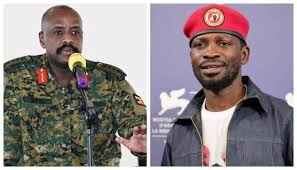

Ugandan opposition leader Bobi Wine has accused the country’s military of assaulting his wife, Barbara Kyagulanyi, during a raid at their home, an allegation that has sparked renewed tensions in the East African nation following a disputed presidential election. According to Wine, who has been in hiding since the announcement of the results, military officers held his wife at gunpoint, physically assaulted her, and confiscated documents and electronic devices from their residence. Barbara Kyagulanyi, speaking from a hospital bed, described a harrowing ordeal in which dozens of men, some in military uniform, broke into their home, harassing her and demanding to know her husband’s whereabouts. She recounted how one officer struck her on the face, tearing her lip, while another lifted her by the waistband of her trousers and choked her as she hung mid-air. She further alleged that her blouse was forcibly removed, leaving her partially naked, and that her hair was pulled, causing further injury and distress. The incident reportedly left her with both physical and psychological trauma, and Wine said his wife was hospitalized as a result.
The allegations come amid an intensified government crackdown on the opposition, with Wine claiming that his home continues to be surrounded by military personnel, and that threats against his life persist. In response, Uganda’s military chief, General Muhoozi Kainerugaba, categorically denied the claims, posting on X that “my soldiers did not beat up Barbie [Bobi Wine’s] wife,” asserting that soldiers do not target women and that their focus remains on apprehending Wine, whom Kainerugaba has repeatedly demanded to surrender since Museveni’s reelection. He added that the military was not interested in harming Barbara Kyagulanyi, referring to her husband as “cowardly” and indicating that security operations were directed solely at locating him.
The backdrop to these events is Uganda’s recent presidential election, held on January 15, in which long-serving President Yoweri Museveni was declared the winner, marking another term in a tenure that began in 1986 and which will span 45 years by its conclusion in 2031. Museveni, whose son Kainerugaba is the military chief, secured what the government described as a landslide victory, but the results were immediately contested by Wine, a popular musician-turned-politician who leads the opposition National Unity Platform (NUP).
Wine rejected the outcome, citing widespread fraud and irregularities, and has accused the security forces of targeting him and his supporters since the election. Reports from the opposition and independent observers suggest that a number of NUP supporters have faced arrests, detentions, and, in some cases, lethal force by security agencies. Kainerugaba himself has publicly stated that 30 opposition supporters were killed and approximately 2,000 detained following the election, underscoring the high level of political tension and the militarized response to dissent. The Uganda Law Society has condemned the wave of detentions, assaults, and enforced disappearances, stating that no individual should be subjected to violence under the pretext of national security, signaling concerns among legal and civil society groups regarding the country’s human rights record and the suppression of political opposition.
Barbara Kyagulanyi’s detailed account of the raid paints a disturbing picture of the human cost of these political tensions. She described being physically assaulted, humiliated, and left traumatized by the violent intrusion into her home, emphasizing that the military officers’ actions were aimed at coercing her into revealing her husband’s location. Wine, in posts on X, reiterated that the military continues to threaten him and that he remains in hiding, while expressing gratitude to those who have assisted in keeping him safe.
These incidents reflect a broader pattern of post-election unrest in Uganda, where opposition figures and their supporters frequently face intimidation, harassment, and violence. Lawmaker Muwanga Kivumbi, a close ally of Wine, was arrested last week over alleged election-related violence, which the NUP denied, illustrating the ongoing crackdown on dissenting voices. Historical context shows that Uganda has never witnessed a peaceful transfer of presidential power, and Museveni’s extended rule has been characterized by repeated claims of election irregularities and heavy-handed responses to opposition, further intensifying political polarization.