

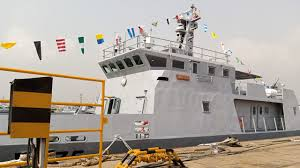

The Nigerian Navy has intensified efforts to expand its indigenous shipbuilding programme, signaling a strategic commitment to strengthen operational capability and reduce reliance on foreign-built naval platforms. This determination was highlighted by the attendance of the Chief of the Naval Staff (CNS), Vice Admiral Idi Abbas, at the ninth edition of the Doha International Maritime Defence Exhibition and Conference (DIMDEX 2026) held in Qatar from January 19 to 22. In a statement released on Thursday, the Navy spokesman, Commodore Aiwuyor Adams-Aliu, underscored that Vice Admiral Abbas’s presence at the exhibition reflects the Navy’s proactive approach to modernizing its fleet, acquiring advanced naval platforms, and enhancing the local production of seagoing vessels. The Nigerian Navy has increasingly emphasized self-reliance in its operational and technological capacities, recognizing that an indigenous shipbuilding programme is essential not only for national security but also for the long-term sustainability of naval operations along Nigeria’s extensive coastline and within its Exclusive Economic Zone.
DIMDEX 2026, the largest maritime defence and security exhibition in the Middle East, provided a critical platform for the Nigerian Navy to interact with global defence manufacturers, naval leaders, and maritime security experts. The event was held under the patronage of the Amir of Qatar, Sheikh Tamim bin Hamad Al Thani, and hosted by the Qatar Armed Forces, drawing participants from across the globe to showcase innovations in naval platforms, emerging maritime technologies, and precision-guided weaponry. During the four-day exhibition, Vice Admiral Abbas engaged with solution providers on modern naval platforms and technology transfer initiatives designed to enhance Nigeria’s capacity to construct its own vessels. These discussions emphasized knowledge sharing, capacity building, and the acquisition of systems that could be locally integrated into Nigeria’s shipbuilding processes, reflecting the Navy’s vision of not only acquiring technology but also mastering its application within the country.
The Nigerian Navy has made tangible progress in indigenous shipbuilding, with a series of locally constructed vessels forming the foundation of its operational fleet. Notable achievements include the MV Sauka Lafia, inaugurated in 2010; NNS Andoni, commissioned in 2012; NNS Karaduwa, launched in 2016; MV Tug Commander Ugwu, also completed in 2016; and NNS Oji, which joined the fleet in 2021. These vessels demonstrate the Navy’s capacity to design, construct, and deploy functional maritime platforms tailored to Nigeria’s specific operational needs. The continued development of these capabilities aligns with the Navy’s long-term objective of positioning itself as a leading manufacturer of warships on the African continent, capable of reducing the strategic vulnerabilities associated with overdependence on foreign-built ships and imported maritime systems.
Commodore Adams-Aliu, in his statement, emphasized that technology transfer arrangements remain central to the Navy’s strategy of scaling up indigenous ship production. He highlighted that DIMDEX 2026 enabled Vice Admiral Abbas to assess innovations in naval architecture, propulsion systems, and maritime defence technologies that could be adapted for local construction. According to the spokesman, these engagements are intended to accelerate knowledge acquisition, improve domestic production standards, and ensure that Nigerian shipyards can produce vessels that meet modern operational requirements. Beyond shipbuilding, the exhibition provided the Navy with an opportunity to evaluate precision-guided munitions and other advanced weaponry suitable for maritime security operations, enhancing the force’s readiness to respond to threats within Nigeria’s territorial waters and contiguous maritime zones.
The strategic importance of building indigenous naval capacity extends beyond mere self-sufficiency; it also strengthens Nigeria’s regional and continental security posture. By cultivating local shipbuilding expertise and operational knowledge, the Navy reduces dependency on foreign suppliers, shortens acquisition timelines, and ensures that critical naval capabilities remain under national control. Moreover, indigenous production fosters technological self-reliance, creates skilled employment opportunities, and promotes collaboration between the military and domestic industries. In the context of rising maritime security challenges, including piracy, illegal fishing, and smuggling in the Gulf of Guinea, the development of a locally sustained naval fleet is vital to safeguarding Nigeria’s economic and security interests.
Vice Admiral Abbas’s participation in DIMDEX 2026 also underscored the Navy’s broader modernization agenda, which seeks to develop a professional, agile, and technologically adept force. The CNS’s engagements at the exhibition were aimed at ensuring that new platforms and technologies are integrated seamlessly into Nigerian shipbuilding programmes while aligning with operational doctrines that prioritize rapid response, interoperability with other security agencies, and multi-dimensional maritime security operations. By leveraging international partnerships and technology transfer agreements, the Nigerian Navy intends to upgrade its fleet in ways that support both defensive and humanitarian maritime missions, reflecting a comprehensive approach to maritime governance and national security.
Historically, the Nigerian Navy has relied heavily on foreign-built vessels and imported technology, which has occasionally constrained operational flexibility and increased procurement costs. The current emphasis on indigenous shipbuilding represents a deliberate shift in policy, highlighting the Navy’s commitment to developing a self-sustaining industrial and technological base. The successful commissioning of vessels such as NNS Karaduwa and NNS Oji illustrates the practical outcomes of earlier initiatives, while the discussions at DIMDEX 2026 aim to expand these capabilities by introducing cutting-edge systems and technical expertise that can be locally adapted. Such strategic moves are intended to position Nigeria as a regional leader in maritime capability development.
In addition to platform acquisition, the Navy’s engagement with international stakeholders at DIMDEX 2026 provided insight into emerging trends in maritime security, including advanced sensors, automated systems, and precision-guided munitions. By assessing these technologies, Vice Admiral Abbas and his team are identifying potential integrations that would enhance the Nigerian Navy’s operational effectiveness in coastal surveillance, interdiction, and rapid response operations. The adoption of these technologies, coupled with indigenous shipbuilding, is expected to create a more resilient and capable naval force capable of addressing both conventional and asymmetric maritime threats in the Gulf of Guinea and beyond.