

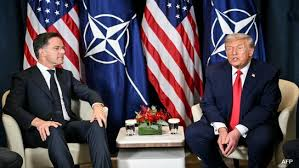

NATO Secretary-General Mark Rutte on Thursday firmly denied reports that Greenland’s sovereignty was discussed or compromised during his talks with United States President Donald Trump on the sidelines of the World Economic Forum in Davos, as speculation swirled over the US leader’s renewed interest in the strategically located Arctic island. Speaking through NATO spokesperson Allison Hart, the alliance made clear that “the Secretary General did not propose any compromise to sovereignty during his meeting with the President in Davos,” pushing back against media reports suggesting that creative territorial arrangements had been floated to appease Washington’s interest in Greenland.
Rutte himself clarified that his discussion with Trump was centred not on territorial concessions but on security concerns in the Arctic region, particularly how to prevent Russia and China from gaining strategic access to Greenland’s economy or military space. Addressing participants at Davos, Rutte described the meeting as “a very good discussion” focused on ensuring Arctic stability, adding that further talks would aim to guarantee that foreign powers do not exploit Greenland’s geographic and economic position. His comments sought to reframe the narrative from one of sovereignty bargaining to one of collective security under NATO’s broader strategic interests.
Denmark also moved quickly to quell concerns over any perceived threat to its territorial integrity. Prime Minister Mette Frederiksen issued a statement calling for “constructive” dialogue that respects the sovereignty of Denmark, a member of both the European Union and NATO. “We can negotiate all political aspects: security, investment, the economy. But we cannot negotiate our sovereignty,” she said, adding that she had been informed that no such compromise had taken place. Her remarks came after Trump unexpectedly announced he was scrapping tariff threats against European countries and ruling out military action to take Greenland, a move that French officials described as a welcome step toward de-escalation.
French Finance Minister Roland Lescure described Trump’s withdrawal of tariff threats as “a first positive sign that is moving in the right direction,” noting that de-escalation had been the key objective of European diplomacy in the preceding 48 hours. While welcoming the development, Lescure added that France remained vigilant, reflecting broader European caution amid the unfolding diplomatic exchanges over Greenland and Arctic security.
Despite official denials, reports in major international outlets suggested that Rutte’s talks with Trump may have included discussions around the Pituffik military base in northern Greenland, including the possibility of the United States gaining sovereignty over the installation and potentially establishing additional military bases in the future. Other reports indicated that the framework under discussion may have involved granting the US right of first refusal on investments in Greenland’s mineral resources, effectively giving Washington a veto over Russian or Chinese involvement in the island’s resource sector.
Additional accounts also referenced discussions between the two leaders about the so-called “Golden Dome” missile defence programme, a proposed $175 billion multilayered system that would place US weapons in space for the first time. These reports suggested that Arctic security, mineral access, and advanced defence systems formed part of a broader strategic conversation between Washington and NATO leadership, even as both sides publicly denied any compromise on sovereignty.
China reacted sharply to the developments, dismissing claims that it posed a threat to Greenland as “groundless.” Speaking at a press briefing, Chinese foreign ministry spokesperson Guo Jiakun accused others of “creating something out of nothing and using China as an excuse for selfish gain,” underscoring Beijing’s sensitivity to being cited as a justification for increased Western military and economic interest in the Arctic region.
As the Greenland issue unfolded, attention at Davos also turned to President Trump’s controversial proposal for a new international body known as the “Board of Peace.” Originally authorised by the United Nations Security Council in November as a transitional body to oversee a US-brokered ceasefire between Israel and Hamas in Gaza, Trump has since described the board as a potential mediator for other global conflicts, raising concerns that it could rival or undermine the authority of the UN itself.
Retired US ambassador Robert Wood, who served under both Republican and Democratic administrations at the United Nations, expressed scepticism about the initiative’s broader ambitions. He said that if Trump’s intention was to replace or bypass the UN Security Council with the Board of Peace on matters beyond Gaza, “I don’t think there’s going to be a lot of interest,” reflecting concerns within diplomatic circles about institutional overlap and legitimacy.
Several countries voiced similar reservations. Slovenia indicated that its main concern was the board’s potentially broad mandate, warning that it could seriously undermine the international order based on the UN Charter. Norway and Sweden also declined invitations to join, while France, one of the five veto-wielding members of the Security Council, confirmed it would not participate. Russia, China, and Britain were said to be still assessing the invitation.
In contrast, eight Muslim-majority countries, including Qatar, Pakistan, and the United Arab Emirates, accepted invitations to join the Board of Peace but issued a joint statement clarifying that their participation was strictly tied to its original mission of advancing peace, reconstruction in Gaza, and supporting Palestinian statehood. Their position underscored unease about expanding the board’s mandate beyond its initial purpose.
Russian President Vladimir Putin added another dimension to the debate, announcing that he would meet US envoys Steve Witkoff and Jared Kushner to discuss the initiative. Speaking at a meeting of Russia’s Security Council, Putin said he would explore the possible use of frozen Russian assets to support recovery work in war-affected regions and would also discuss the matter with Palestinian President Mahmoud Abbas during a scheduled meeting.
Putin further revealed that Russia’s foreign ministry had been instructed to study Trump’s invitation to join the Board of Peace and respond in due course. Even before a formal decision, he said Moscow was prepared to commit $1 billion from frozen assets toward long-term membership, citing Russia’s “special relations with the Palestinian people” as justification for the pledge.
The White House indicated that Trump would spotlight the Board of Peace at Davos with a formal “charter announcement” on the sidelines of the forum. Of the 60 countries invited to join, around 35—including Egypt, the UAE, and Israel—had reportedly agreed to sign on, while others remained cautious or declined outright due to concerns over the board’s implications for global governance.
Asked earlier in the week whether the Board of Peace should replace the United Nations, Trump responded that “it might,” while also acknowledging that the UN “hasn’t been very helpful” but should continue to exist because “the potential is so great.” His remarks encapsulated the broader debate unfolding at Davos: whether the initiative represents a complementary peace mechanism or a challenge to the post-World War II international order anchored by the United Nations.