

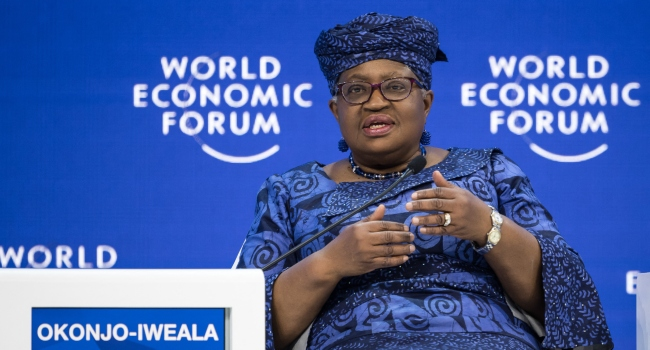

The Director-General of the World Trade Organisation (WTO), Dr Ngozi Okonjo-Iweala, on Wednesday urged the Nigerian government to take deliberate steps to attract global investors and companies seeking to relocate their supply chains, describing the current global economic climate as a rare opportunity for the country to deepen manufacturing, reduce import dependence, and create jobs. She made the call at Nigeria House during the ongoing World Economic Forum in Davos, where she addressed policymakers and business leaders on how Nigeria can position itself as a preferred destination for emerging global supply chain shifts driven by rising geopolitical tensions, particularly between the United States and China.
Okonjo-Iweala spoke during a panel discussion titled “From Scale to Capital: Financing Nigeria’s Role as Africa’s Digital Trade and Infrastructure Anchor,” where she appeared alongside the Managing Director of the Bank of Industry, Dr Oludapo Olusi. She explained that global companies are increasingly rethinking their sourcing strategies in response to tariffs, trade restrictions, and political uncertainties that have made overreliance on single-country production hubs risky. According to her, these developments have accelerated what is now widely known as the “China+1” strategy, where firms seek to diversify production away from China while still maintaining links to its deeply embedded role in global value chains.
She noted that while much of this diversification is still happening within Asia, countries such as India are already benefiting from the shift, and Nigeria must act swiftly and strategically to capture a meaningful share of these opportunities. Okonjo-Iweala stressed that Nigeria cannot afford to be passive but must aggressively market itself as an attractive investment destination. She said the country needs to clearly map out where the opportunities lie and pursue investors deliberately, adding that everything possible should be done to showcase Nigeria as worthy of investment in the face of global supply chain realignments.
The WTO chief also emphasized that ongoing economic reforms in Nigeria must begin to translate into tangible job creation. While acknowledging that progress is being made in stabilising the economy, she argued that the next critical phase is ensuring that these reforms yield employment opportunities for Nigerians. She noted that this transition from stabilisation to job creation will not happen overnight but maintained that the country is moving in the right direction if it remains focused and intentional in its strategy.
Providing practical examples, Okonjo-Iweala highlighted several sectors where Nigeria can attract investment as companies seek new production bases. She pointed to solar panel manufacturing, noting that despite Nigeria’s renewable energy potential, the country continues to import products it could feasibly produce locally. She argued that attracting investors to manufacture solar panels in Nigeria would not only reduce imports but also stimulate industrial growth and employment.
She also drew attention to the textiles and fashion industry, lamenting that many of the wax prints and shiny new fabrics commonly worn by Nigerians are imported rather than produced locally. According to her, Nigeria should deliberately invite foreign and local investors to establish textile production facilities in the country, turning what is currently an import-dependent sector into a vibrant manufacturing hub.
In addition, Okonjo-Iweala identified the pharmaceutical sector as another critical area where Nigeria could plug into global supply chains. She said disruptions in global pharmaceutical production and distribution have created openings for countries willing to invest in local capacity, adding that Nigeria has the market size and potential to become a key player if the right investments are attracted.
She concluded by reiterating the need for Nigeria to adopt deliberate strategies to pursue investors from countries such as China and the United States, rather than waiting for investments to arrive by chance. Okonjo-Iweala expressed optimism that current reforms are laying the groundwork for this shift but stressed that consistent effort, clear planning, and proactive engagement with global investors will be essential for Nigeria to fully benefit from the ongoing restructuring of global supply chains.