

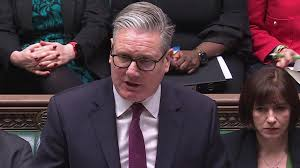

UK Prime Minister Sir Keir Starmer has said he will not give in to pressure from United States President Donald Trump over the future of Greenland, accusing the US leader of using criticism of Britain’s Chagos Islands deal as leverage to force a shift in the UK’s position. Speaking during Prime Minister’s Questions in parliament, Starmer said Trump had deliberately attacked the Chagos agreement in order to apply political pressure on Britain over Greenland, insisting that such tactics would not succeed. “He wants me to yield on my position, and I’m not going to do so,” the prime minister told MPs, stressing that the future of Greenland lay solely with its people and the Kingdom of Denmark.
Starmer’s remarks followed sharp criticism from Trump, who on Tuesday described the UK’s decision to hand sovereignty of the Chagos Islands to Mauritius, while leasing back a key military base, as an “act of great stupidity.” Trump suggested the move undermined Western security interests and cited it as further justification for his long-standing argument that the United States should acquire Greenland. The US president has repeatedly claimed Greenland is vital to American national security and has warned that Washington could impose tariffs on European countries that oppose US control of the autonomous Danish territory.
At Prime Minister’s Questions, Starmer said Trump’s language marked a clear departure from the supportive tone he had previously adopted during meetings at the White House. According to the prime minister, the US president’s latest comments were carefully chosen to influence Britain’s stance on Greenland rather than reflect genuine concerns about the Chagos deal. Starmer reiterated that the UK would not compromise its values or principles under pressure, adding that issues of sovereignty and self-determination must be respected in international affairs.
The Chagos Islands agreement has become a central point of contention in the widening dispute. Under the deal signed in May, the UK agreed to transfer sovereignty of the Indian Ocean archipelago to Mauritius while retaining long-term control of the strategically important Diego Garcia military base through a lease arrangement. The base hosts joint UK-US military facilities and is regarded as critical to Western defence operations in the Indo-Pacific region. British ministers have argued that the agreement provides a firm legal foundation for the continued operation of the base, addressing long-running legal and diplomatic challenges.
However, the deal has yet to be fully implemented, with legislation required to finalise the transfer currently caught in a dispute between the House of Commons and the House of Lords. Critics within the UK argue that the agreement weakens Britain’s strategic position, while the government maintains it is the only viable option to safeguard continued military access to Diego Garcia. Trump has seized on the controversy, arguing that the decision demonstrates a lack of resolve among US allies on matters of national security.
Opposition figures in the UK offered mixed reactions to Starmer’s stance. Conservative Party leader Kemi Badenoch said she supported the prime minister’s position on Greenland and agreed that decisions about the territory should rest with Denmark and Greenlanders themselves. However, she sided with Trump in criticising the Chagos deal, describing it as misguided and urging the government to scrap the agreement and redirect funds towards strengthening Britain’s armed forces.
From the Labour backbenches, MP Steve Witherden took a more confrontational approach towards Washington, calling on the UK to close ranks with its European allies and consider retaliatory tariffs if the US follows through on its threats. Witherden accused Trump of acting like a bully and argued that appeasement would only encourage further pressure on British and European interests. He said the UK should respond firmly in defence of sovereignty and international law.
Liberal Democrat leader Sir Ed Davey also condemned Trump’s rhetoric, accusing the US president of behaving like a “crime boss running a protection racket.” Davey urged Starmer to align more closely with European partners, including French President Emmanuel Macron and Canadian Prime Minister Mark Carney, in pushing back against what he described as increasingly aggressive US tactics. He said silence or caution would risk normalising coercive behaviour between allies.
Chancellor Rachel Reeves sought to strike a steadier tone, saying the UK would not be “buffeted around” by tariff threats and remained confident in its economic strategy. Reeves told business leaders that Britain had a plan to withstand external shocks and insisted that ongoing tensions would not derail the prospect of a future UK-US trade agreement. She emphasised the importance of dialogue while making clear that economic coercion was unacceptable.
The dispute has played out against the backdrop of the World Economic Forum in Davos, where Trump has again defended his position on Greenland. Speaking to an international audience, the US president said he would not use military force to seize the territory but insisted that American ownership remained necessary for security reasons. “I don’t want to use force. I won’t use force,” Trump said, while maintaining that the US would struggle to secure its interests in the Arctic without control of Greenland.
US Treasury Secretary Scott Bessent added to the pressure by accusing the UK of “letting us down” over the Chagos deal. Bessent said the United States would not outsource its national or hemispheric security and suggested the transfer of sovereignty to Mauritius undermined shared defence interests. He also claimed there were “glitches” in UK-US trade relations, further fuelling concerns about the economic fallout from the standoff.
Reform UK leader Nigel Farage, speaking at an event in Davos, offered a more nuanced view. While he argued that the world could be “more secure” if the US took control of Greenland, Farage acknowledged that such a move conflicted with his belief in sovereignty and national self-determination. He said the rights and wishes of Greenlanders must ultimately be respected, even as he recognised Washington’s strategic concerns.
Beyond the UK, the controversy has raised alarm across Europe and North America, with leaders warning that Trump’s threats risk damaging transatlantic unity. European officials have cautioned that tariffs and territorial pressure could trigger retaliatory measures and weaken cooperation at a time of heightened global instability. Canada has also voiced concern, particularly over the implications for Arctic security and Nato cohesion.
Public opinion has further complicated the issue. Demonstrations have been reported in Denmark and Greenland against any prospect of US control, and opinion polls suggest overwhelming opposition among Greenlanders to becoming part of the United States. These sentiments have strengthened the resolve of European leaders to frame the dispute as a matter of democratic choice rather than geopolitical bargaining.
As tensions continue to rise, analysts say the dispute highlights deeper questions about the future of transatlantic relations under Trump’s leadership. The clash over Greenland and the Chagos Islands has exposed differing views on sovereignty, alliance management, and the limits of pressure between partners. For Starmer, the episode represents an early test of his foreign policy doctrine, balancing close ties with Washington against a firm commitment to international law and self-determination.
The coming weeks are expected to be critical, with Trump’s threatened tariffs due to take effect from February and further diplomatic engagements planned between the UK, Denmark, and other European allies. While all sides have stopped short of a full-blown rupture, the standoff underscores the fragile state of relations and the challenges of maintaining unity amid competing security and economic priorities.