

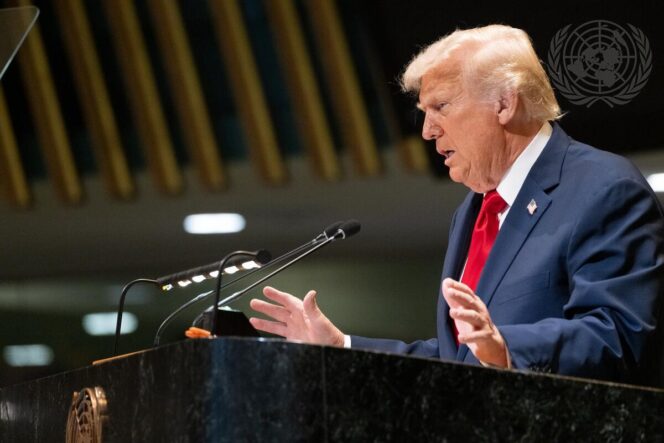

European leaders have frowned against a decision by the US President Donald Trump, planning to slap a 10 percent tariff on imports from eight nations; Denmark, Norway, Sweden, France, Germany, the United Kingdom, the Netherlands, and Finland.
The scheduled plan announced on Saturday, 18th January, is to take effect from 1st February. Trump tied the measure directly to ongoing disputes over Greenland, vowing to hike the levy to 25 percent starting from June until the US acquired complete possession of the bounty.
He aired the threat in his Truth Social platform. He claimed the move is necessary as a retaliation to the recent military actions sanctioned by the listed countries on the Arctic island.
Assault to Trade and Sovereignty, EU Leaders Decry Trump’s Proposed Tariff
The announcement drew swift condemnation from top EU officials. António Costa, the President Council of the EU urged opening markets rather than closing them through tariffs.
He made this disclosure, speaking in Paraguay while signing a free trade deal with the Mercosur bloc.
“The EU has always been very determined in defending international law, especially in the territory of a member state,” he emphasized.
Joining Costa in social media posts, Ursula von der Leyen, European Commission President warned that the tariffs would undermine transatlantic relations and risk a dangerous downward spiral.
They affirmed Europe’s unity, coordination, and commitment to sovereignty, while donating full support to Denmark and the people of Greenland.
Greenland, a largely autonomous Danish territory and NATO member with about 57,000 residents, has repeatedly rejected US overtures. Trump has long pushed for its purchase to bolster Arctic security against perceived threats from China and Russia.
NATO allies counter that such a takeover isn’t necessary for regional protection.
Military Tensions Fuel Trade Clash
Trump’s frustration stemmed from a reconnaissance mission by troops from the targeted nations to Greenland ahead of a NATO military exercise.
He blasted the deployment in his post, claiming the countries were set to Greenland for purposes unknown,endangering global safety.
Von der Leyen and Costa defended the activity as essential for Arctic security, saying the action posed no threat.
Similarly, Søren Andersen, Arctic command head, confirmed that the exercise would extend through 2026, with possibility to run into 2027, involving Germans, Swedes, Norwegians, and others to explore joint training opportunities. He noted that invitations were extended to all NATO members, including the US.
Trade Fallout, Emergency Response
The tariffs threaten to derail a EU-US customs deal which was secured last year. The deal set a 15 percent US duty on most European goods while eliminating duties on US industrial products and easing food import barriers.
As the agreement awaits the approval of the European Parliament, Manfred Weber has protested to suspend the zero percent tariffs on US goods after Trump’s threat.
The Cypriot EU presidency has scheduled another extraordinary ambassadorial meeting for Sunday, 19th January.
Discussions may cover countermeasures under the EU’s anti-coercion instrument, which permits retaliatory tariffs and other measures as a last resort when third countries use trade to coerce policy changes.
While details on potential actions remain unclear as tensions loom, EU officials stress dialogue, building on recent US-Denmark talks, with military planning in Greenland pressed ahead.