

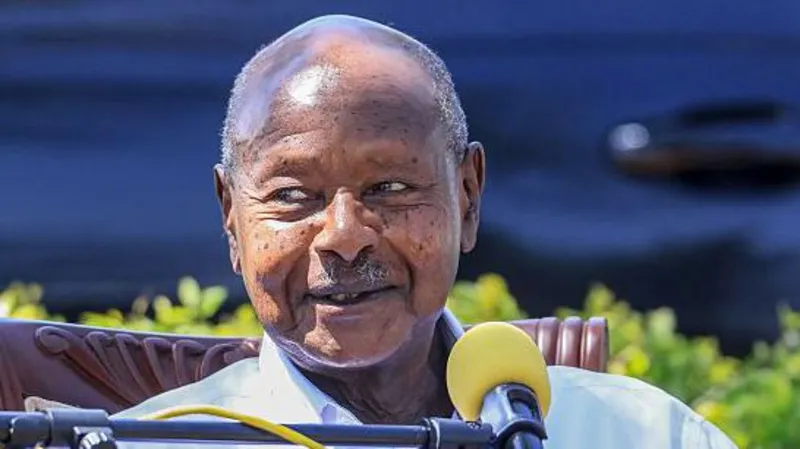

Uganda’s presidential election on Thursday unfolded under a tense and heavily scrutinized political atmosphere, with provisional results released by the country’s electoral agency on Friday morning showing President Yoweri Museveni in a commanding lead. According to the Electoral Commission, results from 45% of polling stations indicate that Museveni, 81, garnered approximately 76% of the votes, while opposition leader Robert Kyagulanyi, popularly known as Bobi Wine, captured about 20%. The numbers highlight a significant margin between the two main contenders, reflecting a continuation of Museveni’s decades-long dominance in Ugandan politics, and are being closely analyzed by political observers for their potential implications ahead of the final results, scheduled to be announced on Saturday by 16:00 local time (13:00 GMT). The remaining six candidates combined accounted for a marginal share, underscoring the essentially two-horse nature of the race.
The campaign period leading up to Thursday’s election was marred by multiple reports of violence and suppression of opposition activities, creating an atmosphere of heightened anxiety among voters and political observers alike. Security forces were accused of targeting Bobi Wine’s supporters, including instances of arrests and physical assaults, though police spokesperson Kituuma Rusoke dismissed such claims, accusing opposition elements of causing disturbances at campaign events. In addition, an internet blackout imposed by the Uganda Communications Commission from Tuesday raised concerns among rights groups and international observers. Authorities justified the shutdown as a measure to prevent misinformation, election fraud, and incitement of violence, but the United Nations human rights office described it as “deeply worrying” for transparency and free communication during a critical national poll. The blackout, coupled with logistical challenges such as delayed arrival of ballot boxes and malfunctioning biometric voter verification machines, contributed to voting delays of up to four hours at several polling stations across the country.
The opposition National Unity Platform (NUP), led by Bobi Wine, immediately raised concerns about potential irregularities following the polling day. Late on Thursday, the NUP reported that security forces had surrounded Wine’s residence in Kampala, effectively placing him and his wife under what they described as house arrest. “Security officers have unlawfully jumped over the perimeter fence and are now erecting tents within his compound,” the party posted on X, Uganda’s equivalent of Twitter. This follows a pattern observed during the 2021 elections, when Wine was confined to his home for several days by security personnel after challenging Museveni’s long-standing rule. Although the NUP did not provide documentary proof of alleged fraud, the party has called for vigilance and warned supporters to monitor the counting process carefully, citing concerns over vote manipulation and lack of transparency.
In contrast, the Museveni camp has sought to emphasize stability and continuity, portraying the incumbent president as the guarantor of peace and progress in Uganda. Analysts note that Museveni, a former rebel leader who came to power in 1986, has won six consecutive elections, and the current provisional lead suggests that he may extend his tenure well into his ninth decade of life. Despite criticism regarding governance, Museveni maintains significant support among older voters and in rural areas, where long-standing patronage networks and development projects have reinforced loyalty to his administration. His leadership team has highlighted his administration’s achievements in infrastructure, healthcare, and regional security, framing the 2026 election as a choice between continuity and uncertainty, particularly in light of opposition-led calls for reform.
Bobi Wine, a 43-year-old pop star-turned-politician, has positioned himself as the voice of Uganda’s youth, a demographic that constitutes over half the country’s population. Throughout the campaign, Wine promised sweeping reforms, anti-corruption measures, and greater economic opportunities, appealing to younger voters frustrated with persistent unemployment and social inequities. However, his platform has faced systemic challenges, including limited media coverage, restrictions on campaign rallies, and, during Thursday’s polling, significant delays at stations where biometric systems failed and ballot boxes arrived late. These operational problems, coupled with the communications blackout, have intensified fears among his supporters about the transparency and fairness of the electoral process.
The logistical difficulties were particularly pronounced in urban centers, where many polling stations opened late, resulting in long lines and frustrated voters waiting for extended periods. Some election officials attributed the delays to the slow arrival of ballot materials, while others noted technical failures of biometric verification machines, which are crucial for confirming voter identity. Observers have linked these issues to the broader network outage, which disrupted both election administration and real-time reporting, leaving many Ugandans reliant on word-of-mouth updates rather than official sources. The delays did not appear to significantly affect turnout in rural areas, where Museveni enjoys traditional strongholds, but they amplified tensions in the capital and other urban districts where opposition support is concentrated.
Political analysts are viewing the defection of votes and organizational alignment as critical factors in determining Uganda’s post-election landscape. While the other six presidential candidates collectively hold a minor portion of the vote, their endorsements, if any, could influence localized outcomes or provide symbolic support for either of the main contenders. However, given Museveni’s entrenched political apparatus and the provisional results so far, analysts widely predict a continuation of the status quo. Museveni’s supporters argue that his leadership remains essential for national stability, citing Uganda’s ongoing efforts to counter insurgency, manage economic challenges, and maintain regional security commitments in East Africa.
Security concerns have remained a dominant theme during the election cycle. Beyond the house confinement of Bobi Wine, reports indicated heightened military and police presence at polling stations nationwide, aimed at preventing violence but also raising questions about voter intimidation. The NUP and civil society groups have criticized the heavy deployment of security forces, asserting that it creates an uneven playing field. Police authorities, meanwhile, maintain that the presence of personnel is essential for safeguarding voters and election materials, especially in light of recent threats and disruptions reported during the campaign period.
Despite these tensions, Museveni’s lead in the provisional tally underscores his continued political resilience and the influence of long-standing patronage networks. Observers note that the president has leveraged decades of governance experience, party machinery, and strategic alliances to maintain electoral advantage. Meanwhile, Bobi Wine’s emergence as a prominent opposition figure reflects growing generational and urban-rural divides in Ugandan politics, where youth populations and educated urbanites increasingly demand reform and greater accountability from the government.
The electoral agency’s release of results covering 45% of polling stations provides only a partial picture, leaving room for speculation about how remaining votes may shift final outcomes. Nonetheless, Museveni’s clear margin suggests that a seventh term is within reach, potentially further extending his tenure well beyond four decades. This outcome would solidify his legacy as one of Africa’s longest-serving leaders while simultaneously raising questions about succession planning, particularly regarding speculation that Museveni favors his son, military chief Muhoozi Kainerugaba, as a potential heir. Museveni has publicly denied grooming his son for leadership, emphasizing continuity without pre-determining succession.
International reactions to the election have focused on both the procedural challenges and broader democratic implications. Rights groups have criticized the internet blackout, delays at polling stations, and reported restrictions on opposition activities as undermining transparency and inclusivity. While no widespread demonstrations were reported as of Friday morning, observers caution that tensions could escalate if final results significantly diverge from expectations, or if allegations of irregularities gain traction. The Electoral Commission has stated that it aims to announce the final presidential results by Saturday afternoon, though observers note that public confidence in the process may hinge on the commission’s ability to communicate clearly and credibly despite previous disruptions.
Bobi Wine, addressing his supporters, framed his campaign as a struggle for youth empowerment and national reform, emphasizing that the election was not merely a contest of personalities but a referendum on governance and opportunity. “We are here to represent the voice of the young people who have long been sidelined,” Wine said. “Our challenge is to ensure that every vote counts and that the people of Uganda see transparency, fairness, and accountability in this election.” His call underscored ongoing anxieties about electoral integrity and the need for close scrutiny by both domestic and international observers.
Museveni’s campaign team, conversely, emphasized continuity and national stability, framing the provisional results as validation of his long-standing leadership. Party officials highlighted the president’s record on infrastructure, education, and security, and argued that his victory would ensure ongoing development and regional influence. The administration maintains that Museveni’s leadership is a stabilizing force amid complex regional dynamics, including security threats from armed groups in neighboring countries and internal socio-economic challenges.
Observers note that Uganda’s demographic composition plays a significant role in shaping electoral outcomes. With over 50% of the population under 30, youth engagement and political mobilization have become increasingly important. Bobi Wine’s appeal to younger voters and urban populations reflects an evolving political landscape where generational expectations are beginning to challenge entrenched governance patterns. Meanwhile, Museveni’s traditional rural support base continues to provide a reliable foundation for electoral advantage, illustrating the persistent tension between generational aspirations and longstanding political structures.
The election also underscores Uganda’s enduring struggle with political pluralism and the management of dissent. The house confinement of Bobi Wine and reports of opposition disruptions reflect broader questions about how dissenting voices are accommodated within the country’s political framework. Analysts suggest that while Museveni enjoys widespread institutional control, the limitations on opposition activities may have long-term implications for democratic consolidation and civic engagement in Uganda.
As the final tally approaches, all eyes are on the Electoral Commission to deliver results that are credible and timely. The partial results, with Museveni in a commanding lead, appear to confirm historical voting patterns, yet the relatively narrow urban support for the opposition highlights underlying discontent that could shape future political developments. Observers emphasize the importance of transparency, clear communication, and legal adherence to safeguard electoral legitimacy and maintain public trust.