

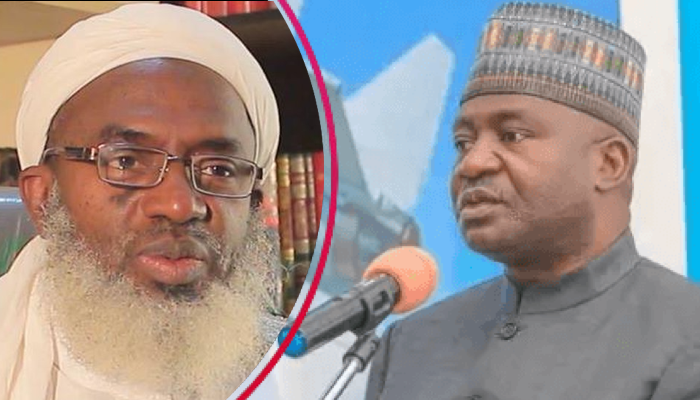

Nigeria’s Minister of Defence, Christopher Musa, on Wednesday issued a stern warning to cleric Sheikh Ahmed Gumi and other individuals he described as sympathisers of terrorists and bandits, cautioning them against offering overt or covert support to criminal groups undermining national security. Speaking during an official visit to Maiduguri, the Borno State capital that has been at the centre of Nigeria’s long-running insurgency, Musa said the country could no longer tolerate narratives that excuse or rationalise violence carried out by armed groups.
Addressing security stakeholders and residents during the visit, Musa said terrorism and banditry must never be framed as expressions of regional, ethnic, or religious brotherhood. “A friend of a thief is a thief,” the defence minister said, stressing that Nigerians must desist from justifying or excusing criminality under any guise. He said his remarks were aimed at reinforcing a clear moral and legal boundary between law-abiding citizens and those who engage in or support violent crime.
Musa explained that his comments were deliberate and directly addressed to individuals who, in his view, use their influence to soften public perception of armed groups responsible for killings, kidnappings, and mass displacement. While he did not name Sheikh Gumi directly in his opening remarks, the minister later made it clear that his warning was linked to long-standing public statements made by the cleric about bandits operating in northern Nigeria.
Sheikh Ahmed Gumi, a prominent Islamic cleric based in Kaduna State, has in the past drawn national controversy for describing bandits as “our brothers” and calling for dialogue and amnesty for armed groups operating from forest enclaves. In several media interviews over the years, Gumi has argued that bandits are largely victims of neglect, injustice, and state failure, and has warned that continued military action alone would not end the violence.
Gumi has also suggested that banditry should be understood within a broader social and economic context, at times saying that society could not function without accommodating those who had taken up arms. His comments have drawn sharp criticism from victims of bandit attacks, civil society groups, and security analysts, who accuse him of downplaying the brutality of crimes that have left thousands dead and many more displaced.
During his Maiduguri visit, Musa said such narratives, while sometimes presented as calls for peace, risk crossing the line into dangerous justification of criminal behaviour. He stressed that there was a clear difference between compassion for suffering communities and complicity with those who inflict violence on civilians. According to him, empathy must never translate into legitimising or excusing acts of terror.
The defence minister said criminal networks thrive not only on weapons and logistics but also on the moral and rhetorical cover provided by influential voices. He warned that when respected figures portray terrorists and bandits as misunderstood brothers rather than perpetrators of violence, it weakens national resolve and emboldens those responsible for insecurity.
Musa said the consequences of such narratives are felt most acutely by ordinary Nigerians, particularly in conflict-affected states where entire communities have been destroyed. He pointed to the displacement of families, the closure of schools, the collapse of local economies, and the loss of innocent lives as evidence that banditry and terrorism are not abstract social problems but real and ongoing tragedies.
He argued that Nigeria’s fight against insecurity requires unity of purpose and clarity of language, insisting that words matter as much as military action. “We cannot defeat terrorism and banditry while narratives blur the distinction between victims and perpetrators,” Musa said, warning that moral ambiguity only prolongs conflict and suffering.
The defence minister added that neutrality is not an option in matters of national security, particularly for those with public platforms. He said individuals who defend, excuse, or shield criminals—whether through words, influence, or silence—share responsibility for the damage caused by armed groups across the country.
Musa’s remarks come amid ongoing military operations against bandits and insurgents in the North-East, North-West, and North-Central regions, where attacks on villages, highways, and security forces have persisted despite years of counterinsurgency efforts. Maiduguri itself has been a focal point of the fight against Boko Haram and its splinter factions, making the location of the minister’s warning symbolically significant.
Security officials say that while kinetic operations have degraded the capabilities of some armed groups, the ideological and social dimensions of the conflict remain a challenge. Musa’s comments reflect growing concern within government circles that public rhetoric perceived as sympathetic to criminals could undermine security gains.
In a related development, the defence minister has also moved to reassure Nigerians of the government’s commitment to protecting educational institutions amid persistent security challenges. Gen. Christopher Musa (retd.) pledged to reinforce security around schools nationwide, saying the safety of students and teachers remains central to the federal government’s broader efforts to stabilise the country and prevent future insecurity.
Musa made the commitment on Wednesday in Abuja while receiving an award from the National Parents Teachers Association of Nigeria (NAPTAN), which honoured him for his contributions to safeguarding schools and advancing the Safe Schools Initiative. The event brought together education stakeholders, security officials, and parent representatives concerned about the growing risks facing learning institutions.
The minister said the federal government would continue to work closely with parents, teachers, and community leaders to ensure schools remain secure, stressing that education cannot flourish in an unsafe environment. “Without security, there will not be a good learning environment. We will continue to work seriously to ensure that our schools are safe,” Musa said. “Let us continue to work hand-in-hand, parents, teachers, government, and society, to ensure that every child has the opportunity to reach their fullest potentials.”
Musa described the award as both recognition and motivation, saying it would deepen his resolve to push policies that strengthen teaching and learning conditions across the country. “This award will strengthen my resolve to continue working for policies and initiatives that improve the quality of teaching and learning, provide a safe and inclusive environment for our children, empower teachers with resources and training, and foster stronger collaboration between schools, parents, and communities. This is very critical,” he said.
He also underscored the role of parents and teachers as key partners in nation-building, noting that education, discipline, and security are closely linked. According to him, a society that fails to protect its schools risks breeding instability, as uneducated and traumatised children are more vulnerable to crime, radicalisation, and social dislocation.
Earlier, NAPTAN President Haruna Danjuma said Musa’s appointment as defence minister reflected years of service and commitment to national security, particularly his role in initiating and strengthening the Safe Schools Programme while serving as Chief of Defence Staff. Danjuma said the programme had helped restore confidence among parents in areas affected by insecurity.
He noted that the initiative had encouraged school attendance despite ongoing threats of kidnappings and attacks on educational institutions, especially in parts of northern Nigeria. According to the association, improved security measures around vulnerable schools have eased fears and reduced disruptions to academic activities in several communities.
NAPTAN said the award was intended to encourage the defence minister to sustain and expand efforts aimed at protecting schools, teachers, and students nationwide, stressing that parents remain deeply invested in any policy that guarantees the safety of their children.
The Permanent Secretary of the Ministry of Defence, Richard Pheelangwa, also praised Musa’s leadership, describing the recognition as an acknowledgment of his dedication to both national security and the future of Nigerian children. He said the ministry would continue to collaborate with education authorities and other stakeholders to ensure that security and education advance together.
Concerns over school safety have intensified in recent years following repeated attacks on schools and mass kidnappings of students and teachers by bandits and other armed groups. These incidents have disrupted learning, forced school closures in some areas, and heightened anxiety among parents and education stakeholders, making school security a growing priority in Nigeria’s fight against insecurity.