

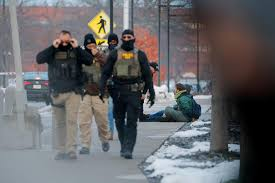

Tensions over President Donald Trump’s sweeping immigration crackdown escalated sharply across the United States on Thursday following two shootings involving federal immigration officers in as many days, including the fatal shooting of a 37-year-old woman in Minnesota and the wounding of a man and a woman in a separate incident involving U.S. Border Patrol agents in Portland, Oregon, developments that have intensified protests, widened political divides, and deepened rifts between state and federal authorities over the scope, tactics, and accountability of immigration enforcement.
In Minnesota, an Immigration and Customs Enforcement (ICE) officer on Wednesday fatally shot Renee Nichole Good, a 37-year-old U.S. citizen and mother of three, during an encounter that federal officials described as a life-threatening confrontation, while state officials and civil rights advocates disputed that account and complained they were excluded from the federal investigation into the shooting.
Less than 24 hours later, a second shooting occurred in Portland, Oregon, where the Department of Homeland Security (DHS) said a U.S. Border Patrol agent fired a “defensive shot” after a driver allegedly attempted to use a vehicle as a weapon against federal officers, wounding both the driver and a passenger, although local officials said they could not independently verify the federal government’s version of events.
The two incidents have reignited protests and sharpened political tensions in Democratic-led states and cities where federal immigration officers have been deployed as part of Trump’s aggressive deportation drive, a central promise of his reelection campaign that has drawn praise from supporters but fierce criticism from Democrats and civil rights groups.
In Minnesota, hundreds of demonstrators gathered in Minneapolis on Thursday, chanting “shame” and “murder” at armed and masked federal officers, some of whom deployed tear gas and pepper balls to disperse crowds, as anger mounted over the killing of Good and the perceived lack of transparency surrounding the federal response.
“I feel like we’re at a turning point. I can’t say it enough, but things have got to change,” said Rachel Hoppei, a 52-year-old protester in Minneapolis, who added, “We don’t want you. You have no right to be here. You’re destroying our communities,” reflecting a broader sentiment among demonstrators calling for the withdrawal of federal officers.
Minnesota Governor Tim Walz, a Democrat, said the situation posed a serious risk of unrest and confirmed that he had placed the state’s National Guard on alert as a precautionary measure, while also criticising federal authorities for denying state investigators access to evidence, witnesses, and case materials related to the shooting.
Minnesota officials said they were blocked from participating meaningfully in the investigation, prompting the Minnesota Bureau of Criminal Apprehension to withdraw entirely, while DHS Secretary Kristi Noem told reporters in New York that the state lacked jurisdiction over the case because it involved federal officers acting under federal authority.
The Department of Homeland Security said the ICE officer who shot Good was acting in self-defense after she allegedly attempted to run him over with her vehicle, a claim echoed by Vice President JD Vance, who repeatedly described Good’s actions as an “attack” on law enforcement and said the agent was owed “a debt of gratitude.”
Vance also referenced a prior incident involving the same officer, saying he had been dragged by a car last year and suffered injuries requiring 33 stitches, a description that matched a June 2025 case in Bloomington, Minnesota, in which an officer identified in court records as Jonathan Ross was injured while attempting to arrest a migrant living in the country illegally.
Federal prosecutors said the driver in that earlier case was convicted last month of assaulting a federal officer, though DHS declined to confirm whether Ross was the agent involved in Wednesday’s fatal shooting or to release the shooter’s identity.
Civil rights activists and community observers sharply challenged the federal account of Good’s killing, pointing to bystander videos that they said raised serious questions about whether deadly force was justified under the circumstances.
Michelle Gross, president of the Minnesota-based group Community United Against Police Brutality and a paralegal with the National Lawyers Guild, said Good had been participating in neighbourhood “observer” patrols that monitor ICE activity and insisted she was exercising her First Amendment right to document law enforcement actions.
“There was absolutely no justification for deadly force,” Gross said, disputing DHS Secretary Noem’s assertion that Good had been “stalking and impeding” agents’ work throughout the day, and adding that video footage showed the vehicle turning away from officers rather than toward them.
The bystander videos show two masked officers approaching Good’s car, which was stopped at an angle on a Minneapolis street, as one officer ordered her out and reached for the door handle, moments before the vehicle briefly reversed and then moved forward while turning to the right, after which a third officer fired three shots while stepping back.
It remained unclear from the footage whether the car made contact with the officer, who appeared to remain on his feet and was seen walking afterward, despite President Trump later posting on social media that the woman “ran over the ICE Officer,” a claim disputed by activists and not independently verified.
In Portland, DHS said the driver involved in Thursday’s shooting was a suspected Venezuelan gang member who attempted to “weaponize” his vehicle against Border Patrol agents, prompting an officer to fire, while Portland police said two gunshot victims were later found about two miles away and taken to hospital, and local officials again said they could not confirm the federal narrative.
Democratic mayors and governors in both states demanded that the Trump administration withdraw federal officers, accusing the administration of inflaming tensions by deploying heavily armed agents to Democratic-led cities, while civil rights groups warned that the aggressive enforcement operations amounted to provocation rather than public safety.
The ICE agent involved in the Minnesota shooting was among roughly 2,000 federal officers deployed to the Minneapolis area in what DHS described as its largest operation ever, part of a nationwide immigration crackdown that also followed a politically sensitive investigation into alleged fraud involving some nonprofit groups in the Somali community.