

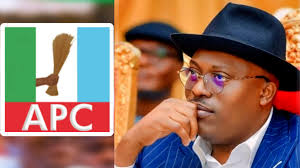

The Rivers State House of Assembly on Thursday formally commenced impeachment proceedings against Governor Siminalayi Fubara and his deputy, Professor Ngozi Odu, issuing both officials a seven-day notice to respond to a wide range of allegations of gross misconduct, in a dramatic escalation of the protracted political crisis that has engulfed the oil-rich state and repeatedly disrupted governance since Fubara assumed office in 2023.
The decision was taken during a plenary session presided over by the Speaker of the House, Martins Amaewhule, and broadcast live on Channels Television, during which lawmakers aligned with the Speaker accused the governor and his deputy of serial constitutional violations, abuse of public funds, and deliberate actions aimed at crippling the legislature’s ability to perform its duties under the 1999 Constitution (as amended).
At the heart of the proceedings was a notice of allegations presented by the Majority Leader, Major Jack, who told the House that 26 members had appended their signatures to the impeachment notice against the governor, insisting that the lawmakers were acting strictly within the ambit of Section 188 of the Constitution, which empowers a state assembly to initiate impeachment proceedings against a governor or deputy governor accused of gross misconduct.
Jack, relying on Section 188, formally reeled out seven allegations against Governor Fubara, describing them as grave infractions that, in his words, “strike at the heart of constitutional governance and legislative authority,” and warning that continued inaction by the House would amount to complicity in what he characterised as persistent breaches of the law.
Among the allegations listed were claims that the governor authorised extra-budgetary spending allegedly running into over ₦800 billion without the approval of the House of Assembly, a move lawmakers said undermined legislative oversight and violated appropriation laws governing public finance in Rivers State.
The notice further accused Fubara of ordering or allowing the demolition of the Rivers State House of Assembly complex, an action lawmakers described as an assault on a constitutionally established institution and a deliberate attempt to weaken the legislature amid ongoing political disagreements.
Lawmakers also alleged that the governor withheld funds meant for the Rivers State Assembly Service Commission, seized salaries and allowances accruing to members of the House and the Commission, and refused to obey Supreme Court judgments affirming the financial autonomy of state legislatures, actions they said amounted to contempt of court and constitutional defiance.
After Jack laid the notice before the Speaker, Amaewhule announced that the document would be formally served on Governor Fubara within seven days, stressing that the House had now crossed the threshold from political dispute to a constitutional process that must be allowed to run its course.
Following the presentation of the allegations against the governor, the Deputy Leader of the House, Linda Stewart, read out a separate notice of gross misconduct against the deputy governor, Professor Ngozi Odu, accusing her of conniving with the governor to undermine the Assembly and participate in unconstitutional financial practices.
According to the notice, the allegations against Odu included reckless and unconstitutional spending of public funds, obstruction of the House from performing its constitutional duties as outlined by the 1999 Constitution, and conniving to allow unauthorised persons to occupy government offices without proper screening by the legitimate Rivers State House of Assembly.
The lawmakers further accused the deputy governor of approaching another group for budgetary approval instead of the constitutionally recognised House of Assembly, as well as seizing salaries and allowances meant for the Assembly and the Assembly Service Commission, actions they said eroded democratic accountability.
Speaker Amaewhule, addressing the House after the notices were read, said the alleged misconducts were largely centred on budgetary issues and spending outside the appropriation law, noting, “It is important to note that the particulars of these allegations relate mainly to the presentation of the budget and spending outside the appropriation law.”
He added, “But we are not here to debate the notice. The notice has been served, and the impeachment process has commenced. In any case, the governor does not even want to present any budget. If he wanted to, he would have done so long ago. Siminalayi Fubara is a mistake. Rivers State has never had it this bad.”
Amaewhule claimed that Rivers State was the only sub-national government in Nigeria yet to present a 2026 appropriation bill, saying, “In the entire Nigeria, Siminalayi Fubara and Prof. Ngozi Odu are the only people at the sub-national level who have not presented an appropriation bill for 2026. I doubt if anywhere in Africa you will find a government that has not presented an appropriation bill in this 21st century.”
The Speaker further alleged that even when the Assembly approved spending in 2023, the governor abandoned the approved budget and awarded contracts outside the appropriation law, accusing the administration of mismanaging public funds while critical sectors such as education, health, and infrastructure deteriorated.
“Our schools are not functioning properly, roads are bad, hospitals are not fully operational, and our youths are unemployed,” Amaewhule said, alleging that funds meant for development were instead being diverted. “What the governor is doing with our funds, funds of Rivers people who have paid taxes, is to change our money to dollars to subvert the will of the Rivers people and the constitution.”
Describing the governor as a threat to democracy, the Speaker declared, “Enough is enough. Let the law take its course,” adding that President Bola Tinubu had intervened several times in an attempt to persuade Fubara to change course. “Mr President has done his best. He gave the governor a second chance, and another one, but the governor refused to change,” he said.
Amaewhule announced that the House would suspend consideration of the 2026 Medium-Term Expenditure Framework and Appropriation Bill until the impeachment investigation was concluded, and that a formal communication would be forwarded to the governor, giving him seven days to respond, in line with constitutional provisions.
The impeachment move marks the second major attempt by the Rivers Assembly to remove Fubara and his deputy, following a similar effort in March 2025, when lawmakers accused the duo of gross misconduct amid a bitter fallout between the governor and his predecessor, Nyesom Wike, now Minister of the Federal Capital Territory.
That earlier crisis spiralled into widespread political tension and institutional paralysis, prompting President Tinubu to intervene by declaring a state of emergency in Rivers State under Section 305(5) of the Constitution, suspending the governor, his deputy, and the entire House of Assembly for an initial period of six months.
“By this declaration, the Governor of Rivers State, Mr Siminalayi Fubara, his deputy, Mrs Ngozi Odu and all elected members of the House of Assembly of Rivers State are hereby suspended for an initial period of six months,” Tinubu said at the time, appointing Vice Admiral Ibokette Ibas (retd.) as the sole administrator of the state.
Fubara later returned to office after six months following a reconciliatory move reportedly brokered between him, Wike, and the lawmakers, raising hopes that the political crisis had been resolved, even as underlying tensions between the governor and his predecessor persisted.
In December, Fubara defected from the Peoples Democratic Party, under whose platform he was elected in 2023, to the ruling All Progressives Congress, a move widely interpreted as a strategic realignment ahead of the 2027 general elections and coming days after some Rivers lawmakers also joined the APC.
Explaining his defection, Fubara said, “We cannot support the President if we don’t fully identify with him, not backyard support. So, we have taken that decision today since we have gotten the pass. Everyone here who had followed me, who had suffered with me, our decision today, this evening, we are moving to APC.”
Despite the governor and the pro-Wike lawmakers now belonging to the same party, divisions within the APC in Rivers State have deepened, with the party’s state chapter aligned with former Minister of Transportation Rotimi Amaechi rejecting the impeachment move as “untenable” and warning against further destabilisation.
In a statement by its Publicity Secretary, Darlington Nwauju, the APC said, “Our position as of today on this matter is that we solemnly reject the resort to an impeachment process against our governor and his deputy,” arguing that a budget passed during the period of emergency rule, totalling ₦1.485 trillion, was expected to run until August 2026.
The party added, “Since the latest threat of impeachment centres on the budget, may we remind ourselves that under the period of emergency rule, a budget was transmitted to the National Assembly by the President and approved. The constitution also allows a six-month spending window into a new fiscal year.”
Youth and civil society groups also raised alarm, with the Ijaw Youths Council Worldwide warning that the impeachment could plunge Rivers State into another round of instability. “This is unacceptable. I thought the earlier crisis had been resolved,” said IYC President Jonathan Lokpobiri, expressing concern about safety and peace in the state.
Similarly, the Civil Liberties Organisation cautioned that impeachment must not be used as a political weapon, warning in a statement that it is “a grave constitutional mechanism meant for accountability, not political retaliation,” and urging strict adherence to due process and dialogue among stakeholders.
As tensions continue to rise, the state government has urged calm, with a senior official saying the administration would only respond after receiving a formal notice. “There are procedures for these things. Any response now would imply that the government has received a notice, which it has not,” the official said, adding, “Our priority is peace and stability in Rivers State.”
The latest impeachment proceedings have once again underscored the depth of Rivers State’s political crisis, driven by an unresolved power struggle between Fubara and Wike, and have raised fresh questions about governance, institutional independence, and political stability in one of Nigeria’s most economically strategic states as the countdown to the 2027 elections begins.