

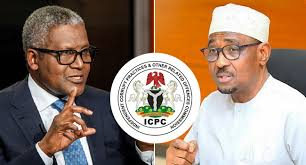

The Independent Corrupt Practices and Other Related Offences Commission (ICPC) has reaffirmed its commitment to investigating Farouk Ahmed, the immediate past Chief Executive Officer of the Nigerian Midstream and Downstream Petroleum Regulatory Authority (NMDPRA), despite the recent withdrawal of a high-profile petition by billionaire businessman Aliko Dangote. In a statement released on Monday, the ICPC emphasised that the withdrawal of the petition would not impede its ongoing probe into allegations of corruption and financial impropriety involving Ahmed, underscoring the commission’s statutory responsibility to pursue investigations in the public interest.
The petition that sparked national attention was filed on December 16, 2025, by Dangote through his lawyer, Ogwu Onoja (SAN). It called on the ICPC to investigate and potentially prosecute Ahmed for alleged misuse of public funds and abuse of office during his tenure as CEO of the NMDPRA. The petition detailed claims that Ahmed had spent more than $7 million on the education of his four children in Switzerland, reportedly paid upfront for a six-year period, without any verifiable lawful source of income to justify such expenditure. These allegations, if proven, would constitute a significant breach of public trust and statutory regulations governing public office in Nigeria.
The petition submitted by Dangote’s legal team outlined several specific claims of alleged misconduct, stating in part: “Engr. Farouk Ahmed has grossly abused his office contrary to the extant provisions of the Code of Conduct for Public Officers, enmeshing himself in monumental corruption and unlawful spending of public funds running into millions of dollars. That Engr. Farouk Ahmed spent, without evidence of lawful means of income, a humongous sum of over $7 million of public funds on the education of his four children in different schools in Switzerland for a period of six years upfront.” The petition alleged that these actions were in contravention of Nigeria’s public service regulations and could potentially warrant both civil and criminal penalties.
The ICPC subsequently received a notification from Dangote’s lawyer, dated January 5, 2026, stating that the petition had been formally withdrawn. The letter explained that another law enforcement agency had assumed oversight of the matter, effectively transferring responsibility for investigating the allegations against Ahmed. However, the ICPC was quick to clarify that the withdrawal of the petition does not diminish its authority to investigate public corruption or prevent the commission from pursuing independent inquiries related to the same allegations, citing its statutory powers under Nigerian law.
In a detailed statement, ICPC spokesperson John Odey emphasised the commission’s ongoing mandate, noting that investigations into Ahmed’s conduct had already commenced prior to the withdrawal. “The ICPC wishes to state categorically that, in line with the provisions of sections 3(14) and 27(3) of its enabling Act, investigations in the interest of the Nigerian people and the Nigerian state have already commenced and are presently ongoing,” Odey said. He further stated that the commission would continue to act in accordance with its statutory mandate to ensure transparency, accountability, and the fight against corruption for the benefit of Nigeria.
The ICPC Act, under sections 3(14) and 27(3), empowers the commission to investigate corruption in public service and prosecute offenders in the interest of public accountability. Analysts have noted that the commission’s reiteration of its commitment highlights the importance of institutional integrity in Nigeria’s governance framework. The ICPC has, in previous cases, pursued investigations even in the absence of formal petitions, demonstrating that its mandate extends beyond individual complaints and is anchored in the wider enforcement of anti-corruption legislation.
Farouk Ahmed’s tenure as CEO of the NMDPRA placed him at the centre of Nigeria’s regulatory oversight for midstream and downstream petroleum operations, a sector historically vulnerable to allegations of corruption due to the scale of revenues and the complexity of regulatory enforcement. During his time in office, Ahmed was responsible for monitoring and regulating petroleum infrastructure, licensing operations, and ensuring compliance with financial and operational standards. Observers have long highlighted the sector as a critical area for anti-corruption vigilance given its contribution to Nigeria’s economy and the potential for abuse of public resources.
The withdrawal of Dangote’s petition has generated discussion among anti-corruption experts and civil society organizations, many of whom emphasise that the ICPC’s independent investigation remains significant. Legal analysts suggest that the commission’s insistence on continuing its probe reflects an institutional commitment to holding public officials accountable, even in cases involving high-profile figures or politically influential petitioners. According to one legal scholar familiar with the matter, “The ICPC’s determination to proceed demonstrates that accountability mechanisms in Nigeria are not solely contingent on the will of private actors or the filing of complaints; they are embedded in statutory authority and public oversight.”
Civil society organizations and advocacy groups have also weighed in, noting that the case against Ahmed, whether pursued through Dangote’s petition or independently, carries broader implications for public confidence in anti-corruption institutions. Many Nigerians have long expressed concerns over selective enforcement of corruption laws, and observers suggest that continued investigations into the petroleum sector may strengthen perceptions of institutional impartiality. Experts point out that Ahmed’s case could serve as a benchmark for transparency in the enforcement of corruption laws in Nigeria’s resource management agencies.
The ICPC’s ongoing investigation will focus on verifying the sources of Ahmed’s personal wealth, assessing the legitimacy of expenditures on his children’s education abroad, and determining whether any public funds were diverted for personal use. The commission is expected to utilize a combination of financial audits, bank transaction analyses, and documentary evidence to evaluate whether the allegations outlined in the original petition have merit. While the withdrawal of Dangote’s petition shifts procedural oversight, it does not negate the responsibility of public institutions to pursue investigations that protect the public interest.
Nigeria has, over the years, witnessed several high-profile cases involving former public officials accused of financial impropriety, ranging from embezzlement of public funds to abuse of office. Ahmed’s case is part of a broader pattern of scrutiny in the petroleum regulatory sector, which has historically been the subject of national and international attention due to its economic significance. Analysts have highlighted the importance of transparency and regulatory compliance in sectors like petroleum, where revenues are substantial and governance challenges persistent.
The role of private individuals, such as Dangote, in filing petitions against public officials has been controversial in some quarters, as critics argue that these actions may be influenced by business interests or political considerations. Nonetheless, ICPC officials have stressed that their investigative mandate is statutory and not dependent on individual complaints. The commission’s reaffirmation that it will pursue the matter independently underscores its intention to maintain impartiality while ensuring that public office holders are held to account under Nigerian law.
Odey noted that the commission’s current investigation into Ahmed will continue in line with established legal procedures and will be guided by principles of fairness, transparency, and due process. “Investigations in the interest of the Nigerian people and the Nigerian state have already commenced and are presently ongoing,” he said. He also reiterated that the ICPC is committed to ensuring that any findings are thoroughly reviewed and adjudicated in accordance with Nigeria’s legal framework, thereby reinforcing the integrity of the nation’s anti-corruption architecture.
Observers suggest that the case also presents an opportunity to demonstrate the effectiveness of Nigeria’s legal institutions in prosecuting allegations of corruption in the petroleum regulatory sector. By continuing its probe independently, the ICPC sends a signal that statutory agencies can operate without undue influence and that accountability mechanisms remain functional even in high-profile or politically sensitive cases. This, analysts say, is critical to bolstering public trust and encouraging civic engagement in anti-corruption initiatives.
While the ICPC investigation is ongoing, there is no official confirmation of any criminal charges being filed against Ahmed at this stage. The commission’s statement indicates that preliminary investigations are focused on gathering evidence, verifying claims, and assessing whether breaches of law occurred. Legal experts stress that this initial investigative phase is crucial to ensuring that any subsequent legal proceedings are grounded in credible and verifiable evidence, reducing the risk of frivolous or politically motivated prosecutions.