

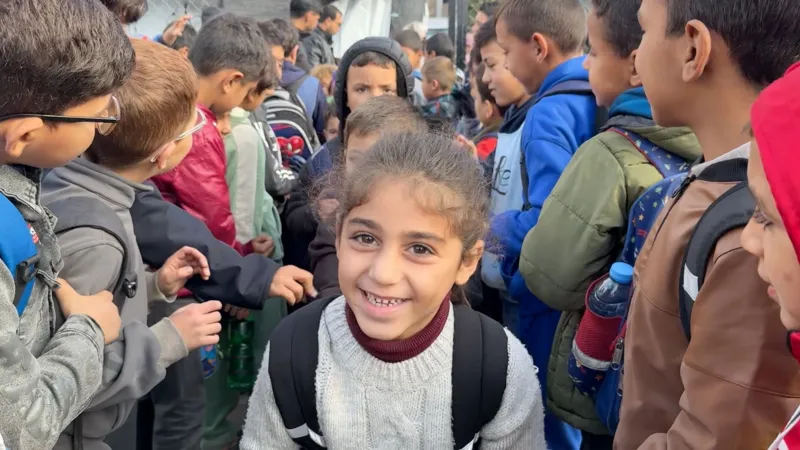

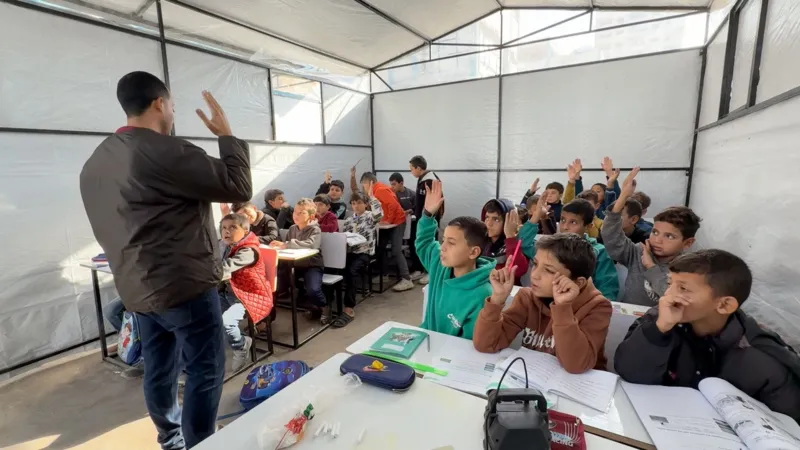
In Gaza City, the sound of children learning has begun to fill the air once again, bringing a sense of normalcy to neighborhoods scarred by years of conflict. At the Lulwa Abdel Wahab al-Qatami School in Tel al-Hawa, which was destroyed during an Israeli airstrike in January 2024 and used for months as a shelter for displaced families, makeshift classrooms now operate in rows of tents set up across the ruined grounds. The atmosphere is noisy, chaotic, and lively, with pupils moving from tent to tent, their voices blending with the scratch of chalk on boards and the soft hum of conversation as teachers guide them through lessons in Arabic, English, mathematics, and science. Although far from the well-equipped classrooms the children once knew, the return to education is a critical first step in restoring a sense of routine and stability after two years of war.
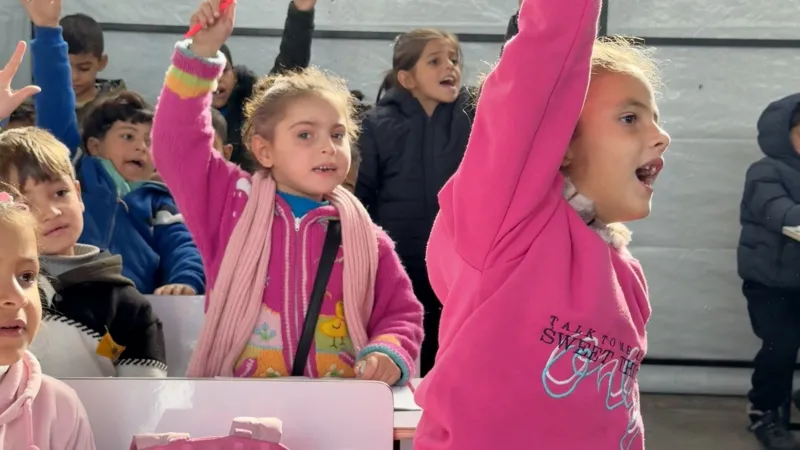
Walking in straight lines, small arms resting on each other’s shoulders, pupils arrive at the tents with smiles on their faces, their enthusiasm a stark contrast to the destruction around them. For many, this is the first structured educational activity they have participated in since the conflict began, a fragile but meaningful return to a semblance of childhood. The tents, though cramped and sparsely equipped, serve as classrooms where students practice letters, numbers, and basic words, with teachers improvising resources to make learning possible despite the lack of electricity, internet access, and textbooks.
Fourteen-year-old Naeem al-Asmaar, who lost his mother during an Israeli airstrike, returns to the school with a mix of sadness and relief. “It was the hardest thing I’ve ever been through,” he says quietly, recalling the months of displacement and insecurity. His home in Gaza City survived the conflict, allowing him and his family to return after the ceasefire. “I missed being in school a lot,” he adds, reflecting on the contrast between the pre-war classrooms and the temporary tented structures. “Before the war, school was in real classrooms. Now it’s tents. We only study four subjects. There isn’t enough space. The education is not the same – but being here matters. School fills all my time and I really needed that.”
Similarly, Rital Alaa Harb, a ninth-grade student who aspires to become a dentist, recounts the effects of displacement on her learning. “Displacement affected my education completely,” she explains. “There was no time to study. No schools. I missed my friends so much – and I miss my old school.” Rital’s experience reflects that of thousands of students across Gaza, many of whom have spent the last two years with limited or no access to formal education, often learning only survival skills and coping with the daily realities of hunger, loss, and fear.
The school is managed by Dr Mohammed Saeed Schheiber, an education professional with 24 years of experience, who took over the management of the site in mid-November 2025. Dr Schheiber describes the challenges of running classes in such constrained conditions. “We started with determination,” he says, “to compensate students for what they lost.” The school currently serves around 1,100 children, operating in three shifts per day to accommodate both boys and girls, with boys attending on alternating days from girls. With just 24 teachers, the staff faces the daunting task of teaching a curriculum reduced to its core subjects while also attending to the psychological needs of children affected by war.
PC: BBC
Dr Schheiber emphasizes that while children are back in a learning environment, the lack of infrastructure limits the quality of education. “Before the war, our students learned in fully equipped schools – science labs, computer labs, internet access, educational resources. All of that is gone,” he explains. The absence of electricity and digital connectivity hampers not only instruction but also the ability to provide supplemental educational materials, leaving students and teachers to adapt to conditions that would have been unthinkable before the conflict.
Many children have suffered deep trauma. According to Dr Schheiber, more than 100 students lost one or both parents, had their homes destroyed, or witnessed killings during the war. Every student has been affected either directly or indirectly, he notes, highlighting the critical need for psychological support services. A counselor now works at the school, running sessions to help children process grief, stress, and the lasting impact of conflict. Demand for support far exceeds capacity, with waiting lists growing as displaced families continue to seek educational opportunities for their children.
Parents have expressed relief at the reopening of schools, but also concern over the hardships still facing their children. Huda Bassam al-Dasouki, a mother of five displaced from southern Rimal, describes the challenges of educating her children in a war-torn environment. “It’s not that education doesn’t exist,” she says. “It’s that it’s extremely difficult. A notebook that cost one shekel ($0.31) before the war now costs five. I have five children. Some children have fallen four years behind, including time lost during the Covid pandemic. My son can’t read. He can’t write. He doesn’t know how to copy from the board.”
UNICEF has highlighted the wider scale of the educational crisis in Gaza, reporting that more than 97% of schools were damaged or destroyed during the conflict. Of the Strip’s 658,000 school-aged children, most have been unable to attend formal schooling for nearly two years. The humanitarian situation has been compounded by restrictions on aid supplies entering Gaza, leaving teachers and aid workers struggling to provide basic materials such as paper, notebooks, pens, and recreational kits for mental health activities.
PC: BBC
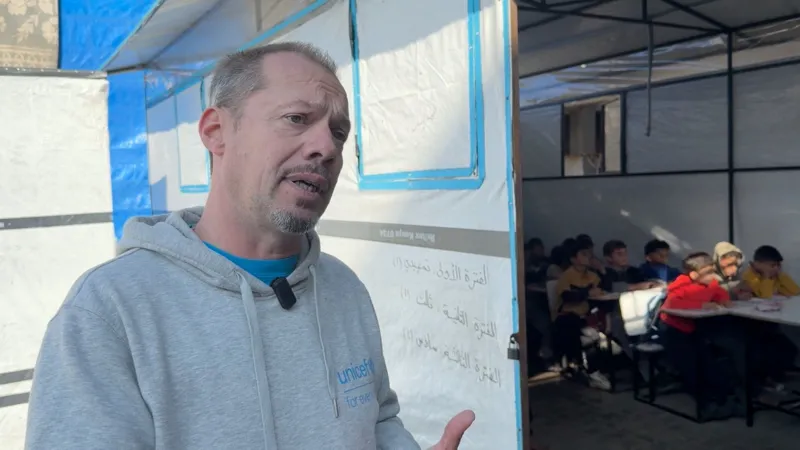
Jonathan Crickx, a UNICEF spokesperson, pointed to the continuing difficulties in supplying schools with essential materials. “Paper, notebooks, pens, erasers, rulers… we’ve been asking for a long time that these supplies can enter the Gaza Strip and they haven’t been allowed in. It’s the same for mental health and psychosocial recreative kits – toy kits that can be used to do mental health activities and recreational activities with the children,” he said. These shortages illustrate how bureaucratic and logistical barriers continue to impede recovery and rehabilitation efforts despite the ceasefire.
Official responses regarding the situation in Gaza have remained limited. An Israeli security official referred questions to the Prime Minister’s office, which did not respond to inquiries. Israel has stated that it is meeting obligations under the ceasefire and facilitating increased aid deliveries, though UN agencies and humanitarian organizations continue to report ongoing restrictions and limited access to essential supplies. Israeli bombardments persist, often described as responses to alleged Hamas violations, underscoring that the ceasefire, while providing a temporary reprieve, has not fully ended the risks facing civilians.
Despite these challenges, children continue to attend school in large numbers, demonstrating resilience and determination. The makeshift school draws children not only from the original Lulwa school but also from nearby displacement camps, where many families remain unable to return home. Teachers and staff work tirelessly to ensure that learning continues, often improvising lessons and using minimal resources to provide educational continuity.
The scale of need far exceeds capacity. Dr Schheiber notes that while the school currently serves 1,100 students, there are many more children in the surrounding displacement camps who want to enroll. “We have more than a thousand students here already, but only six classrooms per shift. There is a large displacement camp next to the school – families from northern and eastern Gaza. Many children want to enrol. We simply cannot take them,” he says. This highlights both the resilience and the limitations faced by the educational system in a post-conflict environment.
For teachers like Kholoud Habib, the perseverance of students reflects the broader importance of education for the Palestinian community. “Education is our foundation,” she says. “As Palestinians, it is our capital. We lose homes. We lose money. We lose everything. But knowledge – knowledge is the one investment we can still give our children.” Her remarks underscore the symbolic and practical role of schooling as a source of hope and stability for children in a society recovering from conflict.
PC: BBC
For students like Naeem and Rital, the school provides more than academic lessons; it offers a sense of structure, routine, and the chance to reclaim pieces of their childhood lost to war. The return to learning, even under difficult circumstances, allows children to reconnect with peers, develop social skills, and begin to heal from the psychological wounds inflicted by prolonged violence and displacement.
While the classrooms are far from ideal, the resumption of lessons in Gaza is an important step in rebuilding the educational and social fabric of the territory. Humanitarian agencies, educators, and families continue to work under extreme conditions, highlighting the urgent need for aid, materials, and long-term investment in schools and child welfare. The story of Lulwa Abdel Wahab al-Qatami School illustrates both the fragility and resilience of education in conflict zones, providing a window into the daily lives of thousands of children striving to reclaim their childhood and right to learn.