

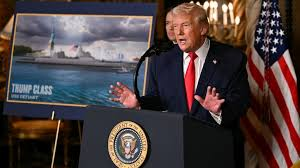

The White House on Tuesday confirmed that President Donald Trump and his senior advisers are actively discussing a broad set of options to acquire Greenland, a vast Arctic territory that is currently part of the Kingdom of Denmark, acknowledging that the possible use of the U.S. military remains on the table. In a statement released in Washington, White House press secretary Karoline Leavitt said the discussions reflect what the administration considers a critical foreign policy objective, framing Greenland as a central piece of national security strategy in the increasingly contested Arctic region. “The president and his team are discussing a range of options to pursue this important foreign policy goal, and of course, utilizing the U.S. military is always an option at the commander‑in‑chief’s disposal,” Leavitt said, underscoring that military force was not being ruled out as part of the deliberations.
White House officials reiterated that Trump views the acquisition of Greenland as necessary to deter rival powers such as Russia and China, whose influence and interests in the Arctic have grown amid climate change and new shipping routes. In the statement, the White House said Trump considers control of the strategically positioned island essential to U.S. defense, citing the need to counter the presence of adversarial forces in the region. Trump’s renewed focus on Greenland follows his controversial military operation in Venezuela in early January 2026 and reflects his broader effort to consolidate U.S. geopolitical influence across multiple theaters, including Latin America and the Arctic, officials said.
The notion of potentially using military force to acquire Greenland has been met with sharp opposition from Greenland’s government and Denmark, the sovereign state responsible for the territory. Danish Prime Minister Mette Frederiksen and Greenland’s Prime Minister Jens‑Frederik Nielsen have repeatedly stated that Greenland is not for sale and that any attempt to change its status without their consent would violate basic principles of sovereignty and self‑determination. Copenhagen has insisted that discussions about Greenland’s future must involve its people and government under international law, not be dictated by external pressure from Washington.
Reacting to the White House’s comments, European leaders issued a strong joint statement affirming that “Greenland belongs to its people” and emphasizing that only Denmark and Greenland can decide the island’s future, a clear rebuke to any suggestion of U.S. acquisition by force or coercion. Leaders from France, Germany, the United Kingdom, Italy, Poland and Spain declared their support for Danish sovereignty and underscored that Arctic security should be addressed collectively among NATO allies rather than through unilateral actions by one member. The statement also stressed the importance of respecting the territorial integrity of sovereign states within the international system.
This broad European response reflects deep concerns among NATO allies over the implications of U.S. moves against a fellow alliance member’s territory. Danish officials and other European supporters have warned that any attempt to change Greenland’s status through force would not only breach norms of sovereignty but could also jeopardize the cohesion of the NATO alliance itself. Frederiksen has explicitly warned that a U.S. takeover of Greenland would mark the end of the NATO alliance, given that the treaty’s core commitment is mutual defense and respect for member territorial integrity a red line for many European capitals.
Within the United States, the debate has also played out with mixed reactions from lawmakers and officials. Secretary of State Marco Rubio reportedly told congressional leaders in a classified briefing that the administration’s preference is for a negotiated purchase of Greenland from Denmark rather than a military invasion, a stance aimed at countering concerns that the rhetoric signaled imminent conflict. Rubio’s comments suggested that diplomatic and economic arrangements might be prioritized, although the military option remains officially unremoved from consideration.
Despite these clarifications, some U.S. officials have downplayed the likelihood of military confrontation, even as they defend the strategic logic behind the initiative. White House Deputy Chief of Staff Stephen Miller, speaking on a U.S. news network, argued that the United States must assess all tools of power in a world governed by strength remarks that were interpreted by critics as an attempt to justify aggressive posturing. Miller asserted that no nation would militarily oppose the United States over Greenland, although his comments did little to soothe anxieties among U.S. allies.
In Congress, bipartisan voices have urged caution and respect for international norms. Lawmakers, including Republican House Speaker Mike Johnson, expressed opposition to any involvement of U.S. troops in a potential Greenland seizure, emphasizing that military intervention in a NATO territory would be inappropriate and destabilizing. Others have raised constitutional and legal questions, urging the administration to pursue diplomatic pathways and uphold treaty obligations.
At the heart of the debate is Greenland’s strategic importance. The island occupies a key position between North America and Europe and hosts vital U.S. military installations, including the Pituffik Space Base, which plays a central role in missile warning, defense and Arctic surveillance operations. Its vast untapped reserves of rare earth minerals and other critical resources have also drawn strategic interest as global competition over high‑tech supply chains intensifies. These factors have made Greenland a focus of great‑power rivalry, particularly involving Russia’s Northern Fleet and expanding Chinese diplomatic and economic engagement in the region.
Greenland’s government has rejected assertions that it lacks the capacity to defend its own territory, with local officials and Danish ministers refuting claims of pervasive Russian or Chinese military presence around the island. Copenhagen has highlighted ongoing investments in Arctic defense and cooperation with NATO allies as evidence that Greenland’s security interests are already being addressed collaboratively, without the need for unilateral U.S. control.
The revived controversy over Greenland also ties into broader themes in U.S. foreign policy under Trump, particularly his assertive use of military power and unconventional diplomatic tactics. Observers note that Trump’s comment that American dominance in the Western Hemisphere “will never be questioned again,” made after a bold military operation in Venezuela, has emboldened similar ambitions elsewhere. This confluence of actions has raised questions about the administration’s long‑term vision of American leadership, shifting from alliance cooperation to direct control of strategic territories.
Critics argue that framing territorial acquisition as a matter of national security risks undermining the post‑World War II international order, which is based on respect for sovereignty, self‑determination and multilateral cooperation. Legal experts point to provisions of the United Nations Charter that prohibit threats or use of force against the territorial integrity of any state, a principle that could be contravened if military coercion were employed in Greenland’s acquisition. Such actions would trigger severe diplomatic fallout and potentially legal challenges at the international level.
Despite the fierce opposition and legal challenges, Trump allies within the administration continue to argue that control over Greenland would secure American interests in the Arctic and preclude rivals from gaining strategic advantage. The idea of a Compact of Free Association (COFA) with Greenland has also been floated as a less confrontational mechanism that could grant the United States significant influence over defense and foreign policy without full sovereignty transfer though details and feasibility remain uncertain.
For its part, Greenland’s leadership has called for respectful dialogue and engagement that honors international norms, rejecting talk of annexation and coercive transfer. The island’s Prime Minister has appealed to Washington to focus on partnerships that respect Greenland’s autonomy and the will of its approximately 57,000 residents, emphasizing that any decision about Greenland’s future should be made by its people rather than external powers.
As tensions continue to simmer, international attention is likely to remain high, with NATO allies, European partners, and global institutions watching closely how Washington balances strategic interests with diplomatic obligations. The unfolding Greenland controversy highlights the delicate interplay between national security concerns, alliance politics and the foundational principles of the international order, raising profound questions about the future of transatlantic relations and Arctic governance in an era of intensifying geopolitical competition.