

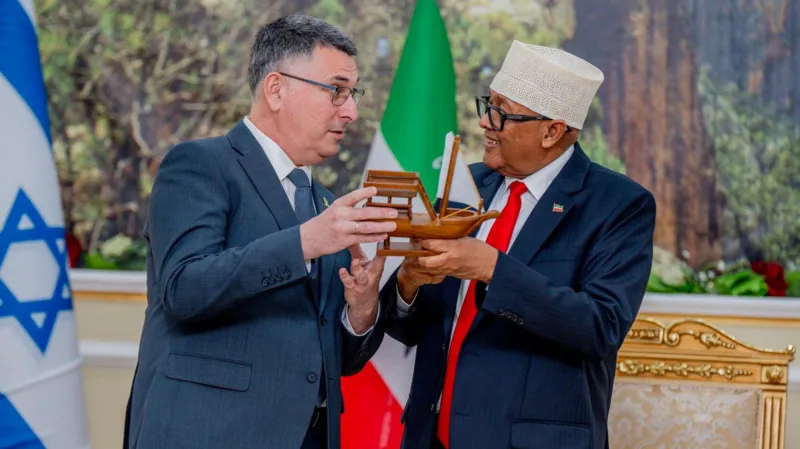

Israeli Foreign Minister Gideon Saar arrived in Hargeisa, the capital of Somaliland, on Tuesday in what both sides described as a landmark diplomatic visit the first by a senior Israeli official since Israel controversially recognised Somaliland’s independence late last year. The trip marks a major step in deepening ties between Israel and the self‑declared republic, with Saar meeting President Abdirahman Mohamed Abdullahi and other senior Somaliland officials to discuss strengthening bilateral cooperation across a range of sectors. Saar described the visit as a demonstration of Israel’s commitment to advancing relations “with momentum,” while Abdullahi hailed the day as historic for his territory’s international legitimacy.
During their talks, Saar and Abdullahi discussed an expansive agenda of cooperation, including economic development, agriculture, water management, security and technology partnerships. According to statements from Israel’s foreign ministry, plans were made to establish full diplomatic relations that include the opening of embassies in each other’s capitals and the appointment of ambassadors – a move that could transform Israel‑Somaliland relations into a long‑term diplomatic and strategic partnership. Saar also reiterated Israeli Prime Minister Benjamin Netanyahu’s invitation for President Abdullahi to visit Israel, a gesture that Somaliland officials said they welcomed.
Israel’s recognition of Somaliland on Dec. 26, 2025 was unprecedented: it became the first country in the world to formally acknowledge Somaliland as an independent sovereign state, breaking with decades of international consensus that the territory remains part of Somalia. Netanyahu defended the decision by citing Somaliland’s “right to self‑determination” and its relatively stable governance compared with Somalia’s protracted instability.
Somaliland’s history as a self‑declared republic dates back to 1991, when it unilaterally declared independence from Somalia following the overthrow of military dictator Siad Barre and the onset of civil war. Despite operating with its own government institutions, currency and military for more than three decades, it had never received formal diplomatic recognition from any nation until Israel’s recent move a milestone long sought by its leaders to unlock foreign investment, aid and international engagement.
The reaction to Israel’s recognition has been emphatic and often hostile from much of the international community. Somalia’s federal government condemned Saar’s visit as an “unauthorised incursion” and a breach of its territorial integrity, demanding that international organisations support its sovereignty claims and declaring any unilateral recognition illegal and void. Mogadishu has urged Israel to cease actions it views as undermining Somali unity.
The African Union (AU) also weighed in strongly, with its Political Affairs Peace and Security Council calling for the immediate revocation of Israel’s recognition and referring to Somaliland as the “so‑called Republic of Somaliland,” reflecting deep concern across Africa that the move could set a destabilising precedent for other secessionist movements.
Beyond Africa, many members of the UN Security Council expressed blunt criticism. Representatives from China, the United Kingdom, South Africa and others publicly reaffirmed Somalia’s territorial integrity and warned that unilateral recognition contravenes the UN Charter and established principles of international law, while some diplomats questioned the double standards applied to such recognitions.
Other regional powers, including Turkey and Arab League states, have also objected to the recognition, with leaders calling it unacceptable and potentially destabilising for peace in the Horn of Africa. Critics argue that Israel’s move could embolden other separatist groups and complicate efforts to resolve longstanding conflicts within African states.
In contrast to much of the global backlash, some neighbouring countries including Ethiopia, Kenya and the United Arab Emirates did not oppose Israel’s recognition and have engaged pragmatically with Somaliland over investment and strategic interests, particularly around the key Berbera port and trade routes connecting the Red Sea, Gulf of Aden and Indian Ocean.
At home, Saar addressed criticism by asserting Israel’s sovereign right to determine its own diplomatic relations, telling supporters and critics alike that “nobody will determine for Israel who we recognize and with whom we maintain diplomatic relations.” He stressed that the recognition was not directed “against anyone,” emphasizing Israel’s agency in shaping its foreign policy in a complex global environment.
President Abdullahi welcomed Saar’s remarks and praised the partnership as strategically beneficial, suggesting that shared interests in peace, stability and security could foster a strong alliance. Somaliland officials have also expressed interest in joining the Abraham Accords, a framework for normalising relations between Israel and several Arab states brokered in 2020, which they say could signal a broader regional acceptance of their statehood claim.
Despite optimism among Somaliland’s leadership, confusion and misinformation have circulated online about potential recognition by other countries. For example, India’s foreign ministry dismissed claims on social media that it intends to recognise Somaliland, calling such assertions “fake,” underlining the ongoing uncertainty around broader diplomatic engagement.
Experts note that strategic considerations are central to Israel’s decision to engage with Somaliland. The territory’s location near vital shipping lanes off the Horn of Africa, across from Yemen’s Bab al‑Mandeb Strait a flashpoint in regional security makes it an attractive partner for intelligence, surveillance and potentially military cooperation amidst tensions with Yemen’s Iran‑aligned Houthi rebels and broader geopolitical competition in the Red Sea region.
Analysts also point out that Israel’s overture reflects a broader foreign policy shift toward strengthening alliances outside traditional diplomatic circles, especially as tensions in the Middle East and Africa intersect with global security and trade priorities. By backing Somaliland’s bid for recognition, Israel hopes to secure strategic footholds and diversify its partnerships beyond conventional diplomatic alignments.
For Somaliland, the partnership offers more than symbolic validation. Recognition by Israel opens avenues for cooperation in agriculture, technology, health and economic development that its leaders hope will catalyse domestic growth and international investment a longstanding challenge due to its stateless status. Somaliland officials have repeatedly denied that there are any plans to host Israeli military bases or resettle Palestinians on their soil.