

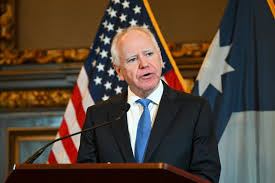

Minnesota Governor Tim Walz announced on Monday that he would not seek a third term in office, citing a growing welfare-fraud scandal in the state as a key factor in his decision. The announcement comes as the issue has intensified in recent weeks and has become a politically charged topic, drawing attention from national figures, including former President Donald Trump. Walz framed his withdrawal as a decision motivated by a sense of responsibility to Minnesotans rather than political calculations.
Speaking at the state capitol in St. Paul, Walz emphasized the demands of defending state programs against fraudsters over the demands of running a campaign. “I can’t give a political campaign my all,” he said, reading from a prepared statement. “Every minute that I spend defending my own political interests would be a minute I can’t spend defending the people of Minnesota against the criminals who prey on our generosity and the cynics who want to prey on our differences.” He declined to take questions from reporters, walking away shortly after delivering his statement.
Walz’s decision follows an intense weekend of consultations with friends, advisers, and political allies. He reportedly spent significant time weighing the implications of staying in the race versus focusing entirely on addressing the welfare-fraud crisis. Sources familiar with the matter noted that Walz also met privately with Minnesota Senator Amy Klobuchar, who is currently deciding whether to enter the gubernatorial race, signaling that discussions about succession and party strategy were a central consideration.
Senator Klobuchar, who was reelected to a fourth Senate term in 2024, has long been rumored to harbor ambitions of becoming governor. As a former prosecutor in Minneapolis and a senior figure in Senate leadership, Klobuchar has cultivated an image as a capable executive, and some Democrats have been actively encouraging her to run. A person close to Klobuchar told CNN that she is “seriously considering” entering the race, though she has not publicly confirmed her intentions or commented on her meeting with Walz.
The welfare-fraud scandal itself has grown into a major point of contention in Minnesota politics. Federal investigators have scrutinized the misuse of taxpayer funds intended for social programs, particularly those supporting child care and assistance for vulnerable families. While Walz has not been accused of any personal wrongdoing, critics from the Republican Party have attempted to attribute blame to his administration for lapses in oversight, creating a politically charged environment that Walz cited as a factor in his decision to step back.
Walz explicitly criticized the politicization of the scandal, singling out former President Donald Trump and his allies. He accused them of seeking to exploit the issue to sow division and target Minnesota’s Somali population. “I won’t mince words here. Donald Trump and his allies – in Washington and in St. Paul and online – want to make our state a colder, meaner place,” Walz said. “They want to poison our people against each other by attacking our neighbors.”
The governor framed his departure not as a retreat, but as an opportunity to ensure the state’s social safety net programs are protected from exploitation. Walz emphasized the need for Minnesotans to have confidence in government oversight. “A single taxpayer dollar wasted on fraud is a dollar too much to tolerate,” he said. He underscored that while responsibility spans multiple layers of government, from local officials to prosecutors, ultimate accountability rests with him as governor.
Walz’s tenure in Minnesota has been marked by both regional and national recognition. He gained prominence as the Democratic nominee for vice president during the 2024 presidential race, serving alongside former Vice President Kamala Harris. During that campaign, he earned a reputation for his aggressive critiques of Donald Trump, which resonated widely among Democratic voters. His ascent on the national stage was rapid, but his political fortunes now face challenges at home in the wake of the welfare-fraud scandal.
The timing of Walz’s withdrawal also reflects the broader political pressures he faces. Republican operatives and the Trump-aligned right have seized on the scandal to pressure the governor and frame the issue as emblematic of Democratic mismanagement. This intensified political environment likely contributed to Walz’s decision to prioritize governance over campaigning, signaling an acknowledgment of the heightened stakes and scrutiny surrounding Minnesota’s social programs.
Walz, 61, has spent decades in public service, first as a teacher and later as a state legislator, before ascending to the governorship. His record includes efforts to expand access to education, healthcare, and social welfare programs. Critics of his administration argue that oversight gaps in welfare programs have left the state vulnerable to fraud, while supporters contend that Walz has worked diligently to correct these issues and that the scandal has been politically amplified beyond its actual scope.
The federal investigation into Minnesota’s welfare programs has added urgency to the situation. Officials in the state have been directed to provide information to the Trump administration regarding providers and parents who receive federal child-care funds by January 9. The probe represents a continuation of longstanding scrutiny into the administration of federal aid in the state, which began during the Biden administration and has carried over amid persistent allegations of misuse.
Walz’s focus on defending Minnesotans and combating fraud reflects a strategy that seeks to separate policy action from political theater. By stepping aside from electoral ambitions, he positions himself as a public servant prioritizing governance over personal ambition. Analysts suggest that this framing may help preserve his legacy in the state while allowing party leaders to recalibrate and select a viable candidate to carry the Democratic banner forward.
The potential candidacy of Senator Klobuchar now takes on heightened significance. Should she enter the gubernatorial race, Klobuchar would bring national recognition and a track record of prosecutorial and legislative experience. Her decision is likely influenced by both party encouragement and the vacuum left by Walz’s exit, creating an opportunity for Democrats to present a seasoned executive figure to voters in Minnesota ahead of the next election cycle.
Walz’s statement also highlighted the broader implications of political polarization in the state. He pointed to organized groups exploiting both fraud and the political climate, framing his withdrawal as a response to both criminal activity and political manipulation. “Even as we make progress in the fight against the fraudsters, we now see an organized group of political actors seeking to take advantage of a crisis,” he said, signaling frustration with the blending of governance issues and partisan attacks.
The governor’s exit underscores the challenges of navigating high-stakes political scrutiny while managing ongoing public programs. For Walz, the calculus was clear: diverting attention to campaigning could compromise the state’s ability to respond effectively to the welfare-fraud scandal, a risk he was unwilling to take. His decision demonstrates the intersection of policy management and political strategy, particularly in a state facing national attention.
Political analysts have noted that Walz’s decision may influence the tone and focus of the upcoming election in Minnesota. By stepping aside, he removes an incumbent candidate from the field, reshaping the dynamics of both the Democratic primary and the general election. The shift opens space for new candidates to emerge while potentially limiting opportunities for Republicans to continue framing the scandal as a partisan attack on the sitting governor.
The controversy surrounding welfare-fraud programs has also raised questions about federal oversight and the role of national administrations in state affairs. Trump’s criticism and demands for information highlight the enduring politicization of local issues by national figures, illustrating how state-level governance can become entangled in broader political narratives. Walz’s statements directly addressed these dynamics, seeking to assert control over the narrative while emphasizing accountability and fairness.
Despite stepping back from electoral politics, Walz has signaled his commitment to transparency and continued cooperation with investigative authorities. His welcome of federal scrutiny contrasts with Republican framing of the scandal as evidence of Democratic negligence. By embracing accountability, Walz positions himself as a responsible steward of public resources, even as political adversaries seek to use the issue for partisan gain.
Observers note that Walz’s career trajectory has been marked by rapid ascents and sudden challenges. From his early work in education to his rise as a nationally recognized Democratic figure, he has navigated both praise and criticism. The current controversy, however, presents a test of leadership in a context where public trust and political optics intersect, making his decision to step aside a defining moment for his political legacy.
As Minnesota looks ahead to the next election, the political landscape remains fluid. Walz’s departure leaves questions about party unity, candidate selection, and electoral strategy. With the welfare-fraud issue continuing to dominate headlines, both Democratic and Republican actors are likely to position themselves strategically in response to the evolving narrative, making the coming months critical for shaping public perception.
In closing, Walz framed his decision not as a retreat but as a redirection of focus. By prioritizing governance over campaigning, he underscores the importance of accountability and public trust in state programs. His announcement marks the end of one chapter in Minnesota politics while setting the stage for new leadership to navigate ongoing challenges and electoral contests in the months ahead.