

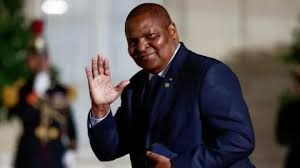

Central African Republic (CAR) President Faustin-Archange Touadéra has secured a controversial third term in office after provisional results from the December 28 presidential election showed he received an overwhelming 76.15% of the vote, according to figures released by the country’s National Elections Authority. The 68‑year‑old leader, who has been in power since 2016, had been widely expected to win following last year’s constitutional referendum that removed presidential term limits, allowing him to seek an extended stay in power beyond the previously mandated two terms.
The provisional figures, announced late Monday by Mathias Morouba, President of the National Elections Authority, also showed former Prime Ministers Anicet-Georges Dologuélé and Henri‑Marie Dondra trailing far behind with roughly 14.66% and 3.19% of the vote respectively. Voter turnout was moderate at about 52.42%, with some 2.4 million registered voters casting ballots in what authorities described as a peaceful election.
President Touadéra has publicly thanked Central African voters for their support, interpreting the decisive outcome as an endorsement of his leadership and his security‑focused agenda. “Thank you to the people of the Central African Republic. With 76.15 percent of the vote obtained in the first round… your determination deserves to be commended. Together, we will continue the work,” he said in a statement on social media following the announcement of provisional results.
The nation’s main opposition coalition, known by its French acronym BRDC (Bloc Républicain pour le Changement), boycotted the election, asserting that the political environment was neither fair nor conducive to free competition. The opposition had accused the government of creating structural imbalances in the electoral process, particularly after the constitutional change in 2023 that allowed Touadéra to run again.
Both Dologuélé and Dondra have challenged the legitimacy of the results, with Dologuélé alleging what he described as a “methodical attempt to manipulate” the outcome. Speaking at a press conference, he insisted the Central African people had expressed a desire for real change and urged the Constitutional Court to review the electoral process thoroughly. The court now has until January 20 to adjudicate any challenges and issue final results.
Observers from international bodies characterised the voting process as largely peaceful, despite operational challenges on election day. Polling in some areas was delayed due to the late arrival of voting materials and discrepancies involving the electoral register, but there were no major security disturbances reported — a marked contrast to the violence that marred the 2020 election when rebel fighters prevented hundreds of polling stations from opening.
Touadéra’s political career shaped by both academic credentials as a mathematician and a long tenure in CAR politics — has been heavily influenced by the nation’s chronic instability. Since a 2013 rebel uprising led to the collapse of the then‑government and plunged the country into widespread conflict, CAR has struggled with fragmented authority, armed groups, and cycles of violence that have stunted economic and social progress.
In response to the 2013 crisis, CAR’s government enlisted foreign support, notably from Russian mercenary forces associated with the Wagner Group and Rwandan soldiers, to counter rebel factions and regain control of strategic regions. Russian and Rwandan deployments have been credited with helping stabilise major urban centres, including the capital Bangui, particularly during moments of intense rebel activity in late 2020 and 2021.
Critics, however, argue that reliance on foreign mercenaries has come at a cost. In earlier protests, thousands of Central Africans rallied against the continued presence of Russia‑linked Wagner fighters, accusing them of human rights abuses and of undermining national sovereignty. Opposition organisers stressed that security assistance should not be used to justify indefinite rule or the erosion of constitutional norms.
Despite these concerns, Touadéra’s campaign remained anchored on security improvements. The president insisted he had restored a degree of stability in a country long beset by rebel violence and that continuity of leadership was essential to consolidating peace and driving development. In his statement after the provisional results, he framed his victory as a mandate to continue working toward these goals.
Still, the 2019 peace deal between the government and 14 armed groups initially seen as a breakthrough has since shown signs of strain, with several signatories abandoning the agreement and returning to sporadic conflict. Humanitarian needs remain acute, with the United Nations estimating that roughly half of CAR’s population depends on aid due to displacement, food insecurity, and ongoing insecurity in rural regions.
The political backdrop of this election also included deep social divisions, economic hardship, and public scepticism toward political elites. CAR remains one of Africa’s poorest countries despite significant resource wealth, including diamonds, gold, and uranium. While these resources hold potential for economic transformation, they have also fuelled contestation among armed groups and foreign actors seeking strategic access.
Analysts warn that Touadéra’s renewed mandate may further entrench geopolitical interests, particularly those of Russia. In exchange for military and security support, Russia has gained footholds in CAR’s mineral sectors, trading security assistance for access to lucrative gold and diamond concessions. Experts caution that Russia’s engagement, while stabilising in the short term, could constrain CAR’s long‑term sovereignty and expose it to shifting geopolitical rivalries.
At the same time, Touadéra has indicated openness to strengthening partnerships beyond his Russian alliances, particularly with Western countries interested in developing CAR’s lithium, uranium, and gold reserves. This signalling reflects a pragmatic approach to attracting foreign investment while balancing competing international influences.
The unfolding post‑election period, with its legal challenges and political manoeuvring, will test both the resilience of CAR’s institutions and the credibility of its electoral processes. While provisional results point to a sweeping victory for Touadéra, the opposition’s insistence on irregularities and broader questions about democratic space in CAR suggest that political stability remains fragile. As the Constitutional Court prepares to review the final outcome, the region and international community will be watching closely, mindful of CAR’s strategic significance and its decades‑long journey toward peace and governance.